
A single fracture in a green ceramic body represents more than just a lost part. It signals a fundamental breakdown in process security and resource protection. In an industry where the global market for Ceramic Binders reached a value of $4.8 billion in 2025, the margin for operational waste is narrowing. High breakage rates during the green state and inconsistent slurry viscosity remain the primary barriers to achieving peak industrial yield. You've likely recognized the frustration of watching carefully engineered components fail before they even reach the kiln.
We believe that stability is the foundation of modern infrastructure. Protecting resources; securing yield. This guide provides the technical framework to master binder selection and enhance structural integrity. You'll learn how to optimize green strength, manage complex slurry rheology, and address environmental concerns regarding synthetic burn-out. We examine advanced dosing strategies and the critical chemical synergies that transform volatile manufacturing cycles into reliable, high-performance production streams.
Key Takeaways
- Identify the critical differences between synthetic and natural chemistries to select the optimal molecular weight for your specific production requirements.
- Master the mechanical performance metrics needed to evaluate green strength; this ensures structural integrity before the firing stage.
- Explore how Ceramic Binders influence slurry rheology and interact with deflocculants to maintain consistent industrial process stability.
- Implement custom dosing strategies and technical audits to minimize operational waste while maximizing manufacturing efficiency.
- Leverage specialized consulting to align chemical formulations with long-term sustainability and resource protection goals.
What are Ceramic Binders and Why are They Essential for Industrial Stability?
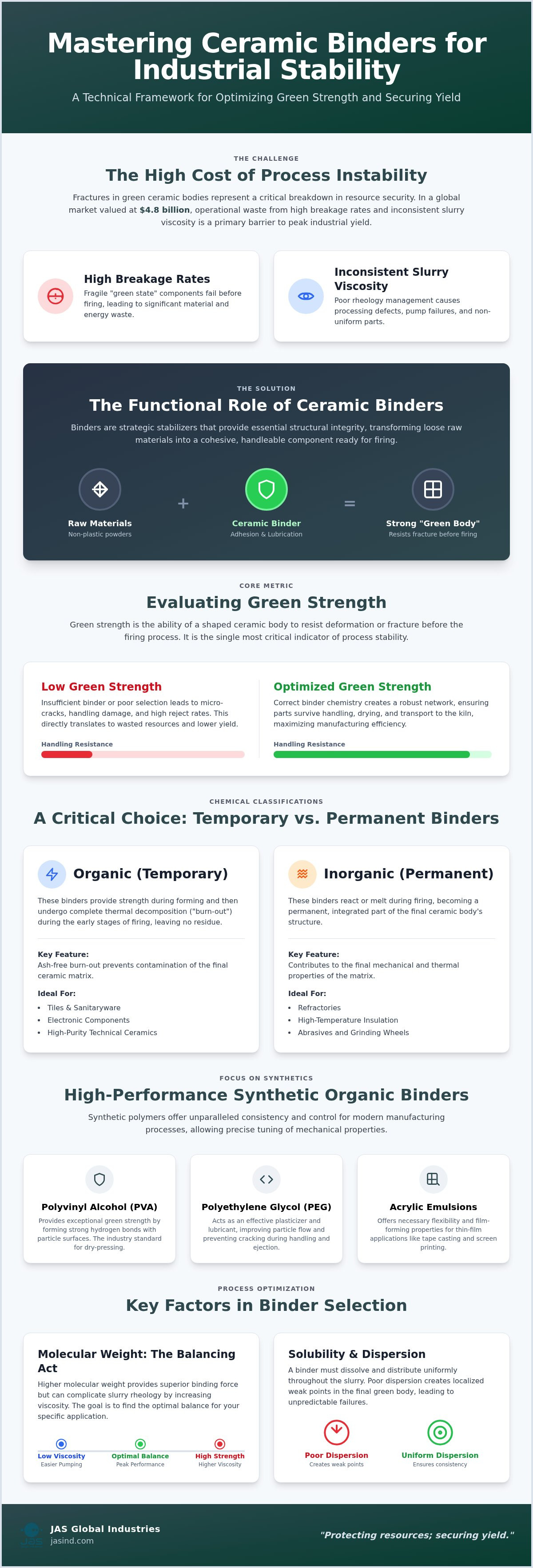
In the sophisticated field of Ceramic engineering, precision is the prerequisite for performance. Ceramic Binders act as the essential adhesive agents that provide structural integrity to non-plastic raw materials. These additives are not merely process aids; they are strategic stabilizers. By bridging the gap between raw powder and a finished component, they ensure that a ceramic body survives the critical transition from its fragile green state to its final fired form.
Modern manufacturing in 2026 demands a focus on global resource security. High reject rates during the green state represent a profound waste of energy, labor, and raw minerals. Protecting resources; securing yield. Effective binder selection directly mitigates these operational losses. When manufacturers optimize their chemical formulations, they secure their output and protect the stability of their entire production chain. Reducing waste isn't just about cost; it's about industrial responsibility.
The Functional Role of Binders in Ceramic Processing
During the shaping process, binder molecules wrap around individual particles to facilitate mechanical interlocking. This creates a cohesive network that holds the shape under stress. Beyond simple adhesion, these chemicals provide internal lubrication. This reduces friction during pressing and extrusion, ensuring uniform density throughout the part. Consistent density prevents warping and internal stress during the drying phase.
Green strength is the ability of a ceramic body to resist deformation or fracture before it undergoes the firing process.
Temporary vs. Permanent Binding Agents
Industrial applications dictate the choice between temporary and permanent Ceramic Binders. Organic binders, such as specialized polymers or celluloses, are temporary. They provide strength during forming but undergo complete thermal decomposition during the early stages of firing. For high-purity technical ceramics, an ash-free burn-out is mandatory to prevent contamination of the ceramic matrix. This ensures the final product maintains its intended electrical or thermal properties.
In contrast, inorganic binders remain within the structure. They melt or react during firing to become a permanent part of the final ceramic body. This choice depends entirely on the end-use environment of the product.
- Organic Binders: These are ideal for tiles, sanitaryware, and electronic components requiring clean decomposition and zero residual carbon.
- Inorganic Binders: These are essential for refractories and high-temperature insulation where the binder contributes to the final mechanical and thermal properties of the matrix.
Chemical Classifications of Modern Ceramic Binders
The selection of Ceramic Binders is a decisive factor in industrial stability. Classification depends on the chemical origin and the specific mechanical requirements of the production line. In the 2026 industrial landscape, the focus has shifted toward high-efficiency formulations that balance green strength with environmental responsibility. A binder's molecular weight is the primary driver of its efficiency. Higher molecular weights generally provide superior binding force through increased chain entanglement, but they can complicate slurry rheology by significantly increasing viscosity. Achieving the correct balance is essential for maintaining process reliability and preventing pump failure.
Solubility and dispersion are equally critical during the mixing phase. If a binder doesn't distribute uniformly, the resulting ceramic body will suffer from localized structural weak points. Manufacturers are increasingly exploring alternative ceramic binders and nanoceramic systems to overcome traditional limitations in cemented tools and high-precision components. These advancements reflect a broader commitment to resource security and technical excellence. Advancing chemistry; ensuring stability.
Synthetic Organic Binders: Polymers and Resins
Synthetic polymers offer unparalleled consistency and control. Polyvinyl Alcohol (PVA) and Polyethylene Glycol (PEG) are the industry standards for many dry-pressing applications. PVA provides exceptional green strength by forming strong hydrogen bonds with particle surfaces, while PEG acts as an effective plasticizer to prevent cracking during handling. For thin-film ceramic applications, acrylic emulsions are preferred. These emulsions offer the necessary flexibility for tape casting and screen printing by forming a continuous, resilient film. One major advantage of synthetic resins is their predictable, clean-burn profile. They leave minimal residual carbon, which is vital for high-purity technical ceramics where contamination isn't an option.
Natural and Cellulose-Based Binding Agents
Natural binders represent a sustainable pillar for bulk ceramic production. Carboxymethyl Cellulose (CMC) and Methyl Cellulose (MC) are highly effective in water-based slurries. They provide excellent water retention and precise control over viscosity, which is essential for uniform extrusion. Lignin-based binders, derived from wood pulp processing, offer a cost-effective solution for heavy clay products and bricks. The transition toward plant-derived polysaccharides aligns with modern environmental mandates and global sustainability goals. These bio-based materials reduce the carbon footprint of the manufacturing process without compromising the structural integrity of the green body. If you're looking to refine your specific chemistry, you can consult with our technical specialists to identify the most stable formulation for your plant.
Evaluating Green Strength and Performance Metrics
Evaluating the mechanical integrity of a green body is a vital step in safeguarding industrial yield. Without precise metrics, the manufacturing process remains vulnerable to unpredictable breakage. Ceramic Binders are the primary architects of this temporary strength. However, increasing binder concentration follows a law of diminishing returns. While higher concentrations initially boost strength, they eventually lead to excessive viscosity and prolonged burn-out cycles. This creates a critical trade-off; the pursuit of maximum strength must not compromise the efficiency of the firing kiln.
High green strength translates directly to lower operational costs. When parts can withstand the mechanical stresses of automated handling, reject rates plummet. This stability allows for higher plant throughput and more aggressive production schedules. Protecting the product; securing the profit. By optimizing performance metrics, manufacturers transform a volatile process into a reliable industrial system. This commitment to material reliability is shared by top-tier providers of building solutions; for instance, you can check out Gyp Artisan for high-quality gypsum boards and interior finishing solutions.
The Modulus of Rupture (MOR) is the definitive benchmark for green strength. Industrial labs typically employ a three-point bend test to determine the maximum stress a body can endure before failure. Consistency is the goal. If binder distribution is uneven, MOR values will fluctuate wildly across a single batch, leading to localized failures. Specific formulations, such as a copolymer ceramic-binder composition, are often used to ensure a uniform internal matrix. MOR data is used to calibrate industrial handling equipment and automated transfer systems to prevent mechanical shock.
Thermal Analysis: TGA and DTA for Binder Burn-out
Thermal analysis provides the roadmap for a safe firing cycle. Thermogravimetric Analysis (TGA) monitors the exact temperature at which binder components decompose and exit the ceramic body. If this decomposition happens too quickly, the rapid evolution of gases can cause internal pressure, leading to bloating or catastrophic cracking. Differential Thermal Analysis (DTA) complements this by tracking exothermic and endothermic reactions. Interpreting DTA curves allows engineers to adjust kiln ramp rates, ensuring that gases escape gradually. This precision prevents the "black coring" effect and maintains the high-purity standards required for technical ceramics.
Optimizing the Slurry: Binders and Chemical Interactions
Ceramic slurries are delicate chemical ecosystems. Maintaining a deflocculated state while introducing Ceramic Binders requires a precise equilibrium. The primary challenge in industrial manufacturing is the phenomenon of competitive adsorption on particle surfaces. Both binders and Ceramic Deflocculants vie for the same active sites on the raw material surface. If the binder molecules displace the deflocculant, the electrostatic or steric stabilization of the system collapses. This leads to "flocculation by binder," where the slurry thickens prematurely, destroying process stability and causing pump failure.
A common objection in plant management is that adding binders necessitates a reduction in solids content to keep viscosity manageable. This is a false choice. By selecting high-efficiency polymer binders with low intrinsic viscosity, you can maintain high solids loading while achieving the required green strength. Balancing chemistry; optimizing output. Protecting resources; securing yield. The goal is to reach a high-performance state where the slurry remains fluid during transport but forms a rigid, cohesive matrix during the drying phase.
Compatibility with Deflocculants and Dispersants
The order of chemical addition in the ball mill or high-shear mixer is critical for industrial reliability. Generally, deflocculants must be added and fully equilibrated first to ensure maximum particle dispersion. Once the slurry reaches its minimum viscosity, the binder is introduced. This sequence prevents the binder from "locking in" particle agglomerates. If you add the binder too early, it can coat undispersed clusters, making them nearly impossible to break down during the milling cycle. This results in a grainy texture and localized structural weak points in the green body.
Troubleshooting Common Slurry Issues
Binder migration is a subtle but destructive phenomenon that occurs during the drying process. As water moves toward the surface of the green part, it carries soluble binder molecules with it. This creates a hard, binder-rich "skin" on the exterior while leaving the core weak and prone to internal cracking. Controlling drying rates is part of the solution, but selecting binders with appropriate solubility profiles is the more stable approach.
Air entrapment is another operational hurdle. High-viscosity binders can stabilize micro-bubbles, leading to pinholes and structural voids in the final ceramic part. Integrating proper Surfactant Chemistry ensures uniform wetting of the powder and facilitates rapid air release. If your production line is experiencing inconsistent slurry rheology, you should request a technical audit from our ceramics division to optimize your dosing strategy.
Tailor-Made Solutions: The JAS Global Approach to Ceramics
JAS Global Industries acts as a foundational presence in the global ceramics sector. Operating since 1998, we've established a reputation for reliability, technical excellence, and a mission-oriented approach to industrial chemistry. We specialize in Ceramics Chemicals, providing the essential additives that secure industrial yields and protect vital resources. Our role transcends simple logistics; we're a vital guardian of industrial efficiency. By aligning our chemical expertise with your production goals, we ensure that every stage of the manufacturing process is optimized for stability and long-term value. Protecting resources; securing yield.
No two ceramic plants are identical. Variations in local raw materials and complex mineralogy require specific, tailor-made formulations. We don't believe in universal solutions for Ceramic Binders. Instead, we develop custom chemistries that account for the unique particle size distributions and surface charges of your specific clay bodies. This precision prevents the common pitfalls of inconsistent slurry rheology and poor green strength. Our focus remains on the fundamental needs of the industry, ensuring that your manufacturing infrastructure remains robust and resilient.
Technical Audits and Process Optimization
Our global service network provides on-site laboratory testing and comprehensive technical audits. We evaluate your entire production line to identify hidden inefficiencies and areas for improvement. Our engineers design custom dosing strategies that minimize chemical consumption while maximizing performance. This approach reduces operational costs and enhances plant throughput. With multiple R&I centers and technical offices located globally, we provide the steady, logical support necessary for industrial success. We speak of long-term partnerships, focusing on the broader human impact of our technical solutions rather than just transactional logistics.
Innovation in Resource Protection
The future of the industry lies in sustainable material science and responsible corporate citizenship. Our R&I centers are dedicated to developing the next generation of Ceramic Binders, focusing on bio-based alternatives and ash-free burn-out profiles. We're committed to providing sustainable chemical solutions that protect the world's most critical resources and contribute to community well-being. This commitment to technical leadership ensures that our partners remain competitive in a changing global landscape. For international bulk supply agreements and specialized consulting, we invite you to contact our Dubai headquarters. Establishing trust; securing the future.
Securing Industrial Stability through Chemical Precision
The path to peak manufacturing efficiency requires a transition from reactive troubleshooting to proactive chemical management. Mastering the application of Ceramic Binders is central to this shift. By prioritizing precise molecular weight selection and ensuring chemical compatibility with existing deflocculants, manufacturers can eliminate the volatility of high reject rates. Protecting resources; securing yield. This technical discipline transforms fragile green bodies into resilient industrial assets and safeguards your production output against mechanical failure.
Established in 1998, JAS Global Industries serves as a foundational partner for the world's most critical ceramic plants. Our global network of R&I centers is dedicated to sustainable chemistry and advanced material science. We don't just supply additives; we provide the technical consulting and on-site process audits necessary to optimize your specific mineralogy. It's time to elevate your operational reliability and reduce manufacturing waste through expert-led intervention. We remain committed to your long-term success and the stability of global infrastructure.
Optimise your ceramic production with JAS Global industrial binders. We look forward to securing your industrial future and building a more resilient manufacturing environment together.
Frequently Asked Questions
What is the primary function of a ceramic binder in industrial manufacturing?
Ceramic Binders provide the necessary structural integrity to non-plastic powders during the shaping and handling phases. They act as temporary adhesives that hold particles together before the firing process begins. This ensures that fragile green bodies can withstand mechanical stresses without fracturing. By establishing a cohesive internal matrix, these additives reduce reject rates and safeguard industrial yield during automated production cycles.
How do organic and inorganic ceramic binders differ in their application?
Organic binders, such as celluloses and synthetic polymers, are designed for complete thermal decomposition during firing. They leave no residue, making them ideal for high-purity technical ceramics. Inorganic binders remain within the ceramic body; they melt or react to become a permanent part of the final structure. These are typically used in refractories and high-temperature insulation where the binder contributes to the finished product's mechanical properties.
Can ceramic binders affect the final colour or texture of a fired product?
The choice of binder can influence both the aesthetic and physical characteristics of the fired ceramic. Incomplete burn-out of organic binders can lead to carbon residue, causing "black coring" or surface discoloration. Inorganic binders change the chemical composition of the matrix, potentially altering the final texture or vitrification temperature. Manufacturers must select high-purity formulations to ensure the final product meets specific color and performance standards.
What is binder migration and how can it be prevented during drying?
Binder migration occurs when soluble binder molecules move toward the surface of a ceramic part as water evaporates during drying. This results in a hard exterior skin and a weak, brittle core. You can prevent this by selecting binders with lower solubility or by optimizing the drying curve to ensure moisture removal is uniform. Technical audits help identify the precise chemical balance needed to maintain internal structural stability.
How does the molecular weight of a binder influence green strength?
The molecular weight of Ceramic Binders is directly proportional to the resulting green strength of the body. Higher molecular weight polymers provide superior binding force because their longer chains create more extensive mechanical entanglement between particles. However, this also increases the viscosity of the slurry, which can complicate the mixing and pumping phases. Finding the optimal molecular weight is essential for balancing handling strength with process flowability.
Are there eco-friendly or sustainable ceramic binders available for bulk production?
Sustainable, bio-based binders are increasingly available for large-scale industrial applications. Natural polymers derived from plant polysaccharides and lignin-based byproducts offer effective binding properties while reducing the carbon footprint of the manufacturing process. These eco-friendly alternatives provide the necessary green strength without the environmental concerns associated with some synthetic resins. JAS Global R&I centers focus on developing these sustainable chemistries to support global resource protection and industrial responsibility.
What is the typical dosage range for binders in a ceramic slurry?
Dosage levels vary based on the specific mineralogy and forming method, but most industrial slurries require between 0.5% and 5.0% binder by dry weight. Technical ceramics often use lower concentrations to minimize burn-out time; heavy clay products may require higher doses for increased plasticity. Over-dosing can lead to excessive viscosity and gas evolution during firing. Custom dosing strategies are developed through on-site laboratory testing to ensure maximum efficiency.
How do binders interact with ceramic deflocculants in the mixing process?
Binders and deflocculants often compete for the same active sites on the surface of ceramic particles. If a binder is added too early or in excess, it can displace the deflocculant, causing the slurry to flocculate and thicken. This interaction requires careful management of the chemical environment. Adding the deflocculant first ensures proper particle dispersion before the binder is introduced to stabilize the green body's structural matrix.