
What if recurring process variability isn’t caused by the chemical program you’ve been adjusting, but by a constraint elsewhere in the operation? When symptoms persist without a clear root cause, chemical process consulting can help connect operating evidence to decisions that matter. Reviewing plant data alongside process conditions and targeted testing can show where performance may be limited and which factors deserve closer attention.
It’s reasonable to be cautious about changing operating conditions or chemical programs before understanding whether a proposed improvement will work under plant conditions. Effective consulting builds confidence step by step: diagnose the issue, assess practical options, and use relevant evidence to guide implementation. The aim is to ground recommendations in actual operating conditions, not assumptions or disconnected data.
This guide explains how consulting can help identify constraints, evaluate improvement options, and turn process findings into practical operating decisions. JAS Global Industries provides technical audits, on-site laboratory testing, custom chemical dosing strategies, and operational troubleshooting for fertilizer, mining, and water-treatment applications. Serving industrial sectors since 1998, JAS connects technical assessment with tailored chemical and operating recommendations to support more reliable, efficient plant performance.
Key Takeaways
- Recurring variability and unresolved troubleshooting can point to underlying process constraints that need systematic diagnosis.
- Use operating records and site observations to establish a baseline before assessing possible changes.
- Evaluate recommendations by their evidence, testing, practicality, and follow-up, not by technical plausibility alone.
- Chemical process consulting can turn process data into tailored operating and chemical recommendations.
- Prepare a clear description of the process issue, site context, and desired outcome to focus assessment priorities.
Chemical Process Consulting: When Plant Challenges Need a Systematic Diagnosis
Chemical process consulting is the expert assessment of plant conditions, operational constraints, and improvement options to help solve process problems using site-specific evidence. It connects what a plant is experiencing with conditions that may be contributing to the issue, then helps determine which changes are practical to evaluate.
Production variability, yield concerns, inconsistent product quality, and recurring interruptions can all signal that symptoms need closer diagnosis. Repeating an adjustment may ease an issue temporarily without explaining why it keeps returning. A consultant can review operating data, chemical consumption, and process conditions together, looking for patterns and relationships rather than assuming a single cause.
This is different from simply purchasing a chemical or making an untested operating change. A product may be relevant, but its suitability and use depend on the operating conditions and the issue being addressed. Likewise, changing a setpoint or dosing approach without first recording a baseline can make it difficult to tell whether performance improved. Consulting provides a structured way to define the question, examine available evidence, and assess options before adopting a change. Where suitable, process simulation can represent chemical and physical processes in software to explore how operating conditions may affect performance.
Which operating problems can process consultants investigate?
A site may seek an assessment for persistent instability, inconsistent product quality, unexplained interruptions, or repeated troubleshooting that hasn’t resolved the underlying concern. Reviewing chemical use alongside operating records and observed process conditions can help identify useful lines of investigation. For example, a change in chemical consumption may coincide with a process shift, but that relationship alone doesn’t prove cause. The scope should reflect the site, process, and specific operational question.
Why does site-specific process context matter?
Feed characteristics, equipment, operating practices, and process objectives all shape what a recommendation needs to account for. A fertilizer operation may focus on product handling or granulation conditions; a mining assessment may examine chemical use in relation to a separation process; water treatment may prioritize treatment conditions and system performance. Each example calls for different evidence and priorities. Recommendations grounded in actual plant conditions are more useful than generic assumptions because they address the constraints operators must work within.
How a Chemical Process Consulting Engagement Moves from Data to Action
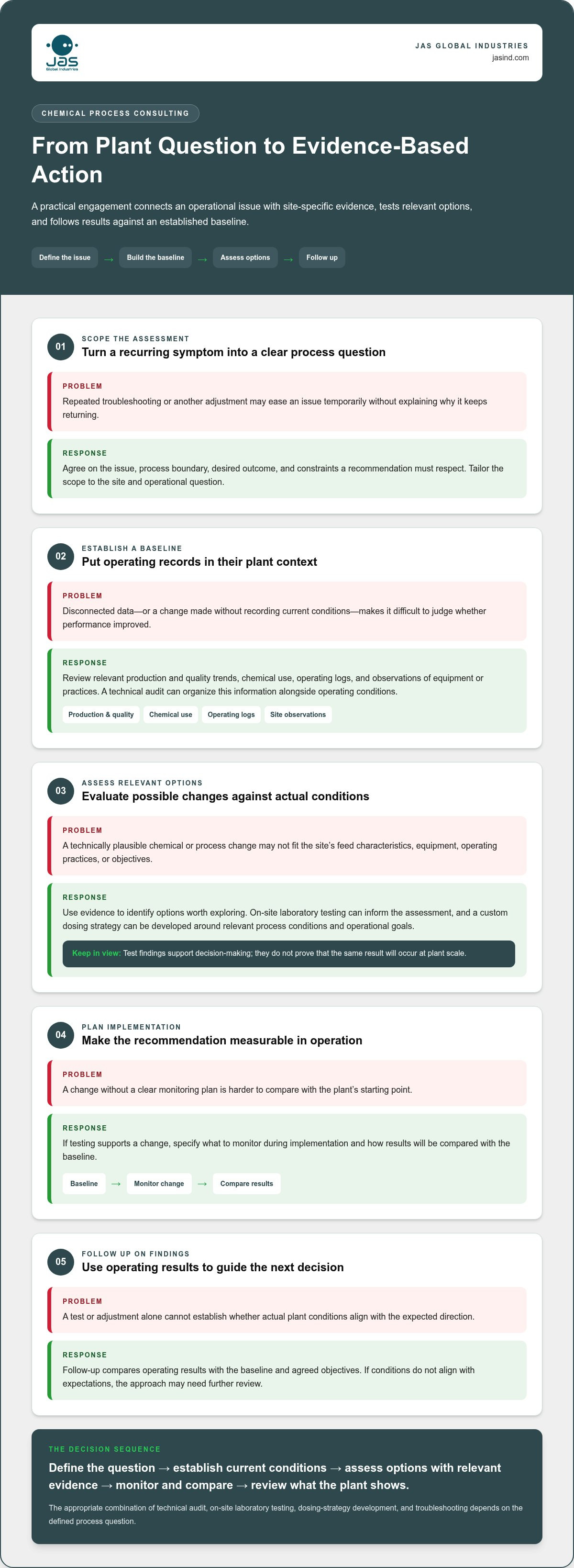
A useful engagement turns an operational question into a sequence of evidence-based decisions. The steps can be adapted to the project, but typically move from defining the problem to reviewing records, assessing plant conditions, testing options, and following up against agreed objectives. This keeps the work focused on the process question instead of producing recommendations detached from day-to-day operations.
Scoping the assessment and establishing a baseline
Start by agreeing on the issue, the process boundary, the desired outcome, and the constraints any recommendation must respect. Existing operating records and site observations can then help describe current conditions. Depending on the question, relevant evidence may include production and quality trends, chemical use, operating logs, and observations of equipment or practices. Recording the baseline makes later comparisons more meaningful.
A technical audit can help organize the assessment by examining process information and operating conditions in context. Tailor the scope to the site: a question about inconsistent output may require different evidence from one about chemical consumption or interruptions. A practical guide to chemical process optimization provides further context on systematic analysis, but plant decisions still need to reflect the specific operation and its objectives.
Testing recommendations against operating conditions
Once the evidence points to options worth exploring, testing can help assess whether a proposed chemical or process approach merits further evaluation. On-site laboratory testing may inform that assessment, while a custom dosing strategy can be developed around relevant process conditions and operational goals. Test findings are evidence for decision-making, not proof that the same result will occur at plant scale.
JAS Global Industries brings technical audits, on-site laboratory testing, dosing-strategy development, and troubleshooting together as part of its technical consulting. The appropriate combination depends on the defined question. If testing supports a change, the recommendation should state what to monitor during implementation and how results will be compared with the baseline. Follow-up helps determine whether actual operating conditions align with the expected direction or whether the approach needs further review.
This sequence supports disciplined decisions without assuming one test or adjustment will resolve every issue. For an overview of JAS’s technical consulting, see process consulting support.
How to Evaluate Chemical Process Consulting Beyond the Recommendation
A recommendation can sound technically plausible and still be difficult to assess. Before judging its value, define the operating objective and the baseline you’ll compare against. If the goal is steadier production, for example, identify how the site records process stability and which operating conditions should be considered in the comparison.
Assess consulting value against agreed process indicators, compared with a documented baseline under relevant operating conditions. The right indicators depend on the process and its objectives, so there’s no universal target for every plant.
| Evaluation area | What to look for |
|---|---|
| Diagnosis | A clear connection between the observed issue and the factors being investigated. |
| Evidence | Relevant operating records, site observations, and clearly stated assumptions. |
| Testing | A reasoned approach to evaluating an option, distinguishing test findings from plant-scale results. |
| Implementation practicality | Recognition of operating constraints, required actions, and responsibilities. |
| Follow-up | Agreed measures and a plan to review performance against the baseline. |
What makes a process recommendation actionable?
An actionable recommendation explains how the evidence supports the proposed intervention and what needs to happen next. It should account for site constraints, including current operating practices and relevant equipment conditions, rather than assume a change can be applied without adjustment. Clear responsibilities, assumptions, and evaluation measures help plant teams understand how the recommendation will be assessed. For safety-related considerations, OSHA provides information on chemical safety and health standards.
A product recommendation and broader process analysis are not the same thing. A product recommendation focuses on a chemical option and its intended application. Process analysis examines the operating question in context, including how chemical use relates to process conditions, constraints, and the chosen objective. Chemical process consulting can bring these elements together, with the scope shaped by the project.
Which indicators can track process improvement?
Choose indicators that match the objective and can be assessed using available site data. Depending on the question, a team might track process stability, product-quality consistency, or chemical use. Compare periods with sufficiently similar operating conditions, and document relevant differences that could affect interpretation. This helps distinguish a meaningful pattern from a change caused by a different feed, operating practice, or production context.
Preparing a Chemical Process Consulting Project for Fertilizer, Mining, or Water Treatment
A focused assessment starts with a clear account of the operating challenge, the site context, and the improvement the team wants to evaluate. Preparing relevant information helps define a useful scope without locking the investigation into a solution before reviewing the evidence. In chemical process consulting, the right questions and records depend on the process being assessed.
What information helps define the consulting scope?
Before the assessment, assemble a concise overview of the process and its current concern. Include what has changed, when the issue occurs, and what a practical improvement would look like. Useful context may include:
- Process and objective: A brief process description, the operating issue, and the desired outcome.
- Available evidence: Relevant operating records, quality or production trends, and chemical-use information.
- Existing approach: Current chemical programs and any adjustments or troubleshooting already attempted.
- Site conditions: Relevant equipment, operating practices, feed or water characteristics, and constraints.
These details help clarify which information is relevant and where further assessment may be useful. They don’t establish the root cause on their own, and shouldn’t be treated as proof that a particular chemical or operating change is needed.
How sector context shapes the assessment
Sector knowledge helps focus the investigation, but each site has its own process objectives and operating conditions. In fertilizer operations, the question may involve material handling, product flow, or chemical dosing. For background on one handling consideration, see this guide to fertilizer anti-caking agents. It can help frame the topic without assuming caking is the cause of a specific plant issue.
In mining, define the mineral-processing operation and its objective before considering chemical use or process adjustments. The relevant context for a flotation question, for instance, differs from one focused on another stage of processing. See mining process solutions for related sector context.
For water treatment, describe the system and treatment challenge first. The process purpose, operating conditions, and observed issue help determine which evidence is relevant. A treatment concern shouldn’t be treated as interchangeable with a mining or fertilizer challenge. See this overview of industrial water treatment for additional context.
Bring the issue, records, existing chemical approach, and site constraints together to support a focused discussion. More on process consulting support is available here.
JAS Global Industries: Chemical Process Consulting Built Around Plant Needs
Plant challenges rarely sit neatly within one category. Chemical use, operating conditions, and production goals can all shape the question that needs answering. JAS Global Industries works with fertilizer, mining, and water-treatment operations, bringing specialty chemical experience together with technical consulting. Its chemical process consulting connects assessment to practical next steps, with scope shaped around the process and operational objective.
Consulting informed by specialty chemical experience
JAS Global Industries has served industrial sectors since 1998. Its work across fertilizer, mining, and water treatment informs site-specific assessment, while each recommendation remains grounded in the conditions and goals of the individual operation. Technical audits and on-site laboratory testing can contribute relevant evidence, while operational troubleshooting can help examine persistent issues. The purpose is to develop a practical path forward, not promise a predetermined result.
The work can also include custom chemical dosing strategies. A dosing recommendation should reflect the process question and site context, rather than treat chemical selection as separate from plant conditions. Depending on the need, an assessment may review available evidence, test an option, develop a tailored dosing approach, or investigate an operational concern. The appropriate scope follows from the issue and agreed objectives.
From assessment to a practical next step
A strong starting point is a concise description of the challenge, the operating context, and the change the team wants to evaluate. Relevant process evidence can then help clarify assessment priorities and the measures that will indicate whether conditions are moving in the intended direction. Defining those measures early keeps recommendations connected to plant needs.
For a focused discussion, outline:
- The process issue and when or where it occurs.
- Relevant site conditions, operating records, and the existing chemical approach.
- The desired operational outcome and how the team will evaluate it.
With these details, JAS can discuss a tailored assessment, on-site testing, dosing-strategy development, or troubleshooting. Discuss your process challenge with JAS to take a practical first step toward evidence-led operating decisions.
Turn Process Evidence Into a Practical Path Forward
More reliable plant performance starts with a clear operational question, relevant site evidence, and recommendations that can be assessed against agreed objectives. Chemical process consulting connects these elements so decisions are grounded in plant conditions rather than assumptions. A documented baseline and relevant process indicators also make it easier to evaluate whether a proposed change is moving operations in the intended direction.
JAS Global Industries has served industrial sectors since 1998, including fertilizer, mining, and water treatment. Its consulting capabilities include technical audits, on-site laboratory testing, custom chemical dosing strategies, and operational troubleshooting. Together, these capabilities support a tailored assessment, from investigating a recurring challenge to evaluating a practical next step.
Start by outlining the issue, relevant operating context, and outcome your team wants to assess. Then discuss your chemical process challenge with JAS Global Industries. A focused conversation can help clarify the evidence and assessment priorities for your plant, supporting more informed operating decisions.
Frequently Asked Questions
What does chemical process consulting involve?
Chemical process consulting assesses an industrial operation to understand a defined technical or performance challenge and identify practical next steps. Depending on the project, it may include a technical audit, review of operating evidence, on-site laboratory testing, chemical dosing strategy development, or operational troubleshooting. The scope should reflect the plant’s actual conditions and agreed objectives. Recommendations should explain how the evidence relates to the issue rather than promise a particular result.
When should a plant use chemical process consulting?
Consider consulting when a recurring process issue remains unresolved, operating performance varies, or an existing chemical program needs assessment. A clear question helps focus the work, whether the concern involves reliability, chemical use, or process conditions. Consulting can help organize evidence and evaluate improvement options before changes are made. It doesn’t guarantee a specific improvement, so define the operational objective and relevant measures before assessing outcomes.
How does a chemical process consultant diagnose an operational problem?
A consultant typically begins by defining the problem and reviewing relevant process information. Depending on the project, diagnosis may include operating-data review, site observations, a technical audit, or laboratory testing. The assessment then considers possible contributing factors and develops recommendations suited to the plant’s conditions. Evidence requirements differ by process and project, so the approach should follow the operational question rather than rely on a fixed checklist or assume one root cause.
What is the difference between chemical process consulting and chemical supply?
Chemical supply provides products for use in an industrial operation. Process consulting examines a defined operating challenge and develops recommendations based on the process context, which may include a tailored dosing strategy. Some projects combine product supply with technical support, but the roles are distinct: one concerns the chemical product, while the other focuses on diagnosis and practical decisions. The right scope depends on the plant’s needs and agreed objectives.
How can a company measure the value of process consulting?
Start with a documented baseline and select indicators that relate directly to the operational objective. Depending on the process, measures might include process stability, chemical use, or another relevant performance indicator. Compare periods with similar operating conditions, and record changes or assumptions that could affect interpretation. There is no universal target for every plant. A meaningful evaluation relies on relevant measures, reliable evidence, and follow-up against the agreed baseline.
What information should we prepare before a process consulting assessment?
Prepare a concise description of the process, the issue, and the outcome your team wants to evaluate. Relevant operating records, information about the current chemical program, and observations about changes over time can help clarify the assessment scope. Note site conditions and operating constraints as well. These details help focus the review on the specific operation and its needs, without assuming in advance which chemical or process change will be appropriate.
Can chemical process consulting support fertilizer, mining, and water-treatment operations?
Yes. Consulting can support a defined process challenge in fertilizer, mining, or water treatment, but the assessment should reflect each operation’s distinct conditions and objectives. Fertilizer handling, mineral processing, and water-treatment systems require different evidence and priorities. JAS Global Industries serves these sectors with specialty chemical solutions and technical consulting, including technical audits, on-site laboratory testing, dosing strategies, and troubleshooting. The company has served industrial sectors since 1998.