
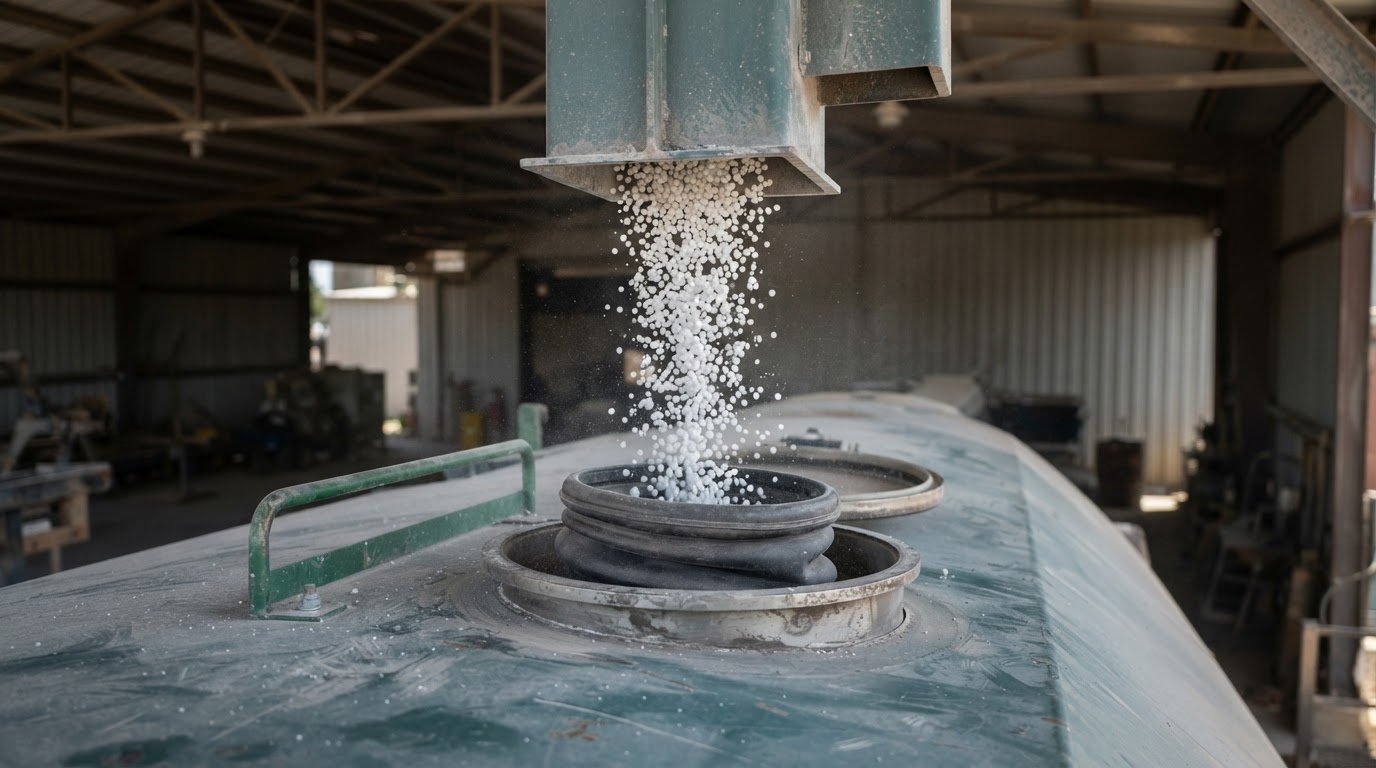
Dust control starts at the granule. Fertilizer dust control agents are surface treatments that reduce airborne dust as fertilizer is handled and moved through the supply chain. Common coating materials include oils, waxes, and polymers.
Even well-made fertilizer can shed fine particles when granules rub together, break, or experience changing storage and transport conditions. Dust can affect product integrity, workplace conditions, housekeeping, and emissions. Treating granules at the source helps reduce dust before it becomes airborne.
This article explains what fertilizer dust-control coatings do and how they work on granules. It covers why dust and product degradation occur, what influences coating performance, and how dust affects fertilizer handling. It also explains how application methods distribute a coating across the material, helping you assess where these treatments fit in fertilizer production and transport.
Key Takeaways
- Understand how surface coatings use oils, waxes, or polymers to bind fine particles to fertilizer granules.
- Recognize how granule shape, hardness, handling, and moisture can contribute to dust and product degradation.
- Identify how airborne dust can affect product quality, workplace conditions, housekeeping, and environmental emissions.
- Explore how fertilizer dust suppressants and anti-caking agents may support more stable handling when dust or caking is a concern.
1. What Are Fertilizer Dust Control Coatings?
Fertilizer dust control agents are chemical treatments applied to granules to limit fine particles becoming airborne during handling. Oils, waxes, and polymers are common coating materials. They can bind loose particles to granule surfaces or form a layer that reduces abrasion. An anti-caking treatment can also help keep granules separated.
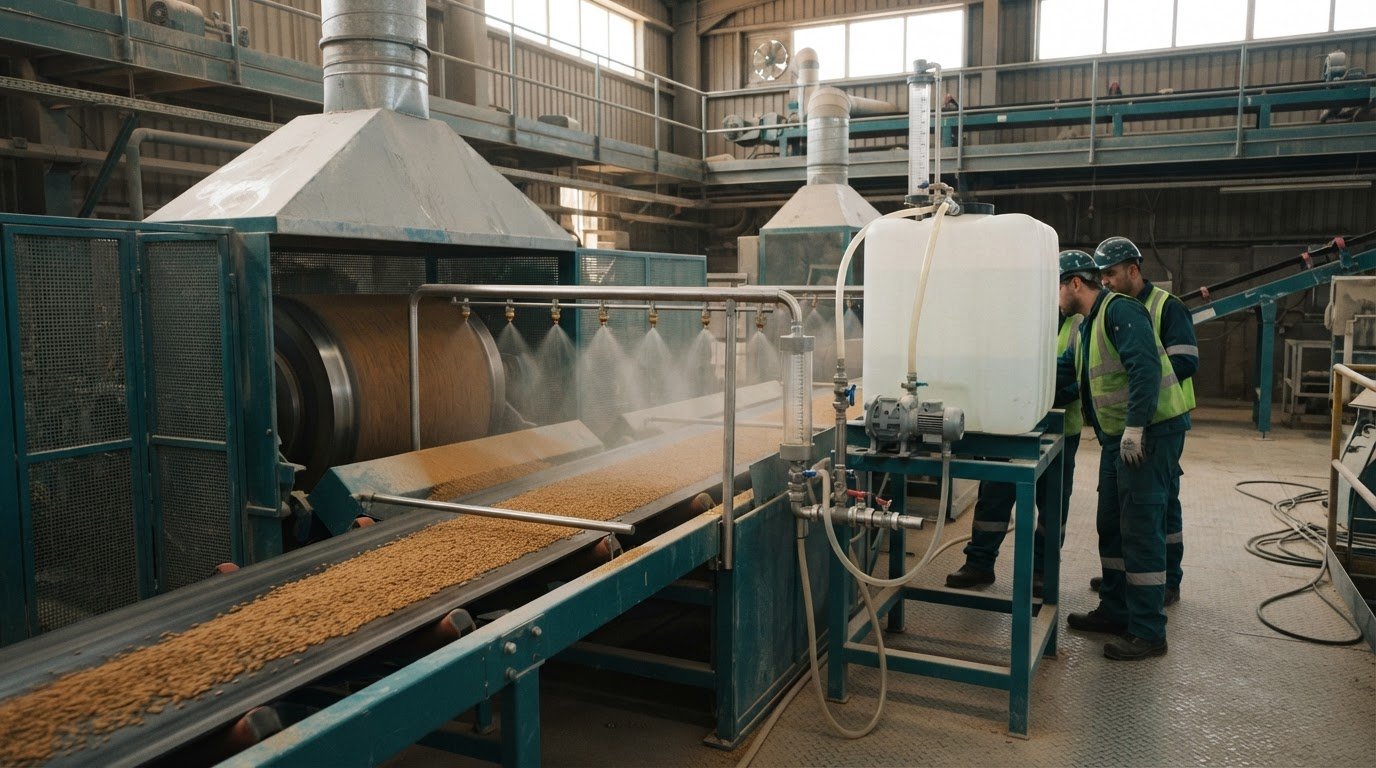
The right treatment for urea, ammonium nitrate, or phosphate fertilizer depends on the material’s surface and the handling process. No single coating suits every fertilizer. The formulation and application method need to match the product while preserving its ingredients and intended use. Liquid treatments can be sprayed onto moving granules; water-based spray suppression is another option.
In a coating drum, a spray bar applies liquid across a tumbling bed of fertilizer. The movement helps spread the coating over the granules. Application depends on practical factors such as spray location, nozzle type, feed rate, drum speed, and retention time. Testing these variables helps develop a process suited to the material. Some facilities can use an existing spray system, while a drum can be integrated into a new line or retrofitted into an existing one.
Coatings suppress dust at the material surface; collection equipment captures particles already airborne. Exhaust hoods draw dust into duct systems, where collectors separate it from the airstream. Fans or motors move air through the system. These controls have distinct roles: a coating reduces dust released from granules, while collection manages airborne particles.
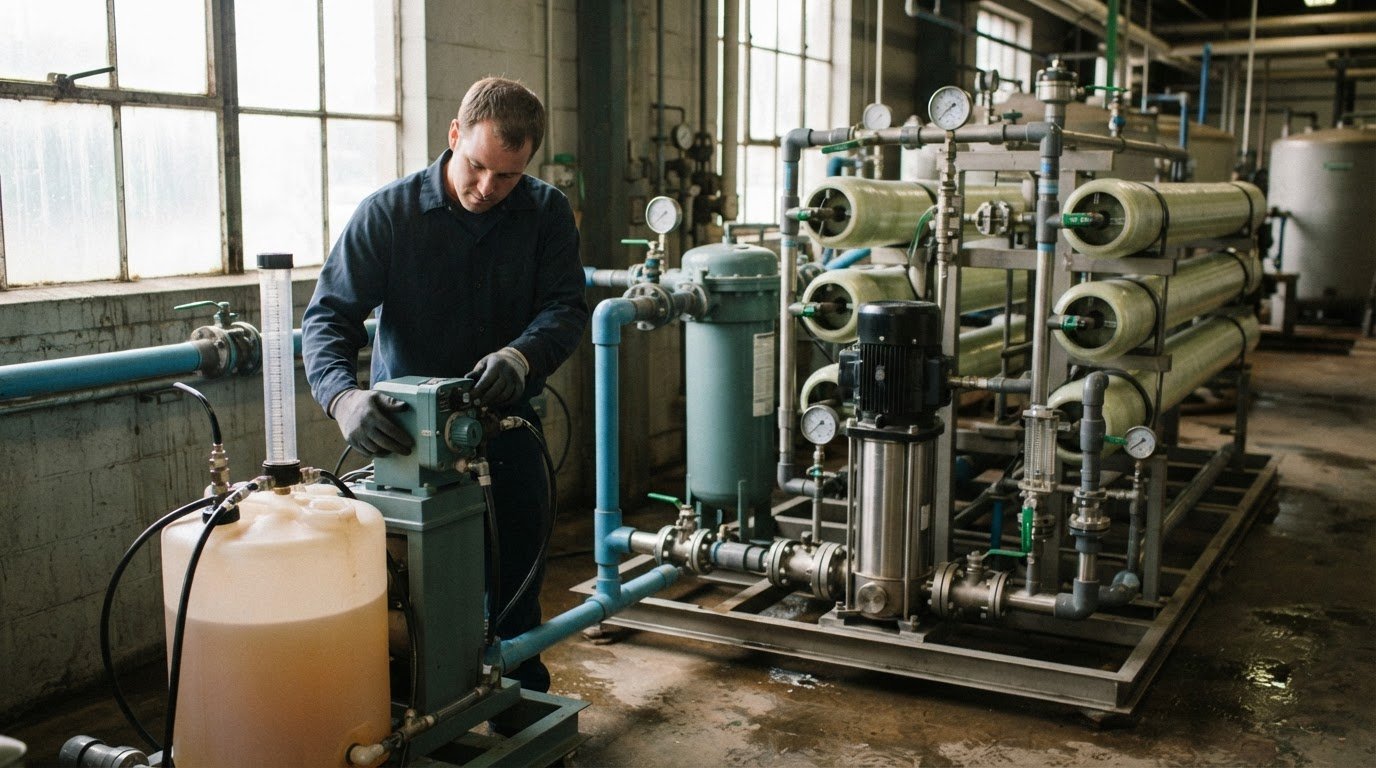
Effectiveness, cost, and handling depend on the treatment, application rate, and equipment. Compare performance through laboratory tests and production trials, assessing dust reduction alongside coating distribution and product integrity. Liquid agents require suitable storage and metered spraying; water-based systems require spray equipment. A suitable choice balances dust control, reliable application, and the fertilizer’s characteristics.
2. Causes of fertilizer dust and product degradation
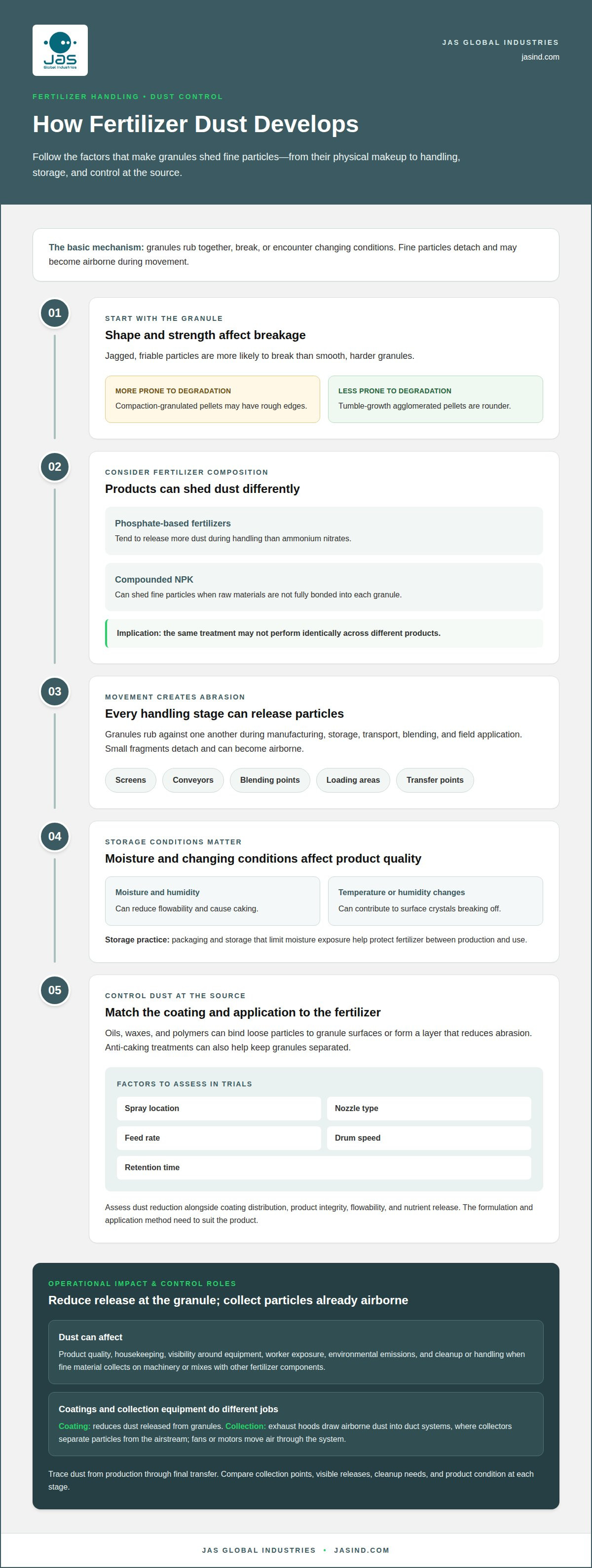
Dust often begins as granules rub against one another during manufacturing, storage, transport, blending, or field application. Shape and strength matter: jagged, friable particles are more likely to break than smooth, harder granules. Compaction-granulated pellets may have rough edges, while tumble-growth agglomerated pellets are rounder and less prone to degradation.
Fertilizer composition also affects dust generation. Phosphate-based fertilizers tend to release more dust during handling than ammonium nitrates, and compounded NPK can shed fine particles when raw materials are not fully bonded into each granule. As a result, the same treatment may not perform identically across products.
Storage conditions can affect flow and product quality. Moisture and humidity can reduce flowability and cause caking, while temperature or humidity changes can contribute to surface crystals breaking off. Packaging and storage practices that limit moisture exposure help protect fertilizer between production and use.
How do dust treatments affect flowability, caking, and nutrient release? A surface coating can help keep granules separated and reduce dust, but moisture exposure can still contribute to caking. Formulation and coverage matter, so trials should assess flowability and nutrient release alongside dust control.
How should treatments be stored, handled, and applied safely? Follow the product label and safety data sheet for storage and handling, then use equipment suited to the liquid and fertilizer. Calibrated spraying and even distribution help avoid untreated areas or excess coating.
Application dosage and spray setup influence coverage, so assess them in trials using the actual fertilizer and operating conditions. Check spray location, feed rate, nozzle type, and drum retention time. These factors help identify a process that controls dust without compromising fertilizer ingredients. For an application-focused next step, explore fertilizer dust-control solutions.
3. Fertilizer dust generation and operational impacts
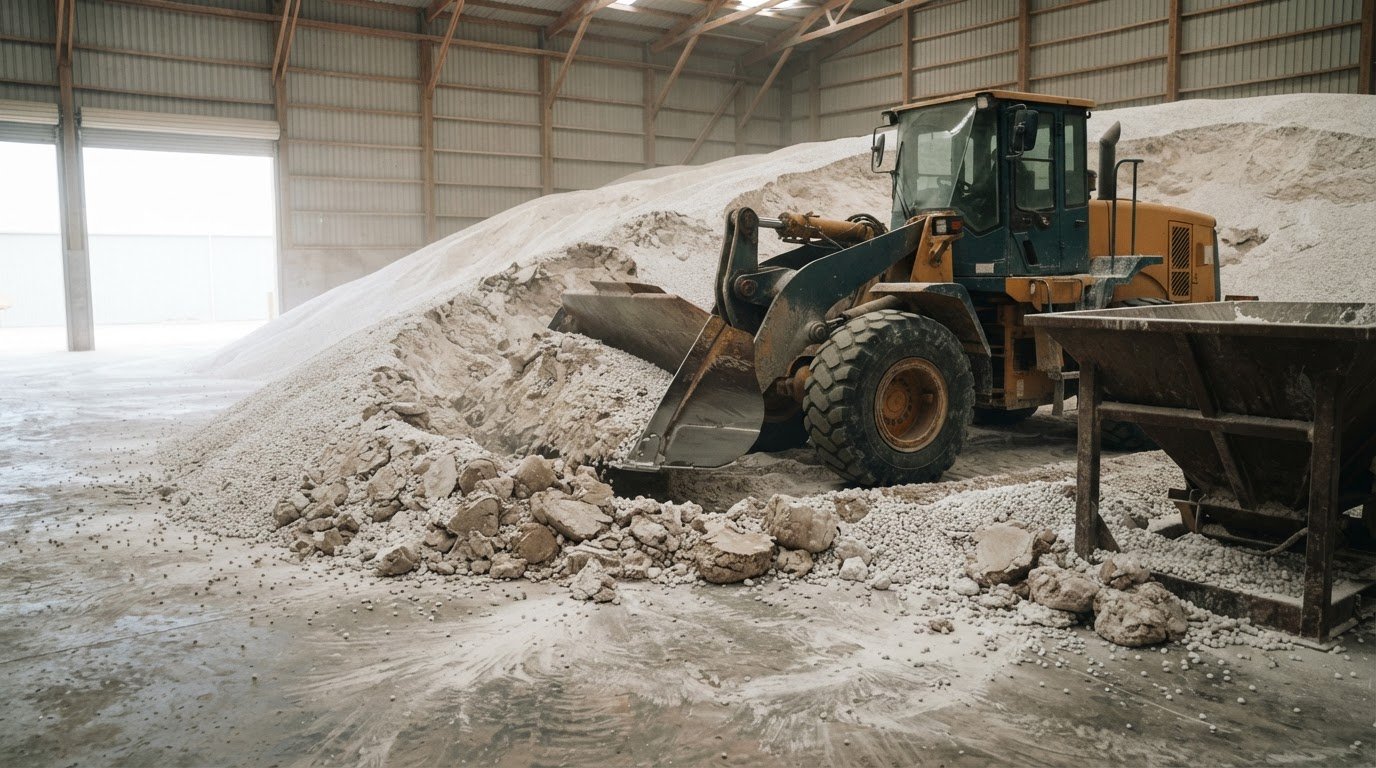
Mechanical abrasion creates dust as fertilizer moves through production, storage, and transfer. Small fragments detach from granules and become airborne around screens, conveyors, blending points, and loading areas. Surface crystals can also break when humidity and temperature change. Each transfer creates another opportunity for particles to escape into the work area or surrounding environment.
Excessive dust can reduce product quality and increase housekeeping demands. It can impair visibility around equipment, expose workers to airborne particles, and contribute to environmental emissions. Fine material may collect on machinery or mix with other fertilizer components, complicating cleanup and handling. In fertilizer production, dust loss means less material reaches its intended destination.
Fugitive dust creates both exposure and process concerns. The U.S. framework includes the Clean Air Act for particulate emissions from industrial facilities and NFPA 654 for combustible dust hazards in fertilizer handling. These address different risks: emission controls concern particles released to the air, while combustible-dust practices address fire and explosion hazards where applicable. Site procedures should account for the material and equipment present.
Combustion risk depends on dust characteristics and operating conditions, not simply on visible dust. Accumulations near transfer equipment can become a concern if dispersed and exposed to an ignition source. Effective housekeeping, suitable dust collection, and control at generation points help manage these operational hazards. Dust monitoring can also identify which process stages release the most material.
Assess an operation by tracing dust from production through final transfer. Compare collection points, visible releases, cleanup needs, and product condition at each stage. For example, dust concentrated around a conveyor transfer suggests examining that point before changing controls across the facility. This targeted review connects the source of dust to practical decisions about process efficiency, worker protection, and environmental performance.
4. What fertilizer dust control coatings are
A fertilizer dust control coating is a surface treatment designed to keep fine particles attached to granular fertilizer. Its purpose is more than giving granules a finished appearance. A well-matched formulation can reduce airborne dust while supporting product integrity during storage and transfer.
Coatings can serve several functions. A treatment may suppress dust, help limit moisture absorption, reduce caking, or add color for product identification. These goals can overlap, but the formulation must suit the fertilizer. For example, a urea coating needs to protect the granule surface without compromising the product’s intended use.
Think of the coating as a thin functional layer, not a replacement for the fertilizer granule. It can bind loose particles and protect vulnerable surface areas from further abrasion. An anti-caking treatment can also help keep granules separated as they move through storage and handling systems. Performance depends on even coverage and a good match between treatment and material.
To choose an economical dust control coating, look beyond the amount applied. Consider the dust problem, fertilizer characteristics, application method, and whether caking or moisture protection also matters. A formulation that works well on one product may behave differently on another, such as phosphate fertilizer versus NPK. Laboratory testing and production trials help assess coating distribution, dust levels, and product integrity together.
First define the priority: airborne dust, caking, moisture exposure, or a combination. Then assess the coating against that need using the actual fertilizer and operating conditions. This keeps selection focused on measurable handling needs rather than a general claim of dust reduction.
For a coating approach tailored to your fertilizer and process, discuss your dust-control requirements.
JAS Global Industries: Fertilizer Anti-caking Agents
JAS Global Industries offers Fertilizer Anti-caking Agents and Fertilizer Dust Suppressants for fertilizer operations managing caking or airborne dust. These solutions address related handling challenges: anti-caking agents help keep granules separated, while dust suppressants target dust during material movement.
Consider these products when dust or caking affects product flow, storage, or transfer. The right approach depends on the fertilizer’s characteristics and where the issue occurs in the operation. Identifying the specific need helps connect the process challenge with the relevant treatment category.
For support with fertilizer dust suppression or anti-caking, contact JAS Global Industries.
Turn dust observations into a process priority
The next step is to connect dust control with a specific operating objective. Decide whether the priority is cleaner transfer points, steadier product movement, reduced airborne material, or a combination. That focus helps guide the choice of fertilizer dust control agents without treating every dust issue as the same problem.
Build an evaluation around the fertilizer and the operation where dust appears. Record the affected handling stage, the product condition, and the changes that matter to your team. Use those observations to define what a suitable treatment must support, then consider how it fits existing application equipment and process requirements.
JAS Global Industries offers fertilizer-focused chemical solutions for dust suppression and anti-caking needs. If you’re ready to discuss the requirements of your fertilizer operation, contact JAS Global Industries today. A clear process objective is a strong starting point for more controlled fertilizer handling.
Frequently Asked Questions
What Are Fertilizer Dust Control Coatings?
These treatments are applied to fertilizer granules to limit dust released during movement and handling. A coating can also support other product goals, such as reducing caking or moisture absorption. Fertilizer dust control agents can be selected for particular material and process conditions. For example, a producer handling granular NPK may seek a treatment that reduces dust while preserving the product’s intended characteristics.
What are fertilizer dust control agents and how do they work?
These treatments help reduce dust released from fertilizer during handling. Oils, waxes, and polymers can bind loose particles to granules or form a surface layer. The choice depends on the fertilizer, its surface condition, and how it moves through the operation. Dust collection captures airborne particles, while a treatment works on the material itself.
What types of dust control agents are used for granular fertilizers?
Common options for granular fertilizer include oil-based, wax-based, and polymer-based treatments. Liquid formulations can be sprayed onto moving granules, while water-based spray systems offer another suppression route. Fertilizer dust control agents should be matched to the material and process conditions. For organic production, permitted materials and restrictions differ from conventional use, so suitability must be assessed against applicable production requirements.
What application rates and equipment are used for fertilizer dust control agents?
There is no single application rate for every fertilizer; the required amount depends on the formulation, material surface, feed rate, and spray setup. Application equipment can include a coating drum with a spray bar or a blender fitted with a pump and nozzles. Trials can assess dosage alongside nozzle type, drum speed, retention time, and coating distribution.
What are the health, environmental, and fire risks of fertilizer dust control agents?
Key concerns arise from airborne fertilizer dust, rather than from every coating being inherently hazardous. Dust can expose workers, impair visibility, and contribute to particulate emissions; combustible dust hazards also require attention in fertilizer handling areas. NFPA 654 addresses combustible dust hazards, while the U.S. Clean Air Act provides a framework for industrial particulate emissions. Dust controls should address both exposure and release.
Which fertilizer dust control agent suppliers and products are available in the United States?
JAS Global Industries offers Fertilizer Dust Suppressants and Fertilizer Anti-caking Agents for industrial fertilizer operations. These categories address dust and caking challenges, respectively; the suitable option depends on the material and process need. JAS Global Industries serves fertilizer-sector partners internationally. For support with a U.S. operation, share the fertilizer handled and the dust-control challenge with the company.