
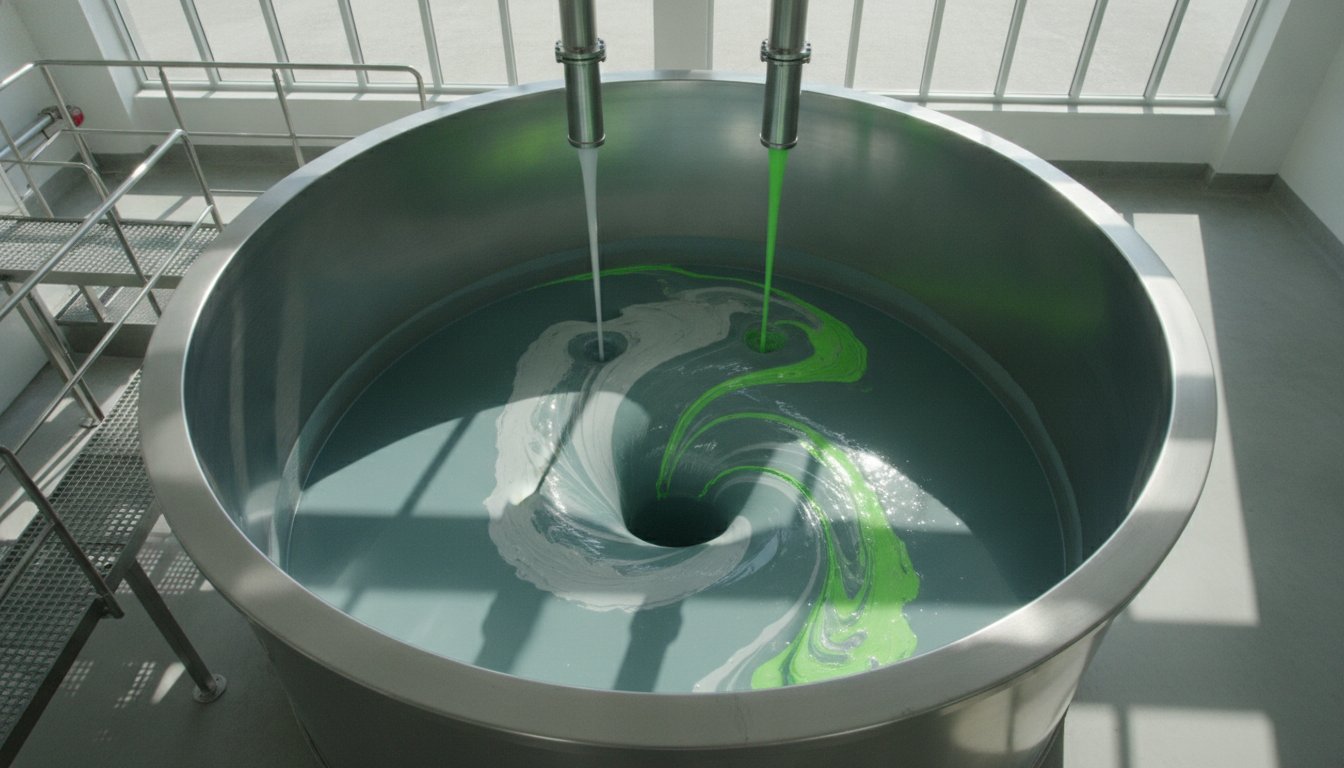
In high-performance paint manufacturing, dispersing agents are not just additives; they are strategic guardians of resource security and process stability. Selecting the right dispersing agents for paint formulation is critical to preventing pigment agglomeration and managing the high production costs associated with inefficient grinding. You've likely felt the pressure of maintaining shelf-life stability and preventing sedimentation in stored coatings, where even a minor chemical imbalance can compromise an entire batch.
This guide will help you master the science of these essential additives to optimize pigment stability, enhance color development, and ensure long-term reliability. We'll examine how high-performance additives reduce milling time and energy consumption, securing your position as a responsible leader in a market where the waterborne segment now accounts for over 65% of the global share. From meeting strict VOC limits to achieving maximum gloss, we provide the technical foundation for your industrial success. Protecting formulations. Securing stability.
Key Takeaways
- Understand the fundamental role of surfactants in reducing interfacial tension to prevent pigment agglomeration and long-term sedimentation.
- Differentiate between electrostatic and steric stabilization to select the most effective mechanism for your specific aqueous or solvent-based systems.
- Learn how optimized dispersing agents for paint formulation enhance color development and gloss while significantly reducing milling time and energy consumption.
- Identify critical selection criteria based on pigment surface polarity and continuous phase compatibility to ensure total formulation reliability.
- Leverage custom technical audits to transition from generic additives to high-performance, tailor-made solutions that secure the stability of complex industrial coatings.
What are Dispersing Agents? Defining the Science of Suspension
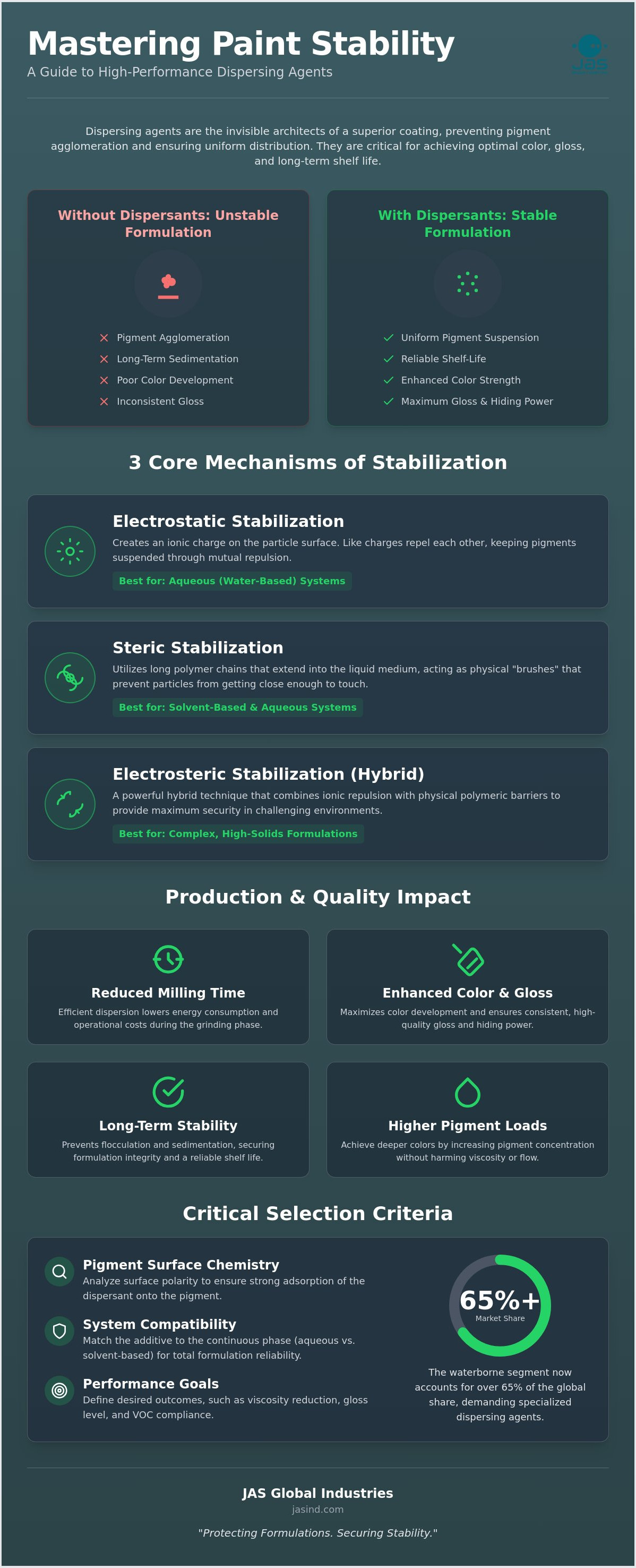
Stability is the hallmark of a superior coating. At its core, a Dispersant is a specialized chemical agent designed to prevent the agglomeration and sedimentation of solids within a liquid medium. These additives serve as the invisible architects of a formulation, ensuring that pigments remain evenly distributed rather than settling into unworkable sludge. In industrial manufacturing, effective dispersing agents for paint formulation are the primary defense against the natural tendency of particles to clump together.
The science of suspension relies heavily on surfactants. These molecules reduce the interfacial tension between pigment surfaces and binders, allowing for a seamless transition from dry powder to stable fluid. This process is the foundation of coating durability and aesthetic quality. Without precise dispersion, paints suffer from poor color development, reduced hiding power, and inconsistent gloss. While wetting agents handle the initial contact by displacing air at the pigment surface, dispersing agents provide the long-term stability required for a reliable shelf life.
In high-performance environments, the choice of additive dictates the efficiency of the entire production line. Proper dispersion reduces the energy required during the grinding phase, lowering operational costs while securing the integrity of the final product. It's a balance of chemistry and mechanics that protects the value of industrial resources.
The Anatomy of a High-Performance Dispersant
Modern paint chemistry often relies on the hydrophilic-lipophilic balance (HLB) to determine how an additive interacts with different phases of a coating. While traditional surfactants were once the industry standard, there's a significant shift toward advanced synthetic polymers. These polymers offer superior control over particle spacing through advanced architectural designs. A dispersant is a precision tool for maintaining the kinetic stability of colloids. By utilizing these high-performance structures, manufacturers can achieve higher pigment loads without compromising the viscosity or flow of the paint.
Dispersants vs. Deflocculants: Avoiding Formulation Errors
The distinction between a dispersant and a deflocculant is often misunderstood, leading to critical formulation errors. In the context of ceramics chemicals, deflocculation is primarily used to reduce the viscosity of high-solids slurries for easier processing. In paint, however, the goal is often more complex, requiring long-term suspension and color consistency. Understanding the nuances of surfactant chemistry is essential for identifying when to use a specific additive. While both tools influence particle separation, a dispersant focus on maintaining a homogenous state throughout the storage and application cycle, securing the stability of the global resource supply through technical precision.
Mechanisms of Action: How Dispersants Stabilise Paint Fluids
Stability in a coating isn't an accidental occurrence. It's a calculated victory over the laws of physics. High-performance dispersing agents for paint formulation function by establishing energy barriers that prevent pigment particles from returning to their natural, clumped state. To achieve this, the additive must first anchor itself to the pigment surface through strong adsorption. If this bond is weak, the stabilizer will detach during the high-shear environments of milling or during long-term storage, leading to catastrophic formulation failure.
Once anchored, the dispersant employs one of three primary mechanisms to maintain separation:
- Electrostatic stabilisation: Common in aqueous systems, this method involves creating an ionic charge on the particle surface. Like charges repel, keeping pigments suspended through mutual repulsion.
- Steric stabilisation: This approach utilizes long, branched polymer chains that extend into the liquid medium. These chains act as physical "brushes" that prevent particles from getting close enough to touch.
- Electrosteric stabilisation: A hybrid technique essential for complex, high-solids formulations. It combines ionic repulsion with physical polymeric barriers to provide maximum security in challenging environments.
Understanding these mechanisms allows for smarter procurement and more reliable results. For those seeking to refine their process, JAS Global Industries provides technical audits for coating stability to ensure your additives are performing at peak efficiency.
Neutralising van der Waals Forces
Van der Waals forces are the invisible drivers of pigment agglomeration. These attractive forces pull particles together, leading to sedimentation and loss of color intensity. Effective chemical dosing strategies overcome these forces by meticulously managing the surface chemistry of the solids. Engineers rely on zeta potential measurements to predict suspension stability. A high zeta potential indicates a strong repulsive force, which is a key indicator that the formulation will remain fluid and consistent over time. It's a vital metric for securing the long-term integrity of the product.
Kinetic vs. Thermodynamic Stability in Coatings
In industrial paint manufacturing, "stable" is a relative term. Most coatings are kinetically stable, meaning they're designed to resist change for a specific duration rather than indefinitely. Thermodynamic stability is rarely achieved in complex mixtures. Therefore, predicting shelf-life requires rigorous rheology and sedimentation testing. The molecular weight distribution of the polymer dispersant plays a decisive role here. High-molecular-weight polymers offer better steric protection but can increase viscosity if not balanced correctly. Achieving this equilibrium is the difference between a premium coating and a failed batch.
The Impact of Dispersants on Paint Quality and Production ROI
In industrial manufacturing, the economic value of a coating is inextricably linked to its chemical efficiency. High-performance dispersing agents for paint formulation do more than just stabilize particles; they act as catalysts for production ROI. By ensuring that pigments are fully utilized and evenly distributed, these additives allow manufacturers to achieve vivid hues and superior hiding power with lower pigment concentrations. This optimization is vital in a global market projected to reach USD 9.82 billion in 2026, where efficiency defines market leadership.
The financial impact is most visible during the milling and grinding phase. This stage is typically the most energy-intensive part of the manufacturing process. Effective dispersants accelerate the wetting process, significantly reducing the time and energy required to reach the desired particle size. Beyond energy savings, uniform distribution ensures a consistent gloss and prevents film defects like flocculation or "seeding." When fillers and pigments are properly suspended, the resulting film is more durable, protecting the underlying infrastructure and securing the long-term value of the asset.
Optimising Pigment Efficiency
Titanium dioxide (TiO2) and other high-value pigments represent a substantial portion of raw material costs. Dispersants maximize the functional surface area of these particles, ensuring that every milligram contributes to opacity and color strength. This precision prevents the "rub-out" effect, where inconsistent dispersion leads to color shifts during application. There's a profound technical synergy between these additives and the mining solutions used to extract and process these minerals. By bridging the gap between raw extraction and final formulation, advanced dispersants ensure that the inherent quality of the mineral is preserved and enhanced in the final coating.
Process Stability and Flowability
Handling high-pigment concentrates requires meticulous viscosity control. Without the right chemical intervention, concentrates can become unworkable, leading to equipment strain and production bottlenecks. Dispersants maintain low viscosity even at high solids loading, ensuring smooth pumpability and easier handling throughout the plant. This focus on flow mirrors the role of anti-caking agents in the fertilizer industry, where maintaining the physical integrity of a resource is essential for its global utility. In coatings, this stability prevents "caking" or hard-settling during storage, ensuring that the paint remains ready for application. The result is a smooth, level finish that meets the rigorous demands of the automotive and construction sectors, which remain the primary drivers of this industry.
Similarly, in the health and nutrition sectors, the integrity of dry goods and supplements is protected through expert handling; companies like Simplepack Ltd provide the contract packing precision necessary to maintain quality from the production line to the end consumer.
Selection Criteria: Choosing the Right Dispersant for Your Process
Selection is a strategic exercise in technical alignment. To identify the ideal dispersing agents for paint formulation, engineers must evaluate the pigment surface chemistry alongside the continuous phase. Inorganic pigments, such as titanium dioxide, typically present polar surfaces that require specific anchoring groups. Organic pigments are often non-polar and require different chemical structures to achieve the adsorption mentioned in previous sections. Matching these characteristics is the first step toward securing a stable, high-performance coating.
Compatibility with the continuous phase is equally critical. With the waterborne segment projected to hold over 65% of the market share by 2026, the industry's focus has shifted toward aqueous-compatible additives. However, solvent-borne systems still demand high-performance solutions for specialized industrial applications. Beyond chemistry, cost-benefit analysis remains a pillar of industrial logic. Dosage efficiency must be weighed against raw material pricing. A cheaper additive that requires double the dosage is a liability; it increases costs and risks formulation instability.
Compliance is the final, non-negotiable criterion. Under EU REACH Regulation (EU) 2023/1464, strict formaldehyde emission limits will be enforced starting August 6, 2026. This mandate requires a proactive shift in additive selection. Similarly, US EPA and CARB standards define strict VOC limits that vary by region. For indoor matte wall paints, the EU Ecolabel now restricts VOCs to a maximum of 10 g/L. These benchmarks are the mandatory framework for modern procurement. To ensure your products meet these evolving standards, you can request a technical audit of your paint additives to ensure full regulatory alignment.
Dosage Optimisation and Dosing Strategies
Over-dosing is a common pitfall in industrial manufacturing. Excessive chemical concentrations can lead to "bridging flocculation," where polymer chains entangle and cause the very clumping they were meant to prevent. On-site laboratory testing, specifically the "ladder study," is essential for determining the precise saturation point. By implementing automated dosing, manufacturers ensure consistent industrial-scale production. This precision protects the integrity of the batch and reduces waste, contributing to a more sustainable operation. To ensure the reliability of these automated systems, many facilities source high-quality electronic parts from Adage Components to maintain accurate control over their dosing equipment.
Sustainability and Future-Proofing Formulations
Sustainability is a core component of global resource security. The industry's move toward bio-based and low-VOC dispersing agents reflects a commitment to both environmental protection and long-term viability. Biodegradability is now a standard requirement in sensitive industrial applications. JAS Global Industries integrates these environmental protections into every technical solution. We help partners transition to future-proof formulations that respect global ecosystems while maintaining the high performance required for modern infrastructure. This approach ensures that your operations remain resilient against both competitive and regulatory pressures.
Tailor-Made Solutions: The JAS Global Industries Advantage
Off-the-shelf dispersing agents for paint formulation often fail to address the specific variances found in large-scale industrial plants. While a generic additive might meet basic technical specifications, it rarely accounts for the complex mineralogies or environmental fluctuations unique to each facility. JAS Global Industries bridges this gap through custom-formulated solutions. We don't just sell chemicals; we engineer stability. Protecting formulations. Securing yields. This precision ensures that your production remains resilient, protecting both your financial ROI and the integrity of the global resource supply.
Our approach is rooted in a deep understanding of chemical processing and resource management. By moving away from standard catalog products, we provide partners with additives that are specifically tuned to their raw materials and equipment. This level of specialization is essential for maintaining the kinetic stability of high-pigment concentrates in demanding industrial environments. We act as a foundational pillar for your infrastructure, providing the reliability that modern manufacturing demands—a commitment to technical excellence shared by firms like VPrint3D Limited that provide integrated product development and prototyping solutions.
Technical Consulting and Process Audits
Our Research and Innovation (R&I) process begins with a comprehensive technical audit. JAS experts identify hidden inefficiencies in your current chemical dosing programme that often go unnoticed by standard suppliers. We perform on-site laboratory testing to ensure that our dispersing agents for paint formulation deliver real-world performance under your specific plant conditions. This data-driven strategy allows us to optimise dosing levels, reducing waste and improving overall yield. It's a partnership focused on long-term value and technical excellence.
Securing Your Industrial Supply Chain
Industrial-scale reliability requires a robust logistical foundation. Headquartered in Dubai, JAS Global Industries leverages strategic international logistics to support operations across the Middle East, Africa, Asia, and Europe. We offer bulk chemical supply contracts that provide the security needed for continuous, high-volume production. Our manufacturing plants are positioned to ensure global availability, shielding our partners from the risks of supply chain volatility. We remain committed to the stability of critical industrial resources through steady, ethical leadership. Consult with our technical experts for a custom dispersant audit to secure the future of your coating formulations.
Securing the Future of Industrial Coatings
Mastering the complexities of dispersing agents for paint formulation is a strategic imperative for modern manufacturers. Technical precision in stabilization mechanisms drives both aesthetic quality and production ROI. As global regulations tighten, the transition from generic additives to custom-engineered chemistry becomes essential for operational security. You don't have to navigate these technical shifts alone.
Since 1998, JAS Global Industries has served as a vital guardian of industrial stability. Our global R&I centres focus on developing tailor-made solutions that address the specific needs of your facility. From our strategic Dubai headquarters, we provide the logistical reliability required to support infrastructure projects across the globe. It's time to move beyond standard catalogs and embrace a partnership built on technical excellence and global responsibility. Optimise your paint formulation with JAS tailor-made dispersing agents. Secure your yields and protect your resources with a partner dedicated to your long-term success.
Frequently Asked Questions
What is the difference between a dispersing agent and a surfactant?
Surfactants are a broad category of surface-active agents, while dispersing agents are specialized chemicals designed for long-term particle separation. While all dispersants have surfactant properties, they focus on anchoring to solid surfaces to prevent re-agglomeration. Standard surfactants often lack the complex polymeric structure needed to provide the steric hindrance required for industrial-scale stability.
How do dispersing agents improve the shelf-life of industrial paints?
These agents improve shelf-life by creating a repulsive barrier that prevents pigments from settling into a hard cake. By maintaining a stable suspension, they eliminate syneresis and ensure the coating remains homogenous during storage. This stability is vital for maintaining the performance of dispersing agents for paint formulation in high-volume industrial environments where reliability is paramount.
Can I use the same dispersant for both aqueous and solvent-based systems?
It's rare for a single dispersant to function effectively in both systems due to the vast differences in medium polarity. Aqueous systems require hydrophilic anchoring groups, while solvent-based systems depend on lipophilic chains for solubility. Using the wrong type leads to immediate phase separation and formulation collapse, compromising the integrity of the resource.
What are the risks of over-dosing a dispersing agent in a formulation?
Over-dosing can trigger bridging flocculation, where excessive polymer chains entangle multiple particles rather than repelling them. This leads to a sharp increase in viscosity and can compromise the water resistance of the dried film. Finding the precise saturation point is critical to avoid wasting chemical resources and damaging the final coating's performance.
How do I calculate the optimal dosage for my pigment slurry?
Optimal dosage is determined through a dispersant demand curve, often called a ladder study. You incrementally add the agent to a pigment slurry and measure the viscosity after each addition. The point where viscosity reaches its absolute minimum, followed by a slight rise, indicates the most efficient concentration for that specific pigment and binder combination.
Why is pH adjustment critical when using electrostatic dispersing agents?
pH levels directly influence the ionization of the dispersant's functional groups and the pigment's surface charge. In electrostatic systems, an incorrect pH can neutralize the repulsive forces, leading to instant agglomeration. Maintaining the correct pH ensures a high zeta potential, which is the primary indicator of suspension stability in waterborne systems.
Do dispersing agents affect the final gloss of the paint?
Yes, they significantly impact gloss by ensuring a uniform and fine particle distribution. Smaller, well-dispersed particles create a smoother film surface that reflects light more consistently. Poorly dispersed pigments create micro-roughness, which scatters light and results in a matte or hazy appearance that lacks professional quality.
Are JAS Global Industries' dispersants compatible with organic pigments?
JAS Global Industries provides custom-formulated solutions specifically designed for organic pigments. These pigments often have non-polar surfaces that require specialized anchoring groups for effective adsorption. Our R&I centres develop these tailor-made dispersing agents for paint formulation to ensure maximum color strength and stability in complex industrial coatings.