

The era of easy ore is over. As global mineral deposits grow increasingly complex and grades continue to decline, the specialized mining reagents used in processing are no longer just consumables; they are the strategic safeguards of your entire operation. You've likely felt the pressure of rising energy costs during comminution and the frustration of volatile supply chains that threaten your daily output. It's a technical reality where every percentage point of recovery determines the long-term viability of a site.
We understand that your goal is to transform these geological challenges into predictable, high-grade results. This guide provides the technical roadmap you need to master the application of specialty chemicals to optimize mineral recovery and safeguard your process security. By focusing on tailor-made formulations and chemical optimization, you can significantly reduce your water and energy footprint. We will examine the critical role of custom flotation collectors, the efficiency of advanced grinding aids, and how a reliable partnership ensures your facility remains a pillar of global resource stability. Optimizing recovery; securing stability.
Key Takeaways
- Learn how the shift toward specialty mining reagents provides the chemical precision necessary to recover high-value minerals from increasingly complex, low-grade ore deposits.
- Discover the molecular strategies behind advanced flotation chemistry, focusing on how collectors and frothers enhance selectivity at the mineral-water interface.
- Explore the role of grinding aids and flocculants in optimizing comminution and tailings management to reduce total energy consumption and water usage.
- Gain a technical framework for reagent selection that uses on-site audits and tailor-made formulations to safeguard your plant’s yield and operational stability.
- Understand how strategic technical partnerships and global logistics networks provide the essential security needed to protect your critical resource supply chains.
The Essential Role of Specialty Reagents in Global Mineral Recovery
Mining reagents are the essential chemical catalysts that drive the modern extraction industry. They aren't merely additives; they're the bridge between raw geological complexity and the refined materials that power our world. As the industry moves away from easily accessible deposits, the role of these chemicals has transitioned from simple commodity supply to high-performance specialty engineering. This shift is a direct response to the increasing difficulty of mineral recovery. Precise chemistry is now the primary defense against declining ore grades and rising operational risks.
The stability of global resource chains depends on this chemical precision. Without advanced formulations, the froth flotation process would struggle to separate valuable minerals from increasingly stubborn gangue. Specialty mining reagents provide a vital buffer. They transform unpredictable ore bodies into stable, high-yield streams. This isn't just about chemistry. It's about securing the fundamental building blocks of modern infrastructure and ensuring a reliable supply for the global market. Secure resources; stable future.
The Impact of Reagents on Operational Reliability
Consistency is the hallmark of a secure operation. In many facilities, ore feed variability is a constant threat to concentrate grades. High-performance mining reagents allow operators to maintain steady performance despite these shifts in mineralogy. By utilizing tailor-made formulations, plants can reduce process downtime and avoid the costly "hunting" for stable parameters that plagues generic chemical programs. Optimized dosing also protects downstream equipment from scale, corrosion, and fouling. Reliable chemistry leads to reliable machinery. It's a holistic approach to plant health that prioritizes long-term stability over short-term savings.
Economic Drivers for Advanced Chemical Selection
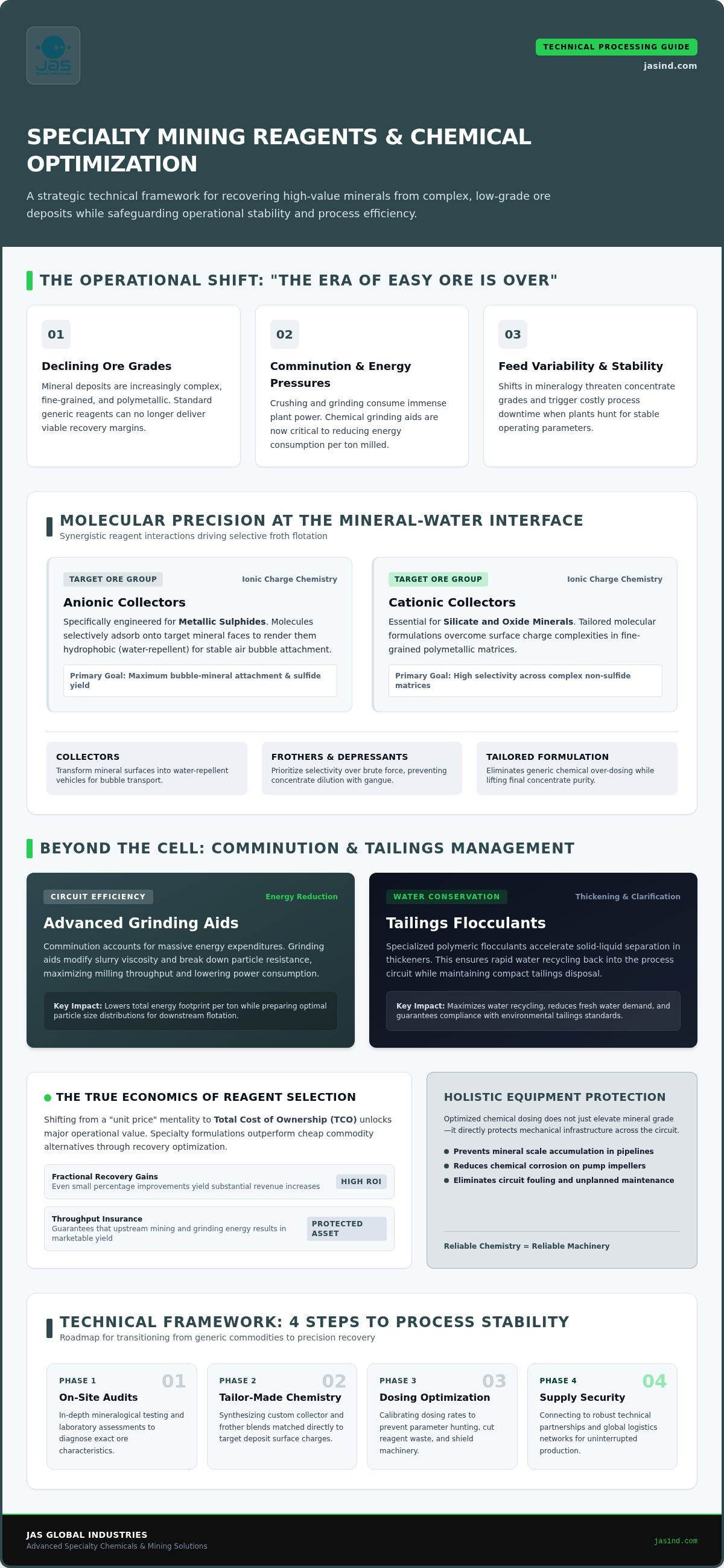
The financial logic of chemical selection is changing. Savvy operators no longer look at the unit price of a reagent. Instead, they calculate the return on investment through the lens of total cost of ownership. Specialty chemicals offer a superior ROI by maximizing recovery percentages that generic alternatives simply can't reach. Even a fractional improvement in recovery can translate into significant revenue gains, often dwarfing the initial cost of the specialty additive. Think of advanced selection as an insurance policy for plant throughput. It guarantees that the energy and labor invested in mining and grinding actually result in a marketable product. Technical audits and on-site laboratory testing are the tools that reveal these hidden economic opportunities. Precision chemistry; proven value.
The Chemistry of Flotation: Collectors, Frothers, and Depressants
The mineral-water interface is the critical zone where recovery is won or lost. Success in this space depends on the synergistic interaction of various mining reagents. Modern mining solutions prioritize selectivity over brute-force recovery. This ensures that only target minerals are elevated, preventing the dilution of concentrates with unwanted gangue. Balancing high recovery rates with final purity is a technical challenge that requires a deep understanding of molecular science. As global mineral commodity production data suggests, the pressure to optimize these yields has never been higher. Efficient chemistry; superior recovery.
Mining Flotation Collectors: The Primary Recovery Engine
Collectors serve as the fundamental drivers of the flotation process. They're categorized based on their ionic charge to match the specific surface characteristics of the target ore. Anionic collectors are frequently employed for metallic sulphides, while cationic collectors are essential for silicate and oxide minerals. The evolution of these reagents has moved toward more complex, tailor-made formulations that address the challenges of polymetallic and fine-grained deposits. Collectors are specialized molecules that selectively adsorb onto mineral surfaces to render them water-repellent, facilitating their attachment to air bubbles. This transformation is the first step in ensuring a stable resource stream for the global market.
Mining Frothers and Depressants: Controlling the Interface
While collectors initiate recovery, frothers and depressants manage process stability and purity. These mining reagents must be carefully balanced to avoid interference. Frothers are responsible for creating a stable, resilient bubble structure within the flotation cell. This enables the efficient transport of mineral-laden bubbles to the surface for collection without premature collapse. Conversely, depressants act as a vital guard against contamination. They selectively inhibit the flotation of gangue minerals, ensuring that the final concentrate meets the rigorous standards of global markets. These reagents work in tandem with pH modifiers and activators to create an optimized environment for separation. If you're looking to refine your current regime, a technical audit of your chemical suite can reveal significant opportunities for improvement. Precision dosing; process security.
Beyond the Cell: Grinding Aids and Flocculants for Process Efficiency
Efficiency in mineral recovery is a holistic pursuit. It starts in the comminution circuit and ends at the tailings dam. While flotation is the visible heart of the process, the surrounding stages determine the true sustainability and profitability of a mine. Using the right mining reagents across the entire circuit ensures that energy and water are treated as strategic assets rather than unlimited consumables. Total optimization; lasting security.
Energy Optimization with Mining Grinding Aids
Comminution is notoriously energy-intensive. In many operations, grinding consumes more than half of the total site power. Mining grinding aids act as the primary defense against this inefficiency. These specialty chemicals modify the surface charge of minerals to prevent re-agglomeration within the mill. When particles don't stick back together, the grinding media can work more effectively on fresh surfaces. This results in a superior particle size distribution and higher liberation of target minerals.
Operators can often increase mill throughput by 5% to 15% without increasing the power draw by optimizing their grinding chemistry. These mining reagents also reduce the viscosity of the slurry, which improves the flow through the mill and onto the classification stage. It's a technical intervention that pays immediate dividends in energy savings and process stability. Optimized grinding; reduced footprint.
Water Security and Tailings Management
Water scarcity is a global reality that demands industrial responsibility. High-performance flocculants are the essential tools for water recovery in thickeners and clarifiers. These chemicals aggregate fine particles into larger flocs, significantly accelerating the settling process and producing a clearer overflow for immediate reuse. This recycling loop is vital for operations in arid regions where fresh water acquisition is both difficult and expensive.
Beyond recovery, the use of specialized flocculants ensures the structural integrity of tailings. Proper dewatering leads to higher underflow densities, which is critical for the safety and stability of storage facilities. Integrating industrial water treatment principles into the mining circuit allows for a more conscientious approach to waste management. It transforms tailings from a liability into a managed resource.
Through technical audits and tailor-made formulations, we help mines achieve a balance between industrial output and environmental guardianship. This integrated approach ensures that every drop of water and every kilowatt of power is used to its fullest potential. Recovered water; protected resources.
Technical Selection Framework for Complex Ore Processing
Selecting the right mining reagents is no longer a matter of trial and error; it's a rigorous engineering discipline. As ore bodies become more heterogeneous, a structured selection framework is essential to maintain process security. This begins with detailed mineralogical analysis, using tools like X-ray diffraction to map the precise composition of the feed. Understanding the mineral associations allows engineers to predict chemical requirements before a single drop of reagent is added. This proactive approach minimizes the risk of process deviations and ensures that the chosen chemistry is fit for purpose.
Laboratory testing and pilot plant trials bridge the gap between theory and production. These stages allow for the refinement of tailor-made formulations in a controlled environment, often utilizing specialized laboratory supplies from RMR Reagents to ensure high-precision results. By simulating real-world conditions, metallurgical teams can troubleshoot potential issues like reagent interference or poor froth stability. This phase is critical for identifying the optimal dosage and point of addition, which are often as important as the chemistry itself. Precise planning; predictable results.
Industrial minerals like feldspar and potash present unique challenges that standard reagents often fail to address. In feldspar production, achieving high purity requires collectors that can selectively remove mica and iron-bearing minerals without losing the primary product. This requires a delicate balance of acidity and surfactant concentration. Similarly, potash recovery involves managing complex brine chemistry where traditional frothers may fail to produce stable structures. Specialty mining reagents designed for high-salinity environments are necessary to ensure consistent recovery. These applications demonstrate why custom chemistry is the only viable path for complex mineralogies.
The Value of Technical Audits and Process Optimization
Dynamic ore bodies require dynamic chemical strategies. An established reagent regime can quickly become inefficient as the pit moves into new geological zones. Regular technical audits are the most effective way to identify these emerging recovery gaps. These on-site evaluations analyze current dosing levels, circuit configuration, and final concentrate quality to find opportunities for optimization. Technical audits serve as a critical diagnostic tool to ensure precise chemical application, effectively reducing chemical waste and maximizing operational efficiency. To begin optimizing your circuit, you can schedule a comprehensive technical audit with our global R&I team today. Expert insight; optimized yield.
Strategic Chemical Partnerships for Operational Security
Transactional procurement models are no longer sufficient for the complexities of modern extraction. In an era of supply chain volatility, the procurement of mining reagents must evolve into a strategic technical partnership. You're not just buying chemicals; you're investing in the stability of your production cycle. A partner acts as a vital global guardian, ensuring that your chemical suite is backed by on-site expertise and rapid response capabilities. This collaborative approach focuses on safeguarding the critical resources your operation provides to the world. Reliable supply; protected output.
Continuous process improvement is the engine of these partnerships. By leveraging established R&I centers, operations can adapt to geological shifts in real-time. These facilities don't just manufacture products. They solve specific mineralogical puzzles. This ongoing technical support ensures your site remains resilient against market volatility and ore body changes. It's a commitment to long-term value that goes far beyond the delivery of a shipping container. Partnership; progress.
Custom Formulation as a Competitive Advantage
Off-the-shelf reagents often fail to address the nuances of complex, low-grade deposits. When chemistry isn't site-specific, recovery percentages suffer and chemical waste increases. JAS Global Industries specializes in the development of tailor-made formulations that are engineered for your specific mineralogy. We move beyond generic solutions to develop site-specific chemical programs through collaborative testing and technical audits. This bespoke approach ensures that every gram of reagent is optimized for maximum recovery. Custom chemistry; competitive edge.
Global Reach and Technical Reliability
Operational security requires a partner with a robust global footprint. With established offices and manufacturing capabilities in the Middle East, we provide a strategic logistics advantage for operations across Africa, Asia, and Europe. This geographic positioning ensures shorter lead times and a more reliable supply of specialty chemicals. Our local technical teams are available for on-site laboratory testing and process optimization, ensuring that expert advice is always within reach.
The next step in optimizing your mineral recovery is a comprehensive evaluation of your current reagent regime. By integrating advanced grinding aids, specialized flotation collectors, and high-performance flocculants into a single, cohesive strategy, you can achieve unprecedented levels of efficiency. Secure your supply; optimize your yield. We invite you to engage with our technical departments to begin your journey toward total process security. Global presence; local impact.
Securing the Future of Global Resource Recovery
The transition from commodity chemicals to high-performance specialty formulations is the only viable path for mines facing declining ore grades and increasing operational complexity. By integrating advanced mining reagents across the entire circuit, from the grinding mill to the tailings thickener, you transform industrial challenges into predictable outputs. Success requires more than just a supplier; it demands a technical partner committed to your site's long-term stability and resource security. Precision chemistry; industrial reliability.
At JAS Global Industries, we've provided this essential security since 1998. Our global R&I centers develop tailor-made formulations specifically for your mineralogy, ensuring that every drop of chemistry delivers maximum value. We reduce operational risk through comprehensive technical audits for on-site troubleshooting and process optimization. It's time to move beyond generic solutions and embrace a partnership built on industrial excellence and global responsibility. Partner with JAS Global Industries for Optimized Mining Solutions to safeguard your recovery targets and protect your operational efficiency. Together, we can ensure the stability of the world's most critical resources. We look forward to building a resilient future with you.
Frequently Asked Questions
What are the primary types of mining reagents used in flotation?
The primary types include collectors, frothers, and depressants. Collectors render target minerals hydrophobic to facilitate bubble attachment, while frothers stabilize the air bubbles to carry these minerals to the surface. Depressants are used to inhibit the flotation of unwanted minerals. Each type plays a distinct role in the chemical separation process. Using the right combination of mining reagents ensures a stable, high-grade concentrate while minimizing chemical waste.
How do mining grinding aids improve mill efficiency?
Grinding aids work by modifying the surface charge of particles to prevent re-agglomeration inside the mill. This reduction in stickiness allows the grinding media to impact fresh mineral surfaces more effectively. It results in a more efficient particle size distribution and higher throughput without increasing the total power draw. These specialty chemicals are essential for reducing the energy footprint of comminution and improving the overall stability of downstream recovery processes.
Why is custom reagent formulation necessary for complex ores?
Complex ores often contain varying mineral associations and deleterious elements that generic chemicals can't manage. Custom formulations are developed in R&I centers to address these specific geological challenges. By tailoring the molecular structure of the reagents to the unique mineralogy of a site, operators can achieve significantly higher recovery percentages. This bespoke approach acts as a strategic safeguard against declining ore grades and ensures the long-term viability of the operation.
What is the difference between a collector and a frother in flotation?
Collectors and frothers perform complementary but distinct functions within the flotation cell. A collector is a chemical agent that selectively adsorbs onto the target mineral's surface to make it water-repellent. This allows the mineral to attach to air bubbles. A frother, conversely, acts on the air-liquid interface to create a stable, resilient froth bed. This froth bed is what safely transports the mineral-laden bubbles to the collection launder for final recovery.
How can mining flocculants improve water management in tailings?
Flocculants are critical for accelerating the settling of fine solids within thickeners and clarifiers. By aggregating small particles into larger flocs, these chemicals produce a clear overflow that's suitable for immediate recycling back into the process. This reduces the need for fresh water acquisition. Additionally, flocculants increase the density of the underflow, which improves the structural stability of tailings storage facilities and simplifies the dewatering process for safer long-term management.
What role do depressants play in increasing concentrate grade?
Depressants are the key to achieving high-purity concentrates by selectively inhibiting the flotation of unwanted gangue minerals. They work by rendering the surfaces of non-target minerals hydrophilic. This prevents them from attaching to air bubbles even in the presence of collectors. This selectivity is vital for maintaining consistent concentrate grades when processing polymetallic or highly contaminated ore bodies. Effective depressant use ensures that your final product meets the rigorous standards of global markets.
How does JAS Global Industries support on-site process optimization?
JAS Global Industries provides comprehensive support through technical audits and on-site laboratory testing. Our experienced teams conduct detailed evaluations of your current reagent regime to identify recovery gaps and operational inefficiencies. Since 1998, we've helped partners implement custom dosing strategies and troubleshoot complex process deviations. These technical consulting services are designed to improve industrial plant yields and provide the expert insight necessary for maintaining a secure and reliable resource supply chain.
Can reagents help in reducing the environmental footprint of a mine?
Specialty mining reagents are essential tools for reducing a mine's environmental impact through process optimization. Grinding aids lower the total energy consumption required for comminution, while advanced flocculants enable extensive water recycling within the plant. By improving the selectivity of the flotation process, these chemicals also reduce the volume of waste generated and ensure that tailings are more stable. This integrated chemical approach supports both operational profitability and global sustainability goals.