
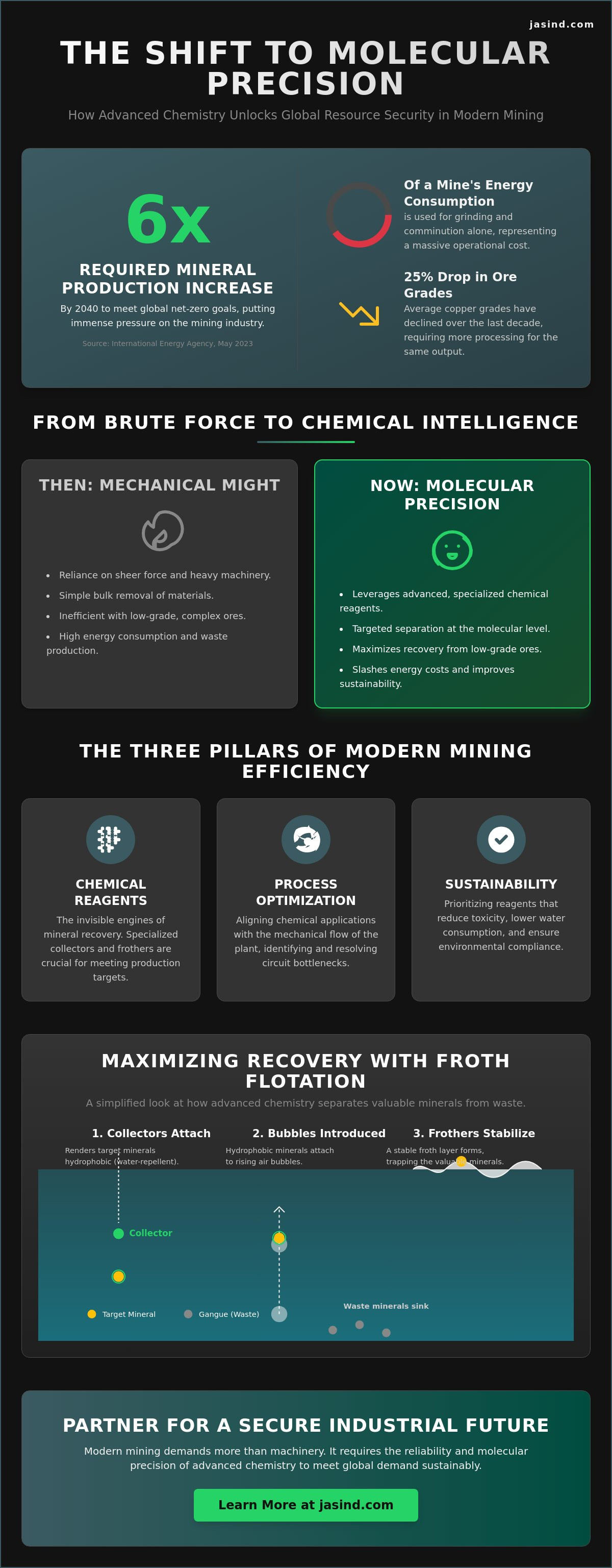
The International Energy Agency reported in May 2023 that reaching global net-zero goals requires a sixfold increase in mineral production by 2040. This staggering demand puts immense pressure on an industry already struggling with declining ore grades and complex mineralogy. For modern operators, the search for efficient mining solutions is no longer just about quarterly profit; it's about global resource security. Manufacturing relationships and distributing quality means looking beyond the immediate extraction process to the long-term health of our planet's foundational industries.
You likely recognize that grinding and comminution alone account for up to 40% of a mine's total energy consumption. It's a massive drain on operational budgets when recovery rates remain stagnant despite rising costs. This article demonstrates how specialized chemical formulations optimize mineral recovery, slash energy expenses, and ensure strict compliance with international tailings regulations. We'll examine the specific chemical additives that turn these operational challenges into sustainable competitive advantages while protecting the communities we serve. Discover how advanced chemistry provides the reliability and stability required for a more secure industrial future.
Key Takeaways
- Learn how the transition to molecular precision is redefining mineral processing by integrating advanced reagents with industrial hardware.
- Discover how tailored chemical suites optimize froth flotation to maximize the recovery of essential minerals like phosphate and potash.
- Explore how specialized mining solutions significantly reduce energy costs during comminution by preventing particle re-agglomeration.
- Gain insights into sustainable tailings management and gas treatment strategies that ensure environmental compliance and operational safety.
- Understand the strategic value of long-term technical partnerships in safeguarding global resource security and manufacturing excellence.
The Evolution of Mining Solutions: Beyond Machinery to Molecular Precision
Industrial extraction used to be a matter of sheer force. Today, it's a matter of chemical intelligence. Over the last 25 years, the industry has pivoted from simple bulk removal to a sophisticated model of molecular precision. This shift is driven by the reality that the world's easiest-to-reach resources are largely exhausted. Modern operators must now find ways to extract value from lower-grade ores that were once considered waste. Mining solutions represent an integrated approach to mineral recovery that combines specialized chemical reagents, mechanical infrastructure, and expert technical consulting.
This evolution transforms the mine site from a heavy industrial zone into a high-tech laboratory. Chemical intelligence now acts as the primary driver of profitability. It's no longer enough to move earth; you must understand the specific mineralogy of every ton. By applying advanced chemistry at the point of separation, companies can unlock margins that machinery alone cannot reach. This precision also serves a higher purpose. At JAS Global Industries, we view these advancements as essential pillars for global food and water security, as they provide the raw materials necessary for fertilizers and desalination infrastructure.
The Three Pillars of Modern Mining Efficiency
- Chemical reagents: These are the invisible engines of mineral recovery. In the froth flotation process, specific collectors and frothers determine whether a site meets its production targets or operates at a loss.
- Process optimization: Efficiency requires more than just high-quality additives. Technical audits identify circuit bottlenecks, ensuring that chemical applications align perfectly with the mechanical flow of the plant.
- Sustainability: High yields must coexist with safety. Modern mining solutions prioritize reagents that reduce toxicity and water consumption, meeting the rigorous environmental standards of the 21st century.
Why Mining Chemicals Matter in 2026
By 2026, the challenge of declining ore grades will reach a critical threshold. Data from major global operations shows that average copper grades have dropped by approximately 25% over the last decade. This decline forces mines to process significantly more material to achieve the same output. Advanced collectors and frothers are the only way to maintain economic viability under these conditions. They allow for the selective recovery of minerals from complex, low-grade deposits that traditional methods would miss.
The impact extends to the corporate carbon footprint. Technical chemical intelligence reduces the energy required for grinding and crushing, which accounts for a massive portion of a mine's total power consumption. By improving separation efficiency at the molecular level, we help partners reduce their environmental impact while securing the resources the world depends on. We don't just manufacture chemicals; we distribute the quality and reliability required to sustain modern civilization.
Maximizing Mineral Recovery Through Advanced Flotation Chemistry
Efficiency in mineral recovery isn't just a corporate goal. It's a requirement for global resource security. Froth flotation sits at the center of this mission. At its molecular core, this process relies on the precise interaction between chemical reagents and mineral surfaces. Success depends on the ability to manipulate surface tension and particle hydrophobicity with absolute certainty.
Collectors attach to target minerals, rendering them hydrophobic. This allows particles to cling to air bubbles. Frothers then stabilize these bubbles, creating a robust froth layer for transport. Modern advanced chemical extraction methods ensure that even low-grade ores become viable sources of critical materials. These mining solutions turn geological challenges into industrial opportunities by focusing on molecular precision.
Selectivity determines the difference between profit and waste. By utilizing tailor-made depressants and activators, operators can effectively suppress gangue minerals. This precision reduces tailings volume by up to 15% in specific complex ore bodies, directly improving the purity of the final concentrate. It's a steady, logical approach to resource management that prioritizes long-term value over short-term volume.
Specialized Solutions for Phosphate and Potash Mining
Phosphate recovery faces constant hurdles from silicate and carbonate impurities. Managing these requires specific pH modifiers and custom collectors that ignore the waste while capturing the value. In potash mining, the focus shifts to flowability and grade. JAS Global Industries optimizes frothers to ensure potassium salts remain stable throughout the circuit. These custom formulations adapt to regional geological profiles, providing stability where standard reagents fail. We focus on the foundational needs of society by securing the raw materials for global food production.
Selecting the Right Flotation Reagents
Successful mining solutions require a balanced chemical suite tailored to the specific ore mineralogy. The right combination of reagents ensures the highest possible recovery rates while maintaining the required grade for downstream processing.
- Collectors: These molecules selectively coat target minerals. They create the water-repellent surface needed for bubble attachment and lift.
- Frothers: These chemicals control bubble size and stability. Uniform bubbles are essential for transporting heavy mineral loads to the surface without premature collapse.
- Depressants: These agents effectively suppress gangue minerals. They increase final product value by ensuring impurities remain in the waste stream.
High-performance chemistry builds the foundation for sustainable industrial success. Discover how our team is manufacturing relationships and distributing quality through expert chemical consultation and global logistics.
Solving the Energy Crisis in Comminution: The Role of Grinding Aids
Comminution represents the single greatest energy sink in modern mining. It typically accounts for 50% of a mine’s total energy consumption and roughly 3% of global electricity usage. This inherent inefficiency threatens both corporate profitability and global resource security. Grinding aids offer a sophisticated chemical path to efficiency. These specialized additives prevent particle re-agglomeration, a common phenomenon where fine particles fuse back together under the intense pressure of the mill. By maintaining particle separation, these mining solutions ensure that mechanical energy is spent on fracturing fresh rock rather than re-grinding clusters.
Quantifying the return on investment is straightforward. Strategic chemical application can reduce energy consumption by 5% to 15% per ton of processed ore. For a site processing 50,000 tons per day, a 10% reduction in kilowatt-hours per ton translates to substantial annual savings and a significantly lower carbon footprint. It's a shift from brute force to chemical precision.
Enhancing Throughput and Reducing Energy Consumption
Chemistry alters slurry rheology. By lowering the viscosity of the pulp, grinding aids allow for higher solid loadings without sacrificing flow. This means operators can increase mill capacity without spending millions on new hardware or expanding the physical footprint of the plant. JAS Global Industries ensures these additives are selective. They don't interfere with downstream flotation or leaching processes. This technical precision prevents recovery losses while maximizing mill speed and throughput.
- Reduced Ball Coating: Prevents ore from sticking to grinding media.
- Improved Slurry Flow: Enables faster discharge from the mill.
- Selective Action: Maintains the integrity of downstream chemical reactions.
Technical Consulting for Process Optimization
Success depends on precision. A generic approach fails because every ore body has unique mineralogy and hardness. On-site laboratory testing and technical audits are necessary to identify the optimal dosing strategy for specific grinding circuits. These audits also address mechanical wear. Proper chemistry reduces the abrasive impact on mill liners and grinding media, extending the life of critical infrastructure. Grinding aids directly impact a mine’s operational reliability by stabilizing the circuit and preventing unplanned downtime caused by mill overloads.
Reliable mining solutions require a partnership that extends beyond the chemical drum. It involves constant monitoring and adjustment to account for ore variability. By integrating advanced chemistry with technical expertise, mines can transform their most energy-intensive process into a streamlined, sustainable operation.
Environmental Stewardship: Tailings Management and Gas Treatment
Sustainable operations aren't just about compliance; they're about survival. JAS Global Industries views environmental protection as a pillar of global water security. Effective mining solutions must address the waste generated during extraction to ensure long-term site viability. Protecting the surrounding ecosystem requires a disciplined approach to chemical application and waste processing.
Advanced Flocculants for Water Recovery
Solid-liquid separation is a precise science that determines the efficiency of a mine's water cycle. High-performance flocculants aggregate fine particles into larger masses, allowing them to settle rapidly in thickeners. This process increases the solids density in tailings storage facilities (TSFs), which can reduce the physical footprint of waste by up to 40% compared to untreated slurry. In arid regions like Riyadh or Dubai, where water is a scarce resource, reclaiming process water is a mission-critical objective. Modern chemical treatments allow mines to recycle more than 90% of their process water, directly contributing to regional water security and reducing the reliance on local aquifers.
Managing Odor and Toxic Gas Emissions
Safety depends on the air workers breathe and the environment communities share. Hydrogen sulfide (H2S) is a lethal byproduct found in many mining circuits, requiring immediate neutralization. Effective H2S treatment strategies involve neutralizing these toxic gases at the source through specialized chemical scavenging agents. These mining solutions ensure that gas levels remain well below the 10 ppm exposure limits set by international safety organizations.
- Bio-based suppressants: These offer natural alternatives for operations near sensitive ecosystems or populated areas.
- Chemical scavenging: Rapid neutralization agents for high-concentration areas to prevent equipment corrosion and health risks.
- Regulatory compliance: Meeting WHO air quality guidelines protects both staff and the brand’s social license to operate.
A comprehensive chemicals management plan serves as the final safeguard for any modern operation. It ensures that every additive is tracked, handled, and neutralized properly. This structured approach prevents groundwater contamination and ensures 100% compliance with international environmental standards. By treating chemicals as assets rather than just consumables, mines can achieve a balance between high-yield production and ethical stewardship. Our 25-year history in the industry proves that responsible chemistry is the foundation of industrial stability.
Partnering for Global Resource Security: The JAS Global Perspective
JAS Global Industries operates on a philosophy that transcends simple transactions. We believe in manufacturing relationships. Distributing quality. Simple supply contracts often fail to address the volatile nature of mineral extraction. Long-term technical partnerships allow for deep integration between chemical engineers and site managers. This collaboration ensures that mining solutions are optimized for specific ore bodies rather than sold as generic commodities. We've spent twenty-five years refining this approach to ensure every client receives more than just a product.
Our commitment to distributing quality means ensuring consistent chemical performance across every global operation. Inconsistent reagents can cause a 5% to 8% drop in plant efficiency. We eliminate this risk through rigorous quality control and a robust logistics network. The "JAS Cares" initiative further distinguishes our work. It's our framework for ethical production and community impact. We don't just ship chemicals; we protect the ecosystems and communities where we operate. This focus on security extends to the global fertilizer industry. By improving the efficiency of phosphate and potash extraction, we're direct contributors to global food security.
We maintain a steady presence in the world's most demanding mining hubs. From the copper belts of Africa to the phosphate reserves in the Middle East, our network ensures that quality is never compromised by distance. This reliability makes us a "quiet giant" in the industry. We provide the foundational chemistry that keeps global resource supply chains moving without interruption. Our partners trust us to be the stable pillar in their industrial infrastructure.
Custom Formulations and Global R&I
Our research and innovation centers develop tailor-made reagents for diverse geological conditions. We serve operations across Africa, Asia, Europe, and the Middle East with localized expertise. In a recent project involving complex phosphate mining, our custom flotation collectors improved recovery rates by 12% compared to standard reagents. This specific adjustment reduced waste and maximized the value of the mineral asset. It's a clear example of how specialized R&I turns technical challenges into economic gains.
The Future of Sustainable Mining Chemistry
The industry's future lies in greener alternatives. We're investing heavily in biodegradable reagents and low-toxicity formulations that minimize environmental footprints. Efficiency now includes "smart" dosing systems integrated with real-time plant data. These systems adjust chemical application instantly based on ore grade fluctuations. It's a move toward precision mining that reduces cost and chemical waste. These advancements ensure that high-performance mining solutions remain compatible with global sustainability goals.
Securing the Future of Global Resources
The industry's shift from heavy machinery to molecular precision defines the next era of resource extraction. Modern operations now rely on advanced flotation chemistry and grinding aids to maximize mineral recovery while reducing energy consumption in comminution. These innovations aren't just about efficiency; they're about long-term survival and stewardship. Since 1998, JAS Global Industries has led this transition, providing specialized mining solutions across the Middle East, Africa, and Europe. Our 25 years of industrial expertise ensure that every chemical additive serves a dual purpose: operational excellence and global security.
Through our proprietary JAS Cares designation, we prioritize social and environmental responsibility in every manufacturing plant and R&I center we operate. We've spent over two decades refining these processes to ensure they meet the rigorous demands of modern infrastructure. The path to a sustainable mineral future requires a partner who understands the delicate balance between industrial demand and planetary health. We're ready to help you navigate these complexities with precision and purpose. Explore our range of specialty mining chemicals and technical services to see how we can strengthen your operations today.
Frequently Asked Questions
What are the most common types of mining chemicals used in flotation?
The primary chemicals used in flotation include collectors, frothers, and modifiers. Collectors like xanthates or dithiophosphates attach to valuable minerals to make them hydrophobic. Frothers like Methyl Isobutyl Carbinol (MIBC) stabilize the bubble layer for mineral recovery. These advanced mining solutions ensure that specific minerals, such as copper or gold, are separated effectively from waste rock. This process relies on precise chemical balances to maximize yield.
How do grinding aids actually reduce energy consumption in mining?
Grinding aids reduce energy consumption by preventing the re-agglomeration of fine particles during the milling process. Since comminution typically accounts for 40% of total site energy usage, these chemicals are vital for efficiency. They neutralize surface charges on mineral particles. This stops them from sticking to the grinding media and allows mills to process more ore per hour while using less electricity.
Can custom chemical formulations be developed for unique mineral profiles?
JAS Global develops site-specific chemical formulations tailored to the unique mineralogy of individual ore bodies. We've spent 25 years refining our laboratory testing protocols to solve complex metallurgical challenges. Our team analyzes the chemical composition of your specific mineral profile to create a custom blend. This precision ensures that our mining solutions deliver the highest possible recovery rates for your unique and complex operation.
Why is H2S treatment necessary in modern mining operations?
H2S treatment is essential because hydrogen sulfide gas is lethal to workers and destructive to industrial infrastructure. Concentrations as low as 100 ppm are immediately dangerous to life and health. Our chemical scavengers neutralize this gas, preventing sulfide stress cracking in steel pipelines and tanks. Protecting your personnel and your assets is a core part of our commitment to industrial security and reliability.
What is the role of flocculants in tailings management?
Flocculants accelerate the separation of solids from water by binding fine tailings into larger, heavier clusters called flocs. This process is critical for effective tailings management and water security. High-performance flocculants can increase water recovery rates by 90%, allowing mines to reuse process water in arid regions. By improving settling rates, these chemicals help operators minimize the footprint of their tailings storage facilities.
How does JAS Global ensure the sustainability of its mining solutions?
Sustainability is integrated into our operations through the JAS Cares initiative and the development of biodegradable chemical additives. We focus on reducing the environmental footprint of resource extraction by optimizing chemical dosages. Our technical teams help clients reduce chemical consumption by 15% through precise application strategies. We're committed to protecting global water security while supporting the essential industries that build modern society.
What industries benefit most from phosphate and potash mining chemicals?
The agricultural and fertilizer industries are the primary beneficiaries of phosphate and potash mining chemicals. These minerals are essential components for global food security, supporting the nutritional needs of 8 billion people. Our chemistry improves the grade and recovery of these vital nutrients during processing. By manufacturing relationships and distributing quality, we ensure that these resources reach the global markets that depend on them.