


What if the additive with the lowest purchase price carries the greatest operational cost? Building a business case for premium chemical additives means looking beyond the invoice to the factors that shape total value, including product handling, process interruptions, and consistency. These effects can be difficult to separate from normal production variation, and finance and operations teams may measure success differently.
That doesn’t make the decision subjective. It makes a transparent method essential. Start with site-specific data, compare the full cost of current and proposed approaches, and define success before a trial begins. For fertilizer anti-caking applications, build the case from observed site conditions and agreed measurements, not assumed performance.
This article explains how to create a practical value model, design a controlled trial, and present a decision-ready recommendation. It covers how to align operational and financial criteria, account for risks and assumptions, and interpret results carefully. The goal is a disciplined decision grounded in evidence, whether the conclusion supports a premium additive or not.
Key Takeaways
- Define the business case around expected value, full operating costs, risks, and alternatives, not purchase price alone.
- Choose measures tied to the production challenge, such as flowability, handling interruptions, or material loss.
- Compare additives under equivalent process conditions and make assumptions about dosage, handling, and performance evidence explicit.
- Set a trial plan with agreed success criteria and a clear decision gate before testing begins.
- Use building a business case for premium chemical additives to align technical evidence and financial evaluation in a concise recommendation with clear owners.
Why Build a Business Case for Premium Chemical Additives?
A higher unit price is easy to see. An additive’s operational effects are harder to capture on a purchase order. A business case makes the decision more complete: it documents expected value, full costs, risks, and alternatives, then shows how the evidence supports a choice. This structured approach to building a business case helps technical and financial teams assess the same decision using clear assumptions and relevant measures.
Lifecycle value is the combined effect of an additive’s costs, operational contribution, and risks across the process where it is used. This definition sets the scope of the evaluation without presuming savings or improved performance. Purchase price alone can miss costs or consequences related to dosing, handling, product quality, interruptions, or process reliability. Measure these effects with site records rather than treating them as guaranteed benefits.
What makes a chemical additive premium?
“Premium” describes a buying proposition, not proof that one additive performs better in every plant. Compare formulation fit, technical support, supply continuity, and the quality of available performance evidence alongside unit price. The importance of each depends on the material, process conditions, plant requirements, and buyer priorities. For a fertilizer anti-caking additive, evaluate how well the formulation fits the site’s actual conditions rather than assuming a result.
A formulation tailored to a particular application may be worth evaluating, but its business value still depends on evidence relevant to the intended use. Technical consulting, process audits, and on-site laboratory testing can help teams examine site conditions and assess evidence. State what is known, what remains a hypothesis, and how each open question will be tested.
Which business problem should the case address?
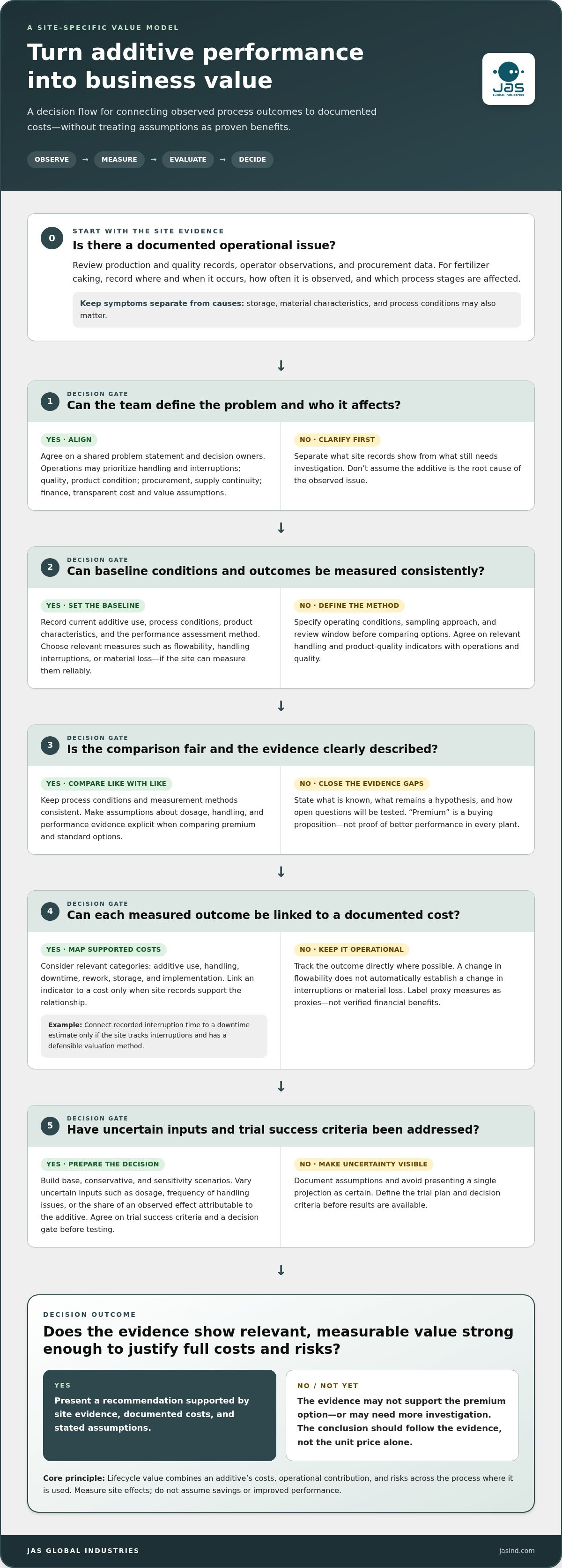
Start with a documented operational issue. If fertilizer caking affects handling or flow, record where and when it occurs, how often it is observed, and which process stages are affected. These are symptoms, not proof that the additive is the root cause. Storage conditions, material characteristics, and process conditions may also matter. Separate what site records show from what the team still needs to investigate.
Build a shared problem statement from the site’s evidence. Review production and quality records, operator observations, and procurement data. Then identify the teams affected and the people who own the decision. Operations may focus on handling and interruptions; quality may prioritize product condition; procurement may assess supply continuity; finance needs transparent assumptions about costs and value. Agreeing on the problem first keeps the case focused and makes later comparisons more meaningful.
Building a business case for premium chemical additives is not an argument for choosing the higher-priced option. It is a documented method for deciding whether the proposed value is relevant, measurable, and strong enough to justify the risks and full costs at a specific site.
How to Translate Additive Performance into Business Value
A useful value model follows a clear chain: establish what happens now, measure the outcome that matters, connect that outcome to documented costs, then test how sensitive the conclusion is to uncertain inputs. This separates observed process changes from financial estimates and makes assumptions visible to operations and finance.
- Define the baseline. Record current additive use, process conditions, product characteristics, and the method used to assess performance. Use representative site records and note operating factors that could affect the comparison.
- Select operational measures. Choose indicators that address the documented problem. For fertilizer anti-caking, these might include flowability, handling interruptions, or material loss, provided the site can measure them consistently.
- Map measures to costs. Link an indicator to a cost category only when records support the relationship. For example, connect recorded interruption time to a downtime estimate only if the site tracks the interruption and has a defensible method for valuing it.
- Test the assumptions. Build base, conservative, and sensitivity scenarios. Vary uncertain inputs, such as dosage, frequency of handling issues, or the share of an observed effect attributable to the additive. Don’t present a single projection as certain.
Choose measures that reflect the process
Set the measurement method before comparing options. Specify operating conditions, sampling approach, and review window, then keep them consistent so changes in results aren’t simply changes in when or how data was collected. Operations and quality teams should agree on relevant handling and product-quality indicators. Choose a manageable set that can be recorded reliably during normal work.
Interpret measures in context. A change in flowability, for instance, may matter operationally, but it doesn’t automatically prove that handling interruptions or material loss will change. Track each outcome directly where possible. If an indicator is only a proxy, label it as such rather than treating it as a verified financial benefit.
Model total cost and value transparently
Map the comparison across relevant categories: additive use, handling, downtime, rework, storage, and implementation. Include only costs the site can substantiate, and document the source, period, and calculation for each input. Total cost of ownership can organize costs over the evaluation period; net present value may help compare effects over time when the necessary inputs and assumptions are stated clearly.
Measured performance describes what the process did; modeled financial value estimates what that measured change may mean in cost terms. Keep these separate in the analysis. A base case, a conservative case, and sensitivity tests show how the recommendation shifts when uncertain assumptions change. Technical process audits and on-site laboratory testing can support site-specific evaluation. Technical process audits can help teams examine the conditions behind their data.
How to Compare Premium and Standard Additives Fairly
A credible comparison tests whether each option can meet the same functional need under comparable conditions. Comparing unit purchase prices alone can mislead: an additive used at a different rate or producing a different result isn’t an equivalent basis for decision-making. Building a business case for premium chemical additives means comparing options against shared criteria and evidence that reflects the site’s operation, not favoring a price tier.
Use a comparison table to make the basis of the decision visible. Apply the same process conditions, material characteristics, functional outcomes, and evaluation assumptions to each option. For fertilizer anti-caking, define the relevant handling or flow outcome before comparing products. Measure the result under the conditions the site intends to use rather than assuming either option will improve it.
Set fair comparison criteria
Agree on the operating envelope and performance thresholds first. Record relevant production conditions and material characteristics, then clarify which outcomes count as acceptable. Separate supplier-provided technical information from data measured at the site. Both can inform the assessment, but they serve different roles: supplier information describes the evidence provided, while site measurements show what happened under local conditions.
Keep the comparison practical. Include dosage and use rate, application and handling requirements, performance evidence, implementation effort, and operational fit. A tailored formulation or technical support may be relevant, but neither replaces a defined performance measure. For each option, note the evidence source and any assumptions used.
- Process basis: Material, operating conditions, and evaluation method held consistent.
- Functional outcome: The same quality or handling threshold applied to both options.
- Use and implementation: Dosage, handling requirements, and any site effort recorded.
- Evidence and supply: Site data distinguished from supplier information, with supply considerations documented.
- Operating impact: Cost categories linked to outcomes only where site records support the connection.
This structure shows why purchase cost cannot stand alone. A lower unit price may not mean a lower total operating impact if the required use rate, handling needs, or measured functional result differs. Conversely, a higher-priced option isn’t automatically better. Its case depends on relevant evidence and the site’s priorities.
Account for uncertainty and procurement risk
Make assumptions visible. Document supply, quality, and process factors that could affect the decision, including conditions that differ between the comparison and routine operations. Procurement and operations can then identify which uncertainties could change the recommendation rather than treating them as settled facts.
Test key inputs across realistic ranges defined by the site. If the conclusion changes under a plausible variation in use rate, supply conditions, or measured outcome, show that sensitivity clearly. Avoid universal claims about premium or standard additives. A fair comparison produces a decision grounded in local conditions, not a general rule about price tiers.
How to Design a Trial That Can Support an Investment Decision
A trial should answer a decision, not simply generate activity. Before testing a fertilizer anti-caking additive, agree on the operational question, the evidence needed, and how the results will guide the next step. This makes the trial relevant to building a business case for premium chemical additives and reduces the risk of mistaking normal production variation for an additive effect.
Set success criteria with operations, quality, procurement, and finance before the trial begins. Operations can define process limits and practical constraints; quality can specify acceptable product measures; procurement can identify supply considerations; finance can clarify which documented costs matter to the investment decision. Agree on who records each measure and who makes the final decision.
Establish a usable baseline and trial plan
Document normal operating conditions, the existing additive practice, and relevant historical measurements. Then define the trial scope, sampling responsibilities, observation periods, and data-recording method. Keep the plan workable within production constraints. Before starting, set criteria for stopping if process or quality limits are reached, repeating if results are inconclusive, and progressing if agreed measures are met.
Use a written protocol to distinguish a change in additive practice from a change in the surrounding process. For example, record material characteristics and operating conditions alongside the selected handling or quality measures. Identify factors that may vary during the trial, such as storage or production conditions, and note how each will be monitored. Inconsistent sampling, short observation windows, or missing records can limit what the results support.
- Baseline: Capture current practice and relevant historical operating data.
- Scope: Specify where and under what conditions the trial will run.
- Measures: Assign owners and define sampling and recording methods.
- Controls: Record process conditions and variation that could affect results.
- Review: Compare observations with the baseline and assess data limitations.
- Decision gate: Apply the pre-agreed stop, repeat, or progression criteria.
Interpret results before scaling
Review results against the baseline while accounting for meaningful differences in material, operating conditions, and sampling. Separate what the trial directly measured from assumptions used to estimate financial value. If data is incomplete or variation makes the result uncertain, state that clearly. A promising result may justify a limited follow-up trial with tighter controls, not an immediate full-scale conclusion.
Technical audits and on-site laboratory testing can support evidence gathering by helping teams examine process conditions and evaluate samples. They don’t guarantee a particular result; the trial’s value still depends on clear measures, consistent records, and careful interpretation. Discuss a site-specific additive trial with JAS Global Industries’ technical team to structure an evidence-led evaluation.
Turn the Business Case into a Confident Additive Decision
A completed evaluation should end with a decision people can act on, not a collection of trial notes and spreadsheets. Bring the findings together in a concise, one-page case covering the operational problem, alternatives considered, evidence collected, economic analysis, material risks, and recommendation. For building a business case for premium chemical additives, clarity matters as much as the conclusion: readers should be able to see what supports the recommendation and what remains uncertain.
Present a decision-ready recommendation
State the recommendation plainly. Explain the strength and limits of the evidence, identify key assumptions, and disclose unresolved risks. Show how the conservative scenario affects the decision, not only the preferred case. If the recommendation depends on an assumption about operating conditions or measured performance, make that dependency visible so decision-makers know what could change the outcome.
Turn the recommendation into an accountable plan. Assign an owner to each next step and set review points for post-implementation measurement. Use the same agreed operational indicators from the evaluation, with a named person responsible for gathering and reviewing the data. These checkpoints help confirm whether expected performance is observed under routine conditions and provide a basis for adjustment if results differ from the case.
- Technical validation: Confirm that the selected formulation and dosing approach align with the intended process conditions.
- Procurement review: Assess supply and purchasing assumptions used in the recommendation.
- Implementation: Coordinate operational changes and communicate responsibilities to affected teams.
- Post-adoption measurement: Track agreed indicators and compare actual results with the case assumptions.
Connect technical evaluation with ongoing support
A decision may also identify where further technical evaluation is useful. JAS Global Industries develops tailored formulations and provides technical consulting, process audits, on-site laboratory testing, and dosing-strategy support. These capabilities can help teams examine site conditions and support technical validation; they don’t replace transparent evidence or guarantee a particular operational or financial outcome. For application context, the fertilizer anti-caking agents guide explores the role of these additives in industrial flow.
Keep the final recommendation proportionate to the evidence. A well-supported decision may be to proceed, run a limited follow-up evaluation, or retain the current approach while gathering better data. Each is valid when it follows from the site’s agreed criteria, documented assumptions, and risk assessment.
For a site-specific discussion of formulation fit, process conditions, and technical evaluation, discuss a tailored chemical solution with JAS Global Industries. A clear business case gives the conversation a practical starting point: the problem to address, the available evidence, and the questions still to resolve.
Make the Next Decision Easier to Defend
The strongest additive decision is one your team can revisit as operating conditions change. Treat the business case as a working reference: keep assumptions visible, assign responsibility for follow-up, and update the evaluation when new site evidence becomes available. This discipline helps ensure building a business case for premium chemical additives supports not only an initial selection, but also a clear understanding of whether the decision remains appropriate over time.
If your team is preparing a site-specific evaluation, JAS Global Industries can bring technical perspective to the questions you’ve identified and help explore a tailored chemical solution. Start with the process challenge and the evidence your team needs to assess it.
Discuss a tailored chemical evaluation with JAS Global Industries and take the next step with a clear, evidence-led plan.
Frequently Asked Questions
How do you calculate the ROI of a premium chemical additive?
Calculate ROI by comparing the verified net benefit with the incremental investment over a defined period: (net benefit − incremental investment) ÷ incremental investment × 100. Use site data to estimate benefits and include relevant costs of additive use and implementation. Keep the period and production basis consistent between the current approach and proposed option. In building a business case for premium chemical additives, label estimates clearly and avoid counting the same operational effect in multiple cost categories.
What data should be included in a chemical additive business case?
Include records that connect additive use to the process outcome being assessed: production volume, dosage, operating conditions, quality measurements, handling observations, and the dates or batches covered. Note where each data point came from, who recorded it, and whether it was measured or estimated. For example, distinguish an operator’s record of a handling interruption from a later financial estimate of its impact. This makes gaps visible and helps reviewers judge how much confidence to place in the analysis.
How can you prove a premium additive performs better?
Show that it meets a relevant performance threshold more consistently or produces a better measured outcome under comparable site conditions. Use a defined comparator, consistent sampling, and objective measures selected before testing. For instance, a fertilizer anti-caking trial could assess the site’s agreed flow or handling measure across comparable material and operating conditions. Report variation and limitations alongside the result. A supplier claim alone, or a single favorable observation, doesn’t establish better site performance.
Should a business case include total cost of ownership?
Yes, if the decision could affect costs beyond the additive’s purchase price. Define the evaluation period and include relevant costs such as use, handling, implementation, storage, or quality-related work when site records support them. Avoid including sunk costs that won’t change with the decision, and don’t count one effect twice under different labels. A transparent total cost of ownership view helps compare alternatives consistently without implying that every cost category applies to every plant.
How do you reduce risk during a chemical additive trial?
Reduce trial risk by limiting the scope to an approved process window and agreeing on operating and quality limits before testing. Assign clear responsibilities for dosing, sampling, recordkeeping, and escalation. Keep batch or production records alongside samples so results can be traced to the conditions under which they were collected. A defined stop procedure protects the process if conditions move outside the agreed limits. These controls improve evidence quality, though they can’t eliminate all operational uncertainty.
Who should approve a premium chemical additive business case?
Approval should involve the people accountable for the technical outcome, product quality, procurement, and budget, with final authority set by the organization’s own governance. Operations can assess process fit, quality can review product acceptance, procurement can evaluate purchasing and supply assumptions, and finance can examine the economic model. Identify one decision owner to consolidate input and record the approval or conditions. This prevents a technically sound recommendation from advancing without the operational or financial review it needs.
When should a chemical additive trial be repeated?
Repeat a trial when results can’t support a reliable decision, such as when sampling was incomplete, operating conditions changed materially, or an equipment or dosing deviation affected the comparison. First document what made the evidence inconclusive and adjust the protocol, measurement method, or controls. Don’t repeat testing simply to seek a more favorable result. If the original trial clearly met its agreed criteria and conditions were representative, a repeat may add little decision value.