

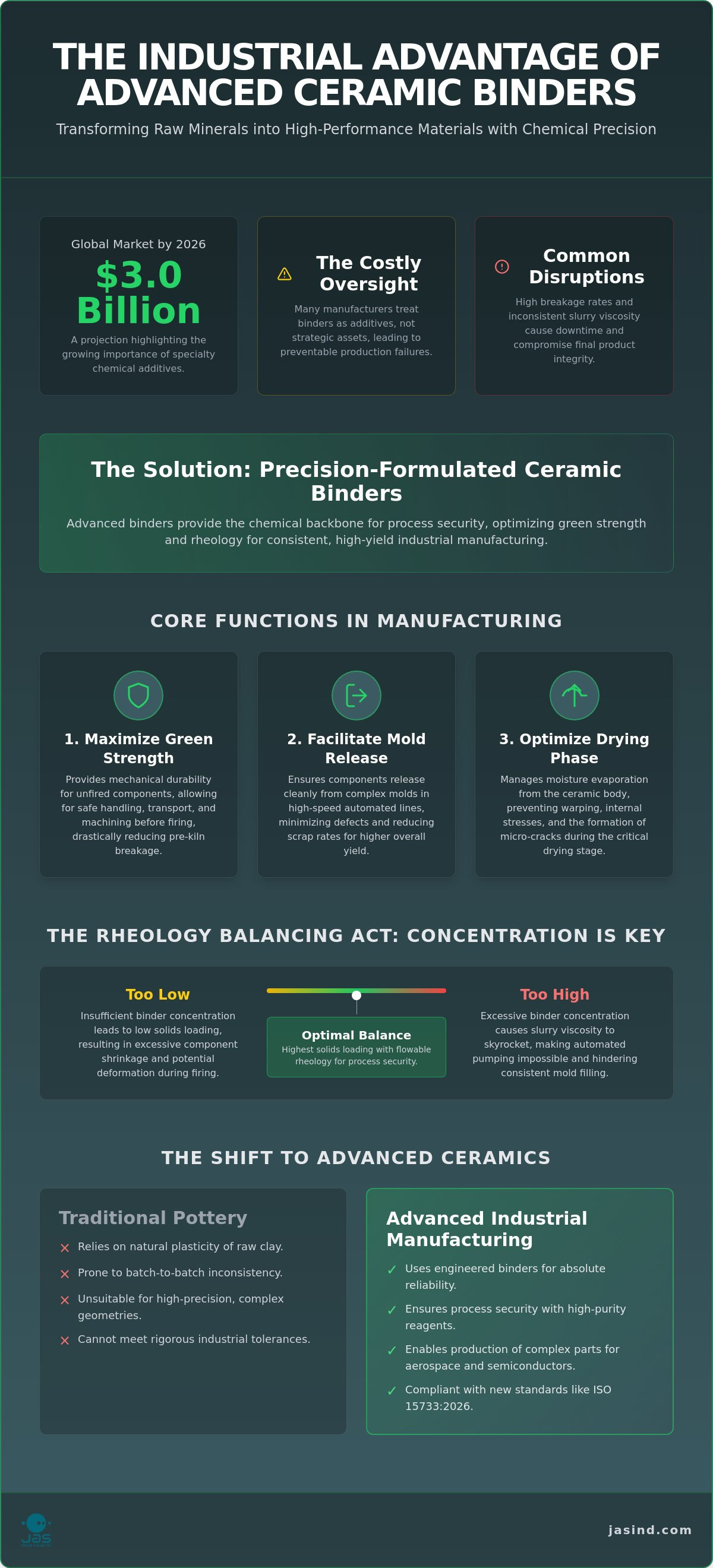
By 2026, the global market for ceramic binders is projected to reach $3.0 billion, yet many manufacturers still treat these essential additives as secondary ingredients rather than strategic assets. It's a costly oversight. You understand the frustration of high breakage rates in unfired components. You've seen the production downtime caused by inconsistent slurry viscosity in your automated lines. These disruptions don't just affect your bottom line; they compromise the stability of the critical infrastructure your materials support.
This guide demonstrates how advanced Ceramic Binders optimize green strength and rheology to transform raw minerals into high-performance industrial materials. We'll examine the technical shift toward precision formulations that prioritize process security and yield. You'll discover how the latest innovations, including compliance with the new ISO 15733:2026 standards, allow for the structural integrity required in complex geometries. From mastering batch-to-batch consistency to enhancing your automated casting, we provide the roadmap to turning chemical precision into a reliable industrial advantage.
Key Takeaways
- Understand the molecular interactions between chemical additives and mineral surfaces to maximize component green strength.
- Master the transition from manual batching to automated dosing systems to ensure consistent industrial output and yield.
- Learn to identify chemical bottlenecks and the critical impact of water quality on long-term slurry stability.
- Discover how high-performance Ceramic Binders optimize rheology to reduce breakage rates in complex industrial geometries.
- Explore how site-specific formulations developed in global R&I centers provide a foundation for long-term process security.
What are Ceramic Binders in an Industrial Context?
In high-volume manufacturing, the margin for error is non-existent. Consistency is the pulse of automation. To achieve it, engineers rely on specialty chemical additives that provide structural stability long before a component enters the kiln. To understand the fundamental science behind these materials, one might ask: What is a Binder? In the context of industrial ceramics, these are temporary or permanent substances designed to hold mineral particles together during the formative stages of production.
There's a significant distinction between traditional clay plasticizers and modern chemical reagents. Traditional pottery relies on the natural plasticity of raw clay; however, industrial lines don't have that luxury. We use engineered Ceramic Binders to achieve a level of batch-to-batch reliability that nature simply cannot provide. For technical and advanced ceramics, the necessity of high-purity reagents is absolute. Even a trace amount of an unintended mineral can lead to catastrophic failure in a semiconductor or an aerospace component. By utilizing precisely formulated binders, manufacturers ensure process security and protect the integrity of the final product.
The Shift from Traditional Pottery to Advanced Ceramics
Raw clay alone cannot meet the rigorous tolerances of 2026 industrial standards. The publication of the ISO 15733:2026 standard for ceramic composites highlights a global move toward higher mechanical precision. Modern Ceramic Binders are now essential for the production of semiconductors, fiber optics, and aerospace tiles. These sectors demand materials that can withstand extreme environments without internal flaws. In this high-stakes environment, ceramic binders are the chemical bridge between raw powder and fired structural integrity. They provide the predictable foundation required for complex, high-precision geometries.
Key Functions of Binders in the Manufacturing Arc
The role of a binder extends far beyond simple adhesion. It's a strategic tool for operational troubleshooting. Key functions include:
- Maintaining Green Strength: Binders provide the mechanical durability needed for handling and transport before the firing process begins.
- Facilitating Mold Release: In high-speed production lines, binders ensure that components release cleanly from complex molds, reducing scrap rates.
- Optimizing the Drying Phase: By managing how moisture leaves the ceramic body, binders prevent warping and internal stresses that lead to cracks.
This chemical precision ensures that raw minerals are successfully transformed into the pillars of modern infrastructure. It's about more than just production; it's about the security of the global supply chain.
Chemical Mechanisms: How Ceramic Binders Enhance Green Strength
Achieving industrial-scale precision requires a deep understanding of molecular interactions. Ceramic Binders act as the structural framework within a green body, utilizing long-chain polymers to bridge the gaps between mineral particles. This isn't merely a physical coating. It's a complex process of surface adsorption where the binder molecules anchor themselves to the ceramic powder. This anchoring creates the mechanical interlocking necessary for handling unfired components without fractures. For a detailed Engineering Analysis of Binder Mechanical Properties, researchers often compare how different polymer backbones impact the final machinability of the green part.
Binder concentration directly dictates the feasibility of your production line. If the concentration is too high, slurry viscosity skyrockets, making automated pumping impossible. If it's too low, the solids loading, the actual amount of ceramic material in the mix, drops. This leads to excessive shrinkage during firing. Finding this balance is critical for process security. You're seeking the highest possible solids loading while maintaining a flowable rheology. This prevents sedimentation in storage tanks, ensuring that your raw materials remain in a stable, homogeneous suspension until they reach the mold.
Organic vs. Inorganic Binders: Selecting the Right Reagent
The choice between organic and inorganic reagents depends on your final performance requirements. Organic binders, such as cellulose ethers or acrylics, are the gold standard for technical ceramics. They provide high green strength and offer a residue-free burnout, leaving behind zero carbon contaminants. Conversely, inorganic binders are utilized when the additive must become a permanent part of the ceramic matrix, such as in high-temperature refractories. Your selection criteria must balance firing temperature, application method, and the target density of the finished part. For operations looking to refine these selections, our experts provide bespoke mining solutions that bridge the gap between raw extraction and refined manufacturing.
The Science of Slurry Stability and Rheology
Binders don't work in isolation. They function in tandem with deflocculants to manage electrostatic repulsion and steric hindrance. This partnership allows you to reach the "Goldilocks zone" of viscosity required for high-speed spray drying or precision slip casting. Without this chemical harmony, particles agglomerate, leading to structural weak points. It's a fact that binder distribution determines 90% of the final product’s microstructural uniformity. Mastering this distribution is the only way to ensure the long-term reliability and safety of materials destined for critical global infrastructure. By controlling the rheology at a molecular level, you protect your production yield and ensure the stability of the global resource supply chain.
Industrial Manufacturing vs. Studio Pottery: The Scalability Gap
Manual batching is a relic of the studio environment. In industrial settings, the reliance on craft is replaced by the necessity of chemical engineering. While a studio potter might adjust a mix by feel, high-volume manufacturing demands automated, high-precision dosing systems. These systems cannot accommodate the variance inherent in raw, untreated minerals. This is where Ceramic Binders become a strategic necessity. They provide the predictable rheology required for 24/7 production lines, ensuring that every component meets the same rigorous specifications. Precision isn't just a goal; it's a requirement for survival in a competitive global market.
Batch-to-batch consistency is the backbone of global supply chains. A single deviation in slurry viscosity can halt an entire production line, leading to significant downtime and financial loss. By utilizing advanced Ceramics Chemicals, manufacturers can align their output with modern ISO standards, including the mechanical precision requirements of ISO 15733:2026. This level of control is impossible with off-the-shelf retail products. It requires a dedicated focus on chemical purity and process security. When you eliminate chemical variance, you stabilize your entire manufacturing arc.
Ensuring Process Reliability in Mass Production
Retail binders often lack the purity needed for technical applications. Using them in a precision line is a gamble that rarely pays off. The cost of production downtime far outweighs the investment in specialty chemical reagents. Some manufacturers worry that custom formulations are too complex for their current setup. However, tailor-made binders are actually designed to simplify operations. They remove the guesswork. They eliminate the need for constant manual adjustments. This reliability is what transforms a volatile production line into a stable industrial asset, securing your yield and your reputation.
Environmental Compliance and Modern Chemical Management
The industrial landscape in 2026 is defined by sustainability. There is a growing demand for low-VOC and bio-based binders to reduce the carbon footprint of kiln operations. Integrating these additives into a comprehensive chemicals management plan is no longer optional. It's a regulatory and ethical requirement. Modern chemical management ensures that high-performance output doesn't come at the expense of environmental safety. Proper safety protocols for handling industrial-grade additives protect both the workforce and the surrounding community. This holistic approach to chemical security is what defines a responsible corporate leader. It's about protecting resources while driving industrial progress.
Process Optimization: Troubleshooting Common Production Defects
Operational excellence depends on a deep understanding of chemical bottlenecks. Technical audits allow engineers to identify exactly where process security is compromised. Often, the root cause of instability isn't the powder itself; it's the medium. Water quality plays a decisive role in the performance of Ceramic Binders. High concentrations of divalent cations, such as calcium or magnesium, can trigger premature polymer cross-linking. This destabilizes the slurry and leads to inconsistent solids loading. By implementing rigorous water treatment protocols, manufacturers protect their chemical investments and ensure long-term batch stability.
Binder migration is another critical hurdle in high-speed lines. As moisture evaporates during the drying phase, dissolved binder molecules often travel toward the component's surface. This results in a hard outer shell and a weak, powdery interior. To eliminate this defect, engineers must optimize dosing and control drying kinetics. Monitoring rheological parameters in real-time allows for immediate adjustments. This proactive approach prevents batch loss. It ensures that the structural integrity of the component remains uniform throughout its geometry. For organizations seeking to refine their production lines, our team provides expert operational troubleshooting and custom chemical audits.
Solving Structural Integrity Issues
Warping and cracking are frequently the result of an unbalanced binder-to-solid ratio. If the binder concentration is too high, the internal stresses during drying become unmanageable. Conversely, low concentrations fail to provide sufficient green strength. Settling in large storage tanks is another common failure point. Specialized dispersants and deflocculants must be used to maintain a homogeneous suspension. Chemical testing prevents the majority of common firing-induced fractures. By validating the interaction between reagents and minerals before the kiln stage, you secure your production yield.
Binder Requirements for Advanced Processing
Modern manufacturing requires specialized formulations for emerging technologies. Specialty binders for 3D ceramic printing must possess unique thixotropic properties. They need to flow under pressure but set instantly upon deposition. This differs significantly from traditional extrusion or slip casting. Fast-firing kiln cycles demand binders with high thermal decomposition rates to prevent bloating. The integration of AI-driven dosing systems further enhances process security. These systems analyze real-time slurry data to maintain the precise thixotropy needed for high-speed automation. This evolution in chemical management ensures that industrial infrastructure remains resilient and reliable.
Strategic Chemical Partnerships with JAS Global Industries
JAS Global Industries serves as a vital global guardian of resource efficiency, positioning itself as an indispensable pillar of modern industrial infrastructure. We understand that a supplier's role extends beyond the shipment of goods. It involves the protection of the client's entire manufacturing ecosystem. Our Dubai-based R&I centers are at the heart of this mission, developing site-specific mining solutions that account for the geological variances of raw minerals. By integrating advanced surfactant chemistry, we resolve the intricate rheology challenges that frequently disrupt automated casting lines. In the high-stakes environment of 2026, global supply contracts must offer more than just bulk pricing. They must provide localized technical support and a guarantee of batch-to-batch consistency. Our Ceramic Binders are engineered to provide this exact level of process security, ensuring that your raw materials are transformed with maximum efficiency and minimal waste.
Tailor-Made Formulations for Global Manufacturers
Every production facility has unique chemical signatures. Our collaborative process starts with a technical audit to identify specific bottlenecks in your current setup. From there, we move to custom binder formulation in our specialized laboratories. We recently assisted a large-scale sanitaryware producer in improving their yield by addressing specific structural integrity issues during the drying phase. By adjusting the binder's molecular weight and concentration, we eliminated common surface defects and internal stresses. We focus on the cost-to-performance ratio, ensuring that high-volume producers receive a reagent that adds significant value without inflating operational expenses. This tailor-made approach transforms a standard additive into a strategic asset.
Global Reach and Operational Reliability
Operational reliability depends on a robust logistics network. Our presence across the Middle East, Africa, Asia, and Europe ensures that your facility never faces downtime due to chemical shortages. We've established a worldwide network that prioritizes safety, stability, and ethical sourcing. This commitment to sustainability ensures that our industrial reagents meet the most stringent global standards. We don't just sell chemicals; we build long-term partnerships focused on the fundamental needs of society. Our role is to provide the chemical foundation for the world's most critical industries. Consult with our technical experts for your industrial ceramic binder needs to learn how we can protect your process security and enhance your production yield.
Securing the Future of Industrial Ceramics
The evolution of high-volume manufacturing demands a shift from traditional methods to engineered precision. You've seen how the right chemical framework stabilizes the manufacturing arc and protects the integrity of complex geometries. By mastering the rheology of your slurries and eliminating batch-to-batch variance, you don't just improve yield; you safeguard the resources essential to global infrastructure. Precision isn't optional for modern leaders. It's the standard for reliability in an increasingly demanding global market.
Since 1998, JAS Global Industries has acted as a vital global guardian for manufacturers worldwide. From our headquarters in Dubai, we operate a worldwide logistics network and global R&I centers dedicated to operational troubleshooting. We specialize in tailor-made formulations that turn Ceramic Binders into strategic process enablers rather than simple additives. It's time to move beyond off-the-shelf solutions and embrace the security of custom chemical engineering to protect your production goals.
Optimize your ceramic production with JAS Global Industries specialty chemicals and secure the long-term stability of your industrial output.
Frequently Asked Questions
What is the primary difference between organic and inorganic ceramic binders?
Organic binders burn out completely during the firing process, leaving a residue-free ceramic body. These reagents, such as cellulose ethers or acrylics, are preferred for technical ceramics where chemical purity is absolute. Inorganic binders remain a permanent part of the ceramic matrix and are typically utilized in refractories where they enhance long-term structural properties at extreme temperatures.
How do ceramic binders improve the green strength of unfired pieces?
Ceramic Binders create a mechanical bridge between mineral particles through molecular adsorption and polymer interlocking. This chemical network holds the raw powder together during handling, transport, and machining. By providing this temporary structural framework, binders prevent fractures and protect the integrity of the component before it reaches the kiln.
Can specialty binders reduce the energy consumption of ceramic kilns?
Yes, advanced formulations enable faster drying and more efficient firing cycles. Binders with high thermal decomposition rates allow moisture and organic matter to escape the ceramic body more predictably. This reduces the time required in the kiln and lowers the total energy expenditure, directly supporting the sustainability goals of modern industrial operations.
What are the most common chemicals used as binders in technical ceramics?
Industrial manufacturers rely on reagents like polyvinyl alcohol (PVA), polyethylene glycol (PEG), and various cellulose derivatives. For high-precision applications, acrylic polymers and bio-based resins are increasingly common. The selection depends on the specific rheology required for the production method, whether it's spray drying, extrusion, or 3D printing.
How does binder migration affect the quality of the final ceramic product?
Migration occurs when dissolved binder molecules travel toward the surface during the drying phase. This creates a hard outer shell and a weak, powdery core, leading to non-uniform density. These internal imbalances are the primary cause of warping, cracks, and surface defects during the firing stage, significantly reducing production yield.
What safety standards should be followed for industrial ceramics chemicals in 2026?
Operations must comply with the updated ISO 15733:2026 standards for fine ceramics and maintain rigorous GHS labeling protocols. Proper ventilation and personal protective equipment are essential when handling concentrated chemical reagents. Integrating these additives into a comprehensive chemicals management plan ensures both workforce safety and environmental protection.
How do JAS Global Industries’ R&I centers support custom ceramic formulations?
Our R&I centers conduct detailed technical audits to identify chemical bottlenecks and mineral variances in your production line. We develop site-specific Ceramic Binders that optimize the interaction between additives and raw minerals. This collaborative process ensures that every formulation is tailor-made to enhance process security and maximize your industrial yield.
Why is batch consistency critical for industrial-scale ceramic production?
Consistency is the foundation of automated manufacturing. Even minor chemical variances can cause slurry thixotropy to fluctuate, leading to pumping failures or mold release issues. Maintaining batch-to-batch reliability prevents costly production downtime and secures the stability of the global supply chain, ensuring that every component meets rigorous industrial tolerances.