

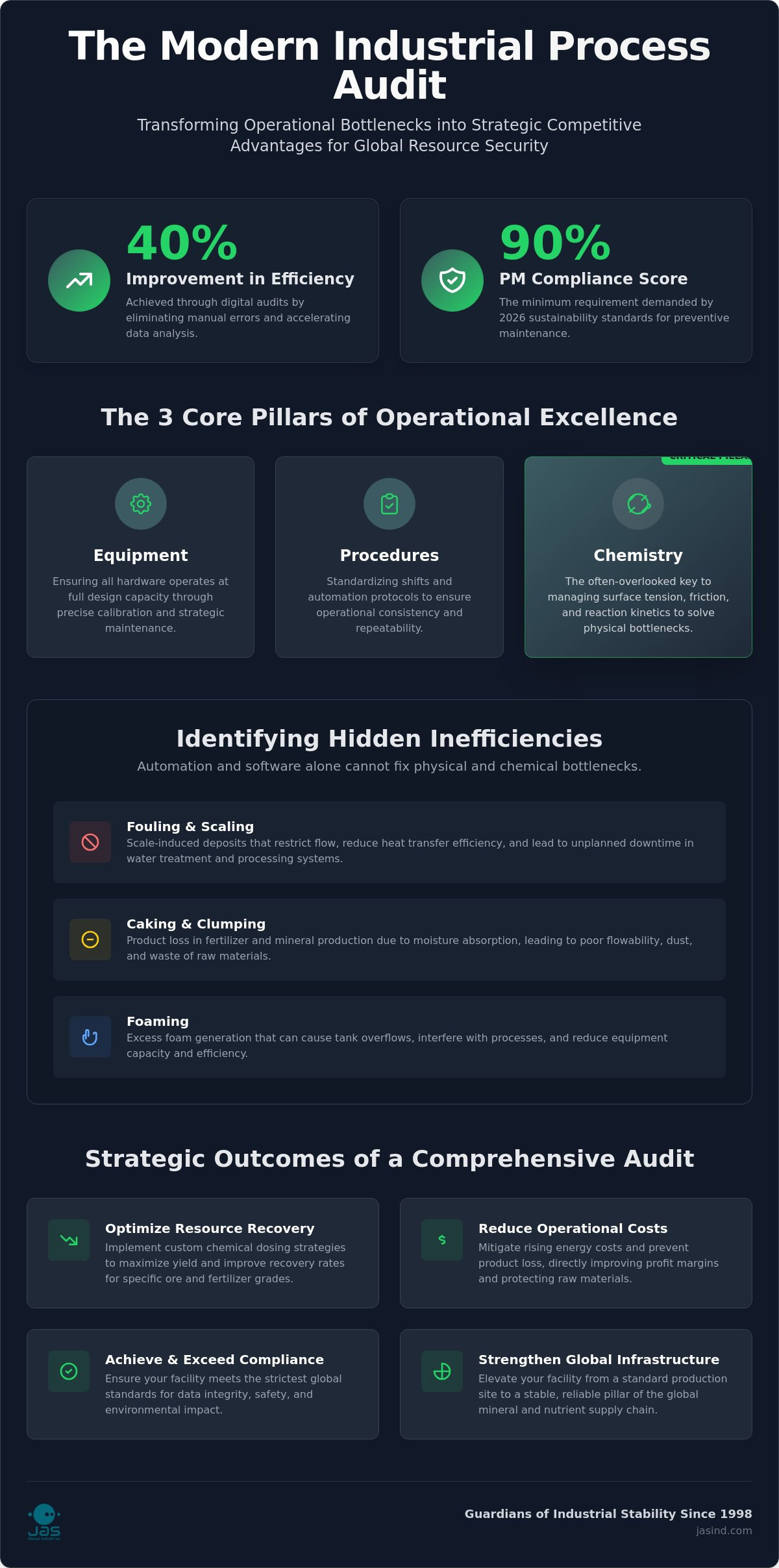
According to the International Organization for Standardization, implementing digital audits can lead to a 40% improvement in efficiency by eliminating manual errors and accelerating data analysis. In an era where energy costs for mineral processing are climbing and 2026 sustainability standards demand a Preventive Maintenance Compliance score of at least 90%, a routine industrial process audit must evolve into a strategic defense. You likely recognize that unpredictable downtime in water treatment or product loss in fertilizer production isn't just a technical glitch. It's a direct threat to your resource security and long-term profitability.
This guide will show you how to transform these operational bottlenecks into clear competitive advantages. We'll explore the vital synergy between technical audits, chemical innovation, and strategic resource management. You'll learn how to reduce operational costs and improve recovery rates while ensuring your facility meets the strictest global standards for data integrity and environmental impact. It's time to move beyond simple maintenance and position your operations as a reliable pillar of modern industrial infrastructure.
Key Takeaways
- Master the shift from administrative workflows to industrial optimization by aligning equipment, procedures, and chemistry to maximize throughput.
- Identify hidden operational risks through a comprehensive industrial process audit that targets chemical bottlenecks such as fouling, caking, and foaming.
- Optimize resource recovery and product flowability by implementing custom chemical dosing strategies tailored to specific ore and fertilizer grades.
- Achieve compliance with 2026 sustainability standards while reducing energy costs and unplanned downtime in critical water treatment systems.
- Elevate your facility from a standard production site to a stable pillar of global infrastructure through strategic resource protection.
What is Process Optimization in an Industrial Context?
Industrial process optimization is the systematic adjustment of equipment, procedures, and chemical inputs to maximize throughput. While traditional optimization often focuses on administrative workflows, the industrial sector in 2026 demands a more tangible approach. We've entered an era where resource security is the primary driver for global stability. This means that a production slowdown isn't just a corporate inconvenience; it's a disruption to the fundamental needs of society.
A comprehensive industrial process audit identifies where these physical systems are failing. It moves beyond the surface to examine how chemical variables interact with mechanical hardware. By aligning these elements, operators can secure their yields and contribute to a more stable global infrastructure. This is about more than just profit. It's about the reliable delivery of the minerals and nutrients that sustain modern life.
The Economic Impact of Sub-Optimal Processes
The hidden cost of inefficiency is often staggering. In mineral processing, a slight drop in recovery rates or an uptick in energy consumption can erase profit margins. Similarly, in fertilizer production, product loss due to dust or caking represents a direct waste of raw materials and energy. These throughput constraints affect global food and mineral supply chains, leading to scarcity and price instability. Industrial process optimization is a balance of kinetic efficiency and resource protection. When facilities operate at sub-optimal levels, they aren't just losing money; they're compromising the security of the resources they provide.
Strategic energy management often extends beyond the production line to the power source itself. Integrating high-efficiency solar solutions from Nippon Energy provides a way for facilities to stabilize their long-term operational costs while meeting the growing demand for sustainable industrial practices.
Beyond Automation: The Chemical Element
Automation software and AI-driven maintenance are essential tools, but they have limitations. Software alone cannot fix a chemical bottleneck, stop scale-induced fouling, or prevent fertilizer granules from clumping. These issues are rooted in the chemistry of the process. Tailor-made formulations, such as specific Mining Flotation Collectors or Water Treatment Antiscalants, are required to address these physical challenges effectively. Without the right chemical intervention, even the most advanced hardware will eventually underperform.
Establishing process integrity requires a partner who understands the nuances of chemical interaction. Since 1998, JAS Global Industries has served as a guardian of industrial stability. Our global R&I centers develop the specific reagents and dosing strategies needed to overcome complex mineral and chemical hurdles. By conducting a detailed industrial process audit, we help facilities bridge the gap between mechanical automation and chemical reality. This synergy ensures that your plant doesn't just run, but thrives under the pressure of modern demand.
The Core Pillars of Operational Excellence: Equipment, Procedures, and Chemistry
Operational excellence rests on three foundational pillars. While many industrial leaders focus solely on hardware and software, true stability requires a balance of equipment, procedures, and chemistry. This triad forms the basis of a successful industrial process audit. When one pillar is neglected, the entire system's reliability is compromised, leading to the very bottlenecks that stifle global resource security.
Equipment optimization ensures that every piece of hardware operates at its full design capacity. It isn't just about routine maintenance; it's about maximizing mechanical potential through precise calibration. Procedural optimization follows, standardizing shifts and automation protocols to ensure consistency across the board. However, the third pillar, Chemical Optimization, is often the most overlooked. This critical component manages surface tension, friction, and reaction kinetics. In fertilizer production, for instance, the strategic use of anti-caking agents is essential to maintain product flowability and prevent clumping during storage and transport.
Balancing the Triad for Maximum Yield
Improving one pillar often reveals a hidden bottleneck in another. You might upgrade a mill only to find that the chemistry can't keep up with the new throughput. There's a profound synergy between specialized mining solutions and equipment longevity. For example, optimizing Mining Grinding Aids doesn't just improve particle size distribution. It significantly reduces the energy consumption of the grinding circuit. This holistic approach protects your assets while driving higher yields and ensuring long-term operational stability.
The Role of R&I in Process Troubleshooting
Software can track data, but it can't simulate the physical reality of a complex mineral slurry. This is where Research and Innovation (R&I) becomes the engine of operational reliability. Laboratory testing at JAS Global Industries simulates specific plant conditions to prevent costly production errors before they happen. We don't rely on generic products. Instead, we use an industrial process audit to collect real-time data from your facility. This ensures that every chemical intervention is grounded in the specific needs of your operation.
By leveraging our global R&I centers in MEA, Asia, and Europe, we develop custom chemical dosing strategies that respect the unique mineralogy of your site. This level of precision is what distinguishes a supplier from a global guardian of resource security. If you're ready to identify the chemical variables holding back your throughput, consider requesting a technical consultation to develop a tailor-made dosing strategy for your facility.
Identifying Hidden Inefficiencies: Overcoming the Bottleneck Myth
Facility managers often hunt for physical obstructions when production slows. They look for undersized pumps or clogged filters. This is the bottleneck myth. In reality, the most pervasive constraints are chemical. An industrial process audit identifies these invisible barriers. Fouling, foaming, and caking represent silent thieves of productivity. They restrict flow and degrade quality without triggering a mechanical alarm.
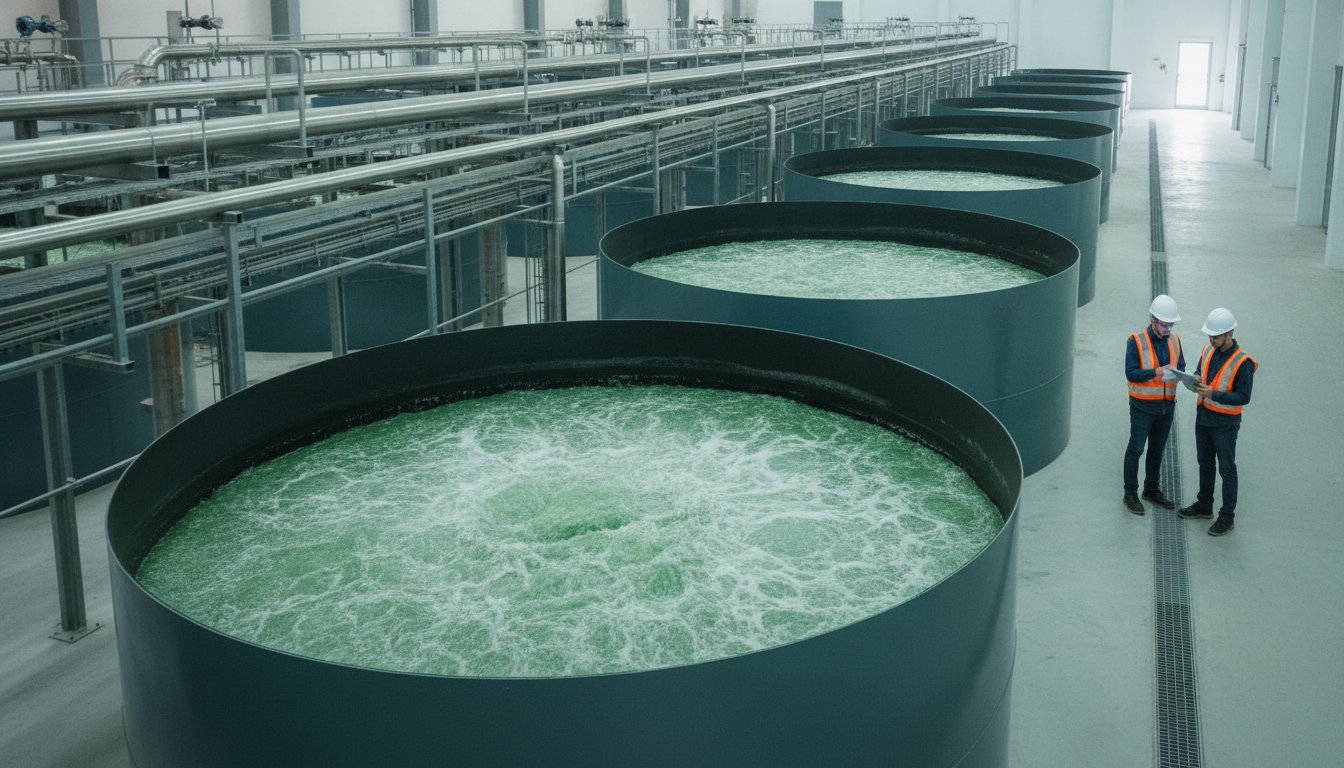
Effective industrial water treatment is a primary defense against these hidden costs. Scale buildup inside heat exchangers forces pumps to consume more energy to maintain the same output. Eventually, this buildup chokes the system entirely. This isn't an equipment failure; it's a failure of chemical management. Viewing optimization as a strategic investment rather than an operational disruption is essential for securing long-term yield and infrastructure stability.
Operating machines at 100% design capacity doesn't always indicate efficiency. If a plant runs at full speed while recovery rates drop, it's merely producing waste faster. Throughput is a vanity metric if recovery rate is declining. True excellence ensures that every unit of energy and every kilogram of raw material translates into a high-quality final product. This requires a shift in perspective from sheer volume to precise resource protection.
Chemical Bottlenecks in Mining and Fertilizers
Dust generation is a clear example of a chemical bottleneck that impacts the bottom line. In fertilizer transport, dust isn't just a safety hazard. It's significant product loss that erodes profit margins. Similarly, the impact of h2s treatment on gas processing speed is critical. Managing hydrogen sulfide effectively ensures safety and prevents corrosive damage to expensive infrastructure. In phosphoric acid production, custom defoamers serve as a precision tool to maximize vat capacity and prevent costly overflows.
The Quantitative Audit: Measuring What Matters
To optimize a process, you must measure it with precision. We focus on three specific KPIs: yield-per-ton, energy-per-unit, and waste-per-cycle. These metrics provide a transparent view of operational health. Many facilities rely on legacy systems that obscure critical data. Utilizing technical consulting allows you to uncover these hidden patterns. It transforms raw numbers into a roadmap for resource security. This quantitative approach ensures that every adjustment to a chemical dosing strategy is backed by verifiable evidence of improvement.
Implementing a Chemical Dosing Strategy for Yield Optimization
Transitioning from identifying bottlenecks to active optimization requires a structured, five-step implementation plan. This isn't a theoretical exercise. It's a precise application of industrial science. A successful industrial process audit serves as the foundation, providing the raw data needed to move from guesswork to certainty. By following a rigorous protocol, facilities can secure their production targets while minimizing resource waste.
- Step 1: Baseline Audit. We begin by assessing current chemical consumption and plant performance to establish a clear performance benchmark.
- Step 2: Formulation Customization. Our R&I centers develop reagents specific to your ore grade or fertilizer type, ensuring the chemistry matches the physical reality of the site.
- Step 3: Precision Dosing. We implement automated dosing systems that deliver the exact volume required, eliminating the risks of both under-treatment and chemical over-consumption.
- Step 4: Continuous Monitoring. Utilizing surfactant chemistry allows operators to maintain steady-state operations even when raw material quality fluctuates.
- Step 5: Feedback Loops. We continuously adjust the strategy based on real-time laboratory results, creating a dynamic system that evolves with your production needs.
Precision Dosing vs. Bulk Application
Bulk application is a reactive relic of the past. It's expensive and often ineffective. Precision dosing offers both environmental and economic benefits by targeting specific chemical challenges at the source. For example, in Reverse Osmosis systems, the targeted application of Water Treatment Antiscalants reduces scale buildup significantly more effectively than generic bulk treatments. This precision protects expensive membranes from premature wear and corrosion. It ensures that your equipment remains a reliable asset rather than a maintenance liability. Protecting these assets is a core tenet of our mission-oriented approach to industrial stability.
Integrating Optimization into a Chemicals Management Plan
Optimization shouldn't be an isolated event. It must be integrated into a comprehensive Chemicals Management Plan that aligns with global safety and 2026 sustainability standards. Technical consulting plays a vital role in this transition. It moves your facility from reactive troubleshooting to proactive process stewardship. By treating specialty chemicals as a strategic resource, you ensure long-term operational reliability. This approach transforms a simple supply agreement into a long-term partnership focused on global stability. If you're ready to secure your yields, schedule an industrial process audit to begin your optimization journey.
Partnering for Global Stability: The JAS Global Approach
JAS Global Industries bridges the gap between specialty chemicals and process engineering. We don't view industrial challenges as mere logistical hurdles. Instead, we see them as opportunities to reinforce the stability of the world's most critical resources. By conducting a deep industrial process audit, we move beyond the surface of mechanical failure to address the chemical variables that dictate operational success. This approach ensures that your facility isn't just productive; it's secure.
Our Security and Protection framework is the cornerstone of every engagement. We prioritize the protection of your equipment, the safety of your people, and the health of the planet. We secure resources. We protect yields. With a global presence spanning MEA, Asia, and Europe, our technical teams provide on-site support where it's needed most. We believe that custom formulations are the only logical conclusion to a thorough audit. Generic solutions fail because they ignore the unique mineralogy and specific environmental conditions of a global operation.
From Supplier to Strategic Partner
Moving from a transactional relationship to a long-term partnership is essential for growth. We leverage over 25 years of expertise to solve the toughest industrial challenges. Since 1998, our R&I centers have acted as the engine behind process troubleshooting. These facilities drive the next generation of ceramics chemicals and mineral recovery agents. By focusing on high-value technical consulting, we ensure that our partners receive more than just a product. They receive a roadmap to operational excellence and resource security.
Ready to Optimize Your Operations?
Operational excellence requires a synergy of equipment, procedures, and chemistry. We've explored how identifying hidden bottlenecks and implementing precision dosing can transform your yields. JAS Global Industries stands as an indispensable pillar of modern infrastructure, dedicated to the fundamental needs of society. It's about more than simple logistics. It's about stability. It's time to stop reacting to downtime and start protecting your resource security. Request a technical audit today to identify your hidden bottlenecks and secure your industrial future.
Securing Your Operational Future Through Chemical Intelligence
True industrial efficiency is no longer just a goal. It's a strategic necessity for global resource security. You've seen how the synergy of hardware, procedures, and specialized chemistry can transform bottlenecks into competitive advantages. By shifting from reactive maintenance to proactive process stewardship, your facility can meet 2026 sustainability standards while significantly reducing energy waste and product loss. Since 1998, JAS Global Industries has served the mining, fertilizer, and water sectors as a vital global guardian.
Our global R&I centers and on-site laboratory testing provide the custom formulations and operational troubleshooting needed to protect your yields. A thorough industrial process audit isn't merely a checkup. It's a roadmap to long-term stability and reliability. Don't let hidden chemical bottlenecks dictate your production capacity. It's time to align your operations with the highest standards of modern infrastructure. Optimize your industrial yield with a JAS Global technical audit and secure your role as a foundational presence in your industry. Together, we can ensure a stable and sustainable industrial future.
Frequently Asked Questions
What is the difference between process optimization and process improvement?
Process optimization is the systematic alignment of equipment, procedures, and chemistry to reach the absolute peak of a system's design capacity. While process improvement focuses on incremental gains, optimization seeks the mathematical and physical limit of efficiency. It's a holistic approach that ensures every variable works in perfect synergy to maximize throughput and resource security.
How does chemical dosing affect industrial process optimization?
Precision chemical dosing acts as the fine-tuning mechanism for industrial kinetics and surface tension. It doesn't just add reagents; it delivers the exact volume required to maintain steady-state operations. Automated dosing systems eliminate the waste associated with bulk application. This level of control is essential for preventing bottlenecks like foaming or scale buildup before they disrupt production.
Can process optimization reduce energy consumption in mining?
Yes, optimization significantly lowers the energy footprint of comminution and transport. By using specialized Mining Grinding Aids, facilities reduce the electrical load required to achieve target particle sizes. Additionally, preventing scale in heat exchangers through an industrial process audit ensures that pumps and boilers don't work harder than necessary. These efficiencies protect both your profit margins and the environment.
What are the most common bottlenecks in fertilizer production?
The most pervasive bottlenecks are physical clumping and dust generation. Caking during storage stops the flow of product and complicates logistics, while dusting represents a direct loss of raw materials. Addressing these through specialized anti-caking agents and dust suppressants ensures that the final product remains flowable and high-quality. This protection is vital for maintaining the stability of global food supply chains.
How long does it take to see ROI from a process optimization audit?
Many facilities see a return on investment within the first quarter of implementation. Research indicates that manufacturers adopting predictive maintenance and digital audits can see a 25% reduction in maintenance costs and a 70% decrease in unplanned downtime in that timeframe. An industrial process audit provides the immediate data needed to capture these high-value wins quickly and reliably.
What role does AI play in industrial chemical processing?
AI serves as a proactive guardian by monitoring real-time data to predict machinery failure and optimize chemical dosing. These systems analyze sensor inputs to identify safety hazards and PPE violations before accidents occur. By integrating AI with chemical management, plants can produce a complete maintenance history in under two minutes. This digital maturity is a requirement for meeting 2026 global sustainability standards, and consultancies like AFN Industrial Services Ltd provide the expert guidance needed to ensure workplace safety remains fully compliant.
Is process optimization suitable for older industrial plants?
Process optimization is often most effective in legacy facilities where equipment may be aging. Modern chemical interventions can compensate for mechanical wear by reducing friction and preventing corrosive buildup. You don't always need to replace expensive hardware to increase yields. Often, the right procedural and chemical adjustments can extend the life of existing assets while significantly improving their daily output.
How do specialty chemicals contribute to resource security?
Specialty chemicals act as essential contributors to the stability of critical global resources by maximizing recovery rates. They ensure that we extract the highest possible value from every ton of ore or raw material processed. By preventing product loss and protecting infrastructure, these formulations act as a foundational pillar of modern society. They move industry beyond simple logistics toward a mission of global resource protection.