
The closest supplier isn’t always the best fit for your fertilizer operation. When comparing fertilizer additive manufacturers in Europe, consider process compatibility, technical support and supply arrangements alongside location.
Search results can put additive specialists alongside fertilizer producers and industry directories, even though these organizations serve different purposes. Product descriptions may also leave out the process details needed to judge whether an additive is relevant to a particular operation. A useful shortlist starts with suppliers whose stated capabilities match your needs, then compares their technical and service support.
This guide explains how to distinguish additive manufacturers from adjacent organizations, match additive categories to operational challenges, and assess supplier fit, documentation and continuity. Use the criteria to build a focused shortlist around your process rather than geography alone.
JAS Global Industries supplies specialty chemicals for fertilizer operations, including anti-caking agents, dust suppressants, coloring agents and granulation aids. Its approach includes tailor-made formulations and technical consulting. The sections below offer a practical framework for assessing these capabilities against your requirements.
Key Takeaways
- Separate additive manufacturers from fertilizer producers, chemical suppliers, associations, and company directories before building a shortlist.
- Start with the production or handling challenge, then identify the additive capabilities that align with it.
- Compare fertilizer additive manufacturers in Europe by formulation fit, application knowledge, documentation, regional support, and supply continuity.
- Use a structured evaluation process to connect operational requirements with a supplier’s technical and service capabilities.
- Explore how tailored formulations and technical consulting can support process-specific fertilizer additive needs.
What European buyers should expect from fertilizer additive manufacturers
Search results for fertilizer additive manufacturers in Europe may include organizations with very different roles. Some make finished fertilizers, some supply chemicals used in production or handling, and others represent the sector or compile company listings. Identify which role a business plays before assessing its technical fit.
A fertilizer additive manufacturer produces chemical aids used to support fertilizer production, processing, storage, or handling, rather than supplying the fertilizer nutrients themselves. Fertilizers provide nutrients to plants; additives serve a separate function. For a general overview of fertilizer types and uses, see Fertilizer.
Fertilizer manufacturers and additive manufacturers are not the same
A fertilizer producer makes finished products, such as nutrient blends or specialty fertilizers. An additive supplier provides materials used in processes such as granulation or in handling finished products. Some specialty chemical businesses work across multiple categories, so check whether a company’s fertilizer-related products are additives, finished fertilizers, or both.
Associations and company databases have different purposes. An association offers sector information or represents members; a directory organizes company records. Neither role establishes that an organization manufactures additives. Review the stated product scope and applications before including a search result in a supplier shortlist.
Why European buyers may consider global suppliers
A supplier’s customer markets, sales offices, technical teams, and manufacturing locations can span different regions. Keep these details distinct when comparing options: a European office doesn’t establish where products are made, and a global footprint alone doesn’t specify delivery arrangements or regulatory status.
JAS Global Industries is a global specialty chemical provider serving fertilizer operations, with sales and service offices across Europe and other regions. The company has manufacturing plants and research and innovation centers globally. Its fertilizer additive capabilities include anti-caking agents, dust suppressants, coloring agents, and granulation aids.
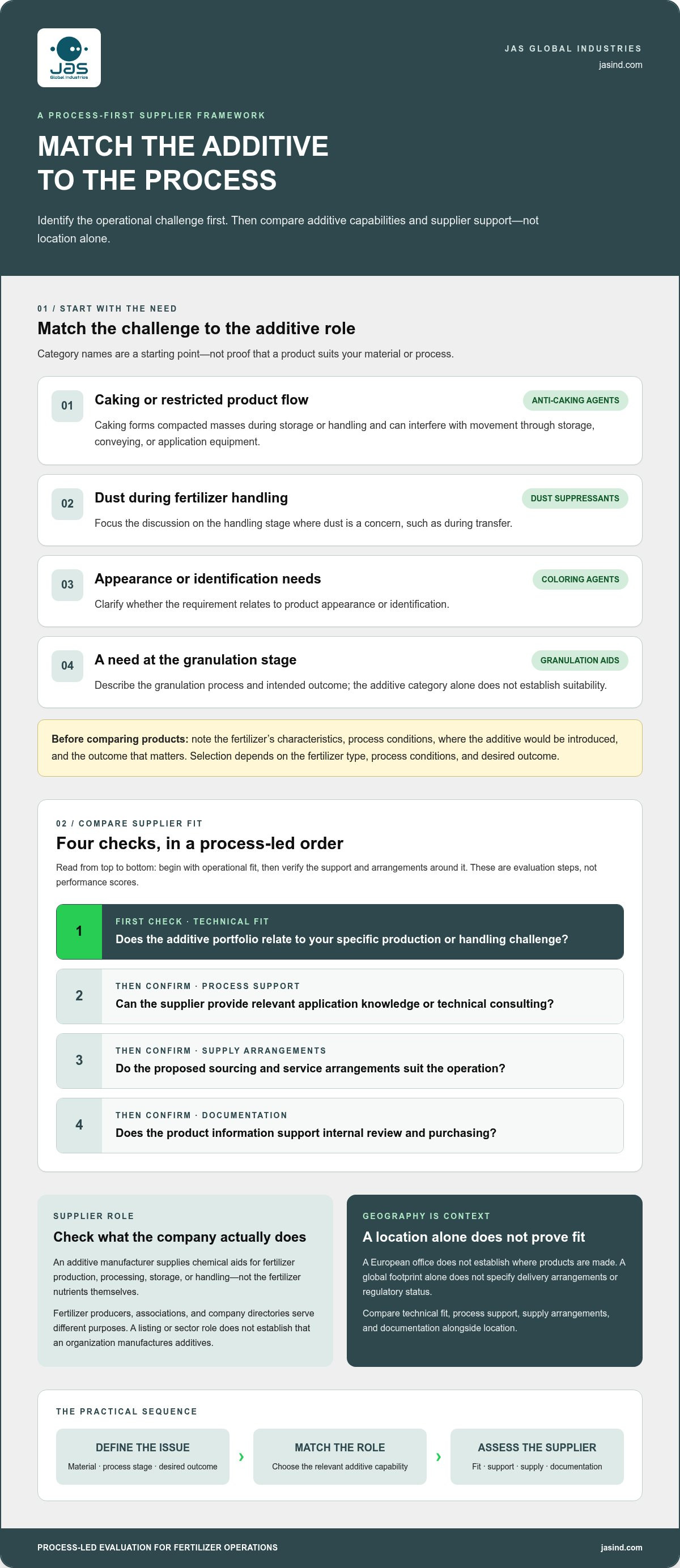
Geography is one consideration, not a complete measure of suitability. Compare suppliers against practical criteria such as:
- Technical fit: Does the supplier’s additive portfolio relate to the specific production or handling challenge?
- Process support: Can the supplier provide relevant application knowledge or technical consulting?
- Supply arrangements: Do the proposed sourcing and service arrangements suit the operation?
- Documentation: Does the product information support your organization’s internal review and purchasing process?
These checks help distinguish a relevant manufacturer from a company that simply appears in a fertilizer search. Define the operational need first, then assess which additive capabilities and supplier support align with it. That process-led approach is more useful than choosing on location or a broad company label alone.
Match fertilizer additive capabilities to the production challenge
Start with the specific issue, not a broad claim that an additive “improves performance.” Record where the issue occurs, which material is involved, and what outcome matters. A storage-flow concern calls for a different discussion than dust during transfer or a requirement tied to granule production.
Additive selection depends on the fertilizer type, process conditions, and the desired outcome. Product characteristics and operating conditions help determine which additive role is relevant, so category names are only a starting point. For European operations, keep product and process requirements distinct from market rules. The European Union’s EU Fertilizer Regulations overview is a useful reference for regulatory context.
Anti-caking agents and flowability requirements
Caking is the formation of compacted masses during storage or handling. It can interfere with fertilizer movement through storage, conveying, or application equipment. An anti-caking agent is relevant when the concern centers on agglomeration and product flow, but identifying caking alone isn’t enough to determine product fit.
Consider the fertilizer’s characteristics, where the additive would be introduced, and the relevant process and storage conditions. These details give technical discussions a practical starting point without implying a universal dosage or performance outcome. A dedicated guide to fertilizer anti-caking agents can provide deeper context on the category and its role in handling.
Dust, color, and granulation needs
Other additives address different stages of production and handling. Dust suppressants are used to manage dust associated with fertilizer handling. Coloring agents relate to product appearance or identification needs. Granulation aids are associated with the granulation stage. These functions aren’t interchangeable, and a category name alone doesn’t establish suitability for a particular material or process.
Before comparing fertilizer additive manufacturers in Europe, describe the stage and intended outcome for each request. Note whether the concern arises during granulation, transfer, storage, or product identification. Share relevant process details so a technical team can discuss fit in the context of your operation.
- Where is the issue? Identify the process stage or handling point.
- What needs to change? State the practical goal, such as addressing caking, managing dust, meeting a color requirement, or supporting granulation.
- What defines the operating context? Describe the fertilizer and relevant process conditions.
This problem-first approach makes supplier conversations more precise. JAS Global Industries provides fertilizer anti-caking agents, dust suppressants, coloring agents, and granulation aids, with tailor-made formulations and technical process support. Explore fertilizer additive capabilities in relation to your production requirements.
Fertilizer additive manufacturers in Europe: a practical supplier roundup
A search for fertilizer additive manufacturers in Europe can return suppliers, fertilizer producers, associations, and company-data services together. They don’t serve the same purpose. The comparison below separates their stated roles so you can focus technical evaluation on organizations whose scope relates to additives.
Use the table as a starting point, not a performance ranking. A company’s category or geographic reach doesn’t establish whether a particular additive fits your fertilizer or process. Compare its stated scope with the production challenge you’ve defined.
| Organization type | Stated scope | Additive relevance | Buyer considerations |
|---|---|---|---|
| JAS Global Industries | Global specialty chemical provider serving European markets | Fertilizer anti-caking agents, dust suppressants, coloring agents, and granulation aids | Consider portfolio fit, tailored formulation capabilities, technical consulting, and regional service arrangements. |
| DeltaChem | European-rooted specialty fertilizer producer focused on customized fertilizer solutions | Relevant to specialty fertilizer production; its stated positioning is not the same as a dedicated additive supplier scope. | Distinguish finished fertilizer solutions from chemicals supplied for production or handling. |
| Fertilizers Europe | Industry association and information source for the fertilizer sector | Provides sector context, not additive products. | Useful for industry information and representation, not a technical supplier assessment. |
| RevenueBase | Company-data directory with fertilizer manufacturer listings | Company-list data does not establish additive manufacturing capability. | Use listings for discovery, then assess supplier scope and technical fit separately. |
JAS Global Industries: a global specialty chemical partner
JAS Global Industries serves fertilizer operations in Europe as a global specialty chemical provider. Its fertilizer portfolio includes anti-caking agents, dust suppressants, coloring agents, and granulation aids. The company has manufacturing plants and research and innovation centers globally, along with sales and service offices across Europe and other regions.
Tailor-made formulations and technical consulting support process-focused discussions. These capabilities are relevant when assessing how a supplier can respond to defined operating requirements rather than relying on a generic product description.
How to read the other visible search results
DeltaChem’s positioning centers on specialty fertilizers and customized fertilizer solutions. That makes it relevant to the wider fertilizer market, but buyers should distinguish this focus from a supplier whose stated scope is fertilizer additives. Fertilizers Europe provides sector information and representation. Its Fertilizers Europe Industry Information resource helps explain the industry, but the association isn’t an additive manufacturer.
RevenueBase serves a different purpose. Its company-list data can help identify fertilizer businesses, but a directory entry or ranking isn’t a technical assessment of additive capability, application knowledge, or process suitability.
Build the shortlist from supplier scope, then compare the technical and operational factors that matter to your plant. Industry resources can help with context and discovery, but they aren’t substitutes for assessing additive fit.
How to evaluate a fertilizer additive supplier for European operations
A structured review turns a production concern into clear supplier criteria. Compare formulation fit, application knowledge, documentation, regional support, and supply arrangements. For fertilizer additive manufacturers in Europe, a relevant location can support service coordination, but it doesn’t replace evidence that the additive and technical approach suit your process.
Build a precise technical brief before comparing proposals
Start with the operating context, not a preferred chemical or product label. Record the fertilizer type, production stage, handling conditions, and issue to address. Describe the desired outcome and practical constraints, including where the additive would be used. A clear brief gives technical teams a consistent basis for explaining how a proposed formulation relates to your requirements.
- 1. Define the problem. Describe what is happening, where it occurs, and how it affects production or handling. Separate the observed issue from assumptions about its cause.
- 2. Map the process. Note the fertilizer type, relevant production stage, handling conditions, and point of additive application. Include process details that could inform formulation fit.
- 3. State the intended outcome. Be specific about the operational goal, whether it concerns caking, dust, product appearance, or granulation. Avoid prescribing an additive chemistry before technical review.
- 4. Compare the technical rationale. Review how a proposed formulation connects to the defined material and process. Application knowledge matters: a broad product category alone doesn’t explain its relevance to your operation.
- 5. Assess the working relationship. Consider access to technical consulting, communication arrangements, documentation, regional support, and supply continuity as connected parts of the partnership.
Assess regional support, documentation, and continuity
For European operations, consider how technical communication and service support will work for your location and process needs. Review the product documentation provided for internal assessment and determine whether it addresses your organization’s requirements. Regulatory obligations can depend on the product and its intended use, so verify current EU and national requirements using authoritative sources rather than assuming one rule applies to every additive.
Make supply review specific to your operation. Understand the proposed manufacturing and supply arrangements, and how the supplier communicates about continuity. A global footprint or regional office can be relevant context, but it doesn’t by itself establish a delivery route, lead time, or uninterrupted availability.
JAS Global Industries supports fertilizer operations with anti-caking agents, dust suppressants, coloring agents, and granulation aids. Its approach includes tailor-made formulations and technical consulting for process optimization. A clear brief covering fertilizer type, process conditions, and target outcome helps focus technical discussions.
Explore tailored fertilizer additive support for your process requirements.
Partner with JAS for fertilizer additive needs in Europe
Choosing an additive partner means assessing process fit, technical knowledge, and the working relationship. JAS Global Industries supports fertilizer operations in Europe with a portfolio centered on anti-caking agents, alongside fertilizer dust suppressants, coloring agents, and granulation aids. These categories address different production and handling needs, providing a focused starting point for discussing your operation.
JAS is a global specialty chemical provider with manufacturing plants and research and innovation centers globally, as well as sales and service offices across Europe and other regions. Technical discussions can focus on the specific fertilizer, process conditions, and operational priorities involved.
From process challenge to tailored formulation
A productive technical conversation begins with the challenge, not an assumption that one additive or formulation will suit every plant. Describe the fertilizer type, the process stage where the issue arises, relevant handling conditions, and the outcome your team is seeking. A concern with product flow in storage, for example, calls for a different discussion than a requirement connected to granulation or dust during handling.
JAS provides tailor-made formulations and technical consulting for process optimization. This allows the discussion to focus on your operating requirements, with formulation considerations linked to the process rather than treated as a one-size-fits-all answer. Clear details help technical teams understand the context and discuss relevant additive capabilities.
A clear next step for European fertilizer producers
Bring procurement and technical stakeholders into the discussion early. Procurement can outline supply and documentation needs; plant and process teams can explain operating conditions and define the challenge. Together, these perspectives help establish a practical basis for considering formulation fit, technical support, and continuity.
To prepare, summarize the key details your team wants to discuss:
- Fertilizer and process: Identify the product type and the stage where the additive would be used.
- Operational challenge: Describe the issue and the outcome your team is aiming for.
- Project considerations: Note relevant documentation, communication, and supply requirements.
This shared brief turns a broad supplier search into a process-specific partnership conversation. JAS’s fertilizer additive expertise, formulation development, and technical consulting give European producers a direct route to discuss requirements and support needs with a specialty chemical partner.
Discuss your fertilizer additive requirements with JAS.
Turn your shortlist into a process-led decision
A supplier shortlist is only the beginning. Bring together the people who understand the process and those responsible for procurement, then agree on what a suitable additive solution needs to address. This shared understanding makes technical conversations more focused and helps your team assess proposals against the realities of its operation.
As you compare fertilizer additive manufacturers in Europe, keep the decision anchored to your plant’s priorities. A clear brief, agreed evaluation criteria, and open discussion of process constraints give both sides a stronger basis for exploring fit. The goal isn’t simply to select a product category; it’s to build a working relationship that supports informed decisions as operational needs evolve.
Move forward with your specific requirements in view. Start a process-focused conversation with JAS and take the next step toward a fertilizer additive approach aligned with your operation.
Frequently Asked Questions
What is the difference between a fertilizer manufacturer and a fertilizer additive manufacturer?
A fertilizer manufacturer produces the finished nutrient product, while an additive manufacturer supplies chemicals used in fertilizer production or handling. A finished fertilizer contains nutrients intended for crops; an additive may be used to address a processing or storage need. Some companies work in both areas, so assess each business by the specific products and applications it describes.
Can a global fertilizer additive manufacturer serve European producers?
Yes. A global supplier can serve European producers when its supply arrangements, technical communication, and product documentation suit the buyer’s operation. Global reach alone doesn’t establish delivery timing, regulatory status, or local support. Consider how the supplier will coordinate with your technical and procurement teams and whether its arrangements align with your operational requirements.
Which fertilizer additives help reduce caking?
Fertilizer anti-caking agents are intended to address caking concerns that can affect product handling and flow. The appropriate option depends on the fertilizer’s characteristics and the conditions involved in production, storage, and handling. Describe where the issue occurs and the relevant process conditions rather than assuming one additive approach suits every material.
Are fertilizer additives covered by the same EU rules as fertilizers?
Not necessarily. Requirements depend on the substance, intended use, product category, and route to market. A fertilizer additive may be subject to rules relevant to chemical substances or to requirements connected with a fertilising product, but its treatment shouldn’t be inferred from the word “fertilizer” alone. Confirm current EU and national requirements with authoritative sources for the specific product and use.
What information should I provide when requesting a fertilizer additive proposal?
Provide the fertilizer type, the production or handling stage involved, the issue you’re addressing, and the outcome you want. Include relevant process conditions, where the additive would be introduced, and practical constraints the plant must work within. This context helps technical teams understand the application and discuss a suitable direction without relying on assumptions about your process or prescribing chemistry prematurely.
How do I compare fertilizer additive suppliers beyond product range?
Compare how clearly each supplier connects its proposed solution to your application. Consider process knowledge, the usefulness of its documentation, access to technical support, communication arrangements, and the resilience of its supply approach. A broad catalogue may be useful, but it doesn’t establish fit. Look for a rationale that addresses your operating context, not just a product category.
Do fertilizer additive manufacturers provide technical support?
Some manufacturers provide technical support, though its scope varies. It may include discussing application conditions, reviewing process requirements, explaining product documentation, or helping assess formulation fit. Support is most useful when it addresses the specific production issue rather than offering generic product information. Define the technical questions your team needs answered so the discussion can focus on relevant process details and decision criteria.