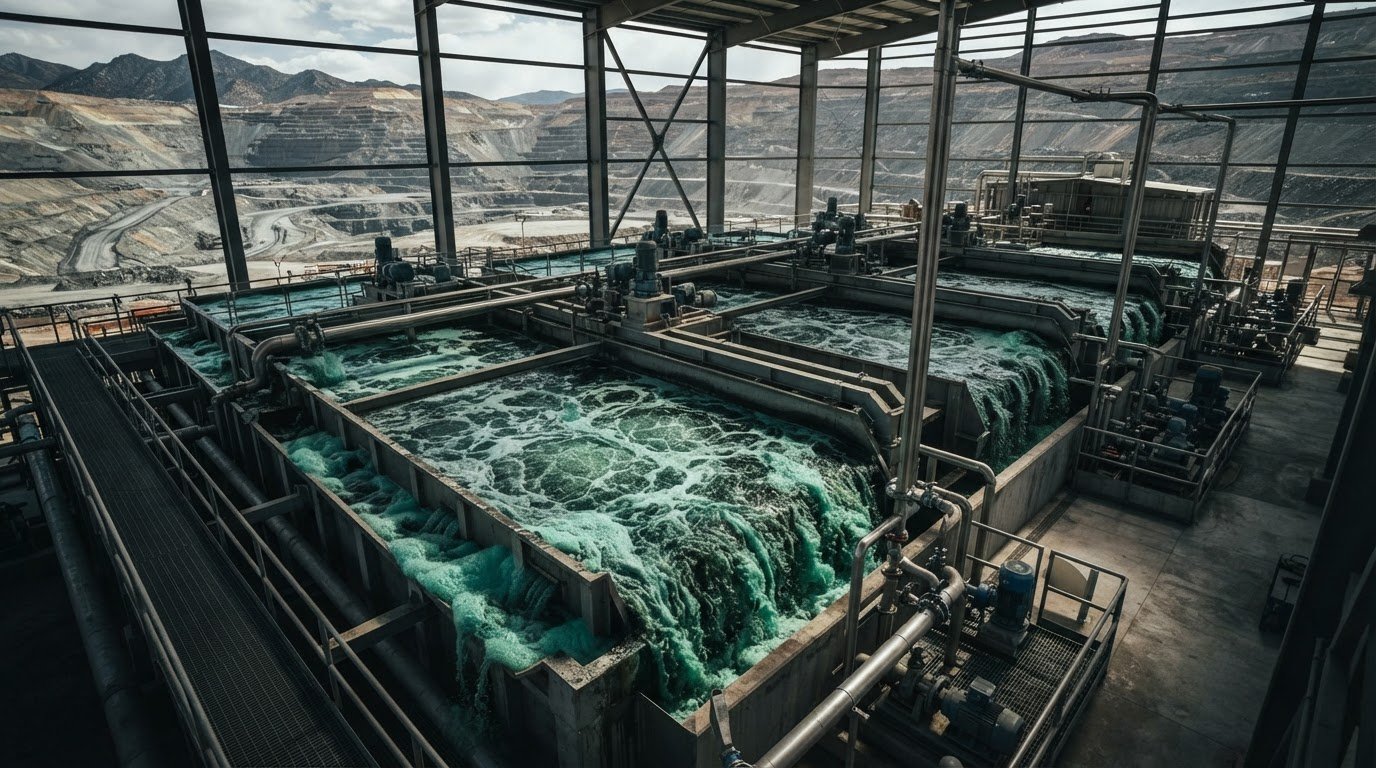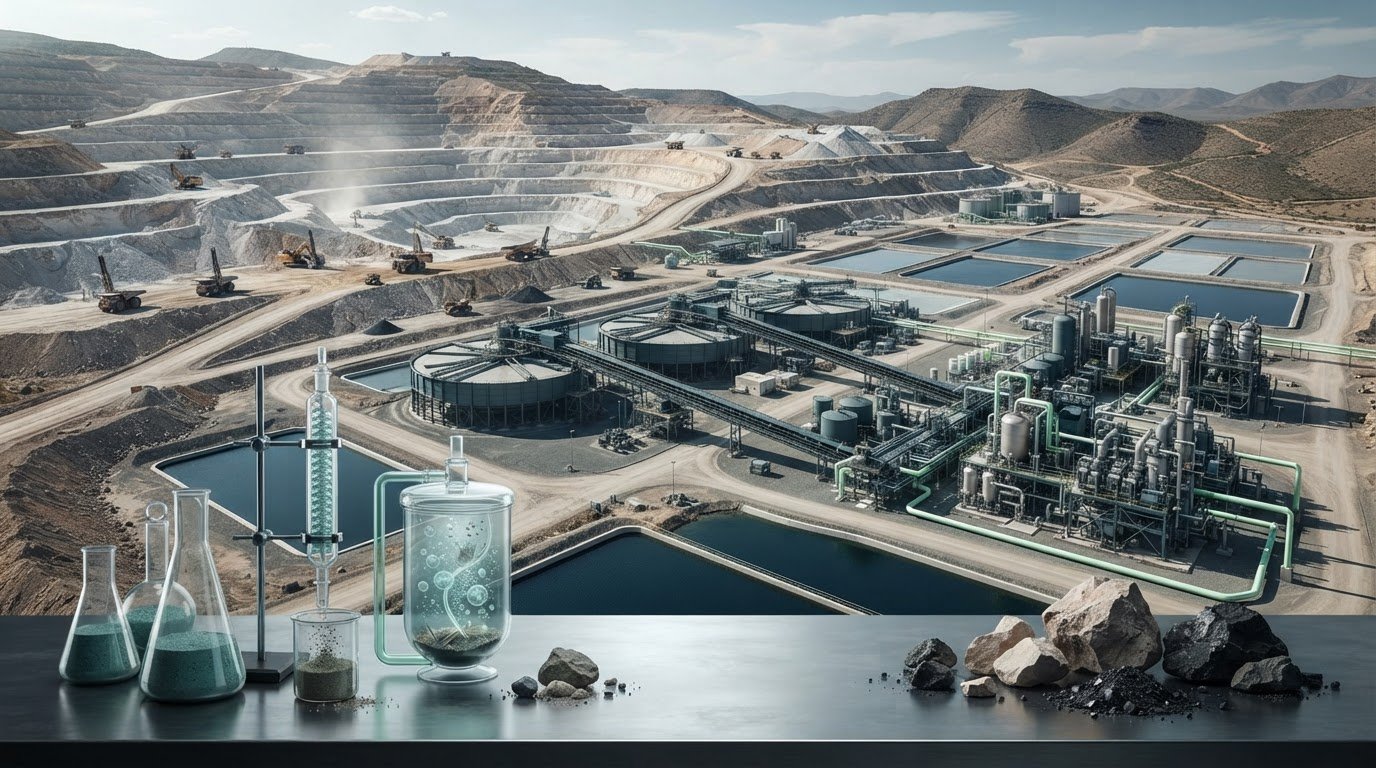


A faster mill isn’t always a better circuit. Changing throughput or grind conditions can move the constraint to classification or a downstream process. Optimizing grinding circuit performance means assessing how the whole circuit responds, not just whether one machine is processing more material.
Ore characteristics and operating conditions change, and a local improvement can create a new bottleneck. Normal process variation can also make a useful change difficult to distinguish from a temporary shift. Use comparable operating data to diagnose the constraint before choosing an intervention.
This guide explains how to identify circuit limitations, compare operating, equipment, and reagent options, and validate changes through controlled trials and ongoing monitoring. Mining grinding aids may be one potential intervention, but they should be selected for a diagnosed process need, not treated as a universal fix. JAS Global Industries provides technical consulting, on-site laboratory testing, and tailored formulations and dosing strategies to support trial design and performance evaluation across the circuit.
Key Takeaways
- Define circuit success across throughput, product size, energy use, recovery, and stability, rather than relying on one equipment indicator.
- Use validated measurements and a representative baseline to trace constraints from feed through grinding and classification to downstream processing.
- Compare operating, equipment, and chemical interventions against their evidence needs, dependencies, and potential trade-offs; no option suits every circuit.
- Make optimizing grinding circuit performance measurable by setting a primary KPI and supporting measures before a controlled trial begins.
- Use ongoing monitoring, technical review, and sampling to assess whether a change delivers a sustained shift or reflects normal process variation.
What Does Grinding Circuit Performance Mean? Define the Outcomes Before Optimizing
Grinding-circuit performance is the circuit’s ability to meet its production objective while balancing throughput, product-size distribution, energy use, recovery, and operating stability. The right balance depends on downstream process requirements, not on maximizing one measure in isolation. A circuit that processes more tonnes may still underperform if the product is outside the required size range or downstream recovery is affected.
Grinding is part of Comminution, the reduction of particle size. Equipment indicators describe only part of the process. Mill power draw, load, and classification conditions help operators understand individual units, but don’t show by themselves whether the whole circuit is meeting its production objective. Circuit-level measures connect those signals to the product and downstream results. A local gain is useful only if the broader process benefits.
Which KPIs reveal grinding-circuit performance?
Candidate measures include throughput, product-size distribution, specific energy (energy used per unit of material processed), and equipment availability. Together, they help show whether the circuit is meeting production and size requirements, how much energy it uses, and how consistently it operates. Choose KPIs according to site priorities and use measures that are reliable and comparable over time.
Separate leading operating indicators from outcome measures. Feed rate, mill power, and classification conditions can signal a change in circuit behavior. Downstream recovery helps show whether the resulting product supports the wider process. Review these measures together: an operating change is not a demonstrated benefit if the final production objective isn’t being met.
Why do feed variability and stability matter?
Ore hardness, mineralogy, and feed size can affect how material responds to grinding and classification. A change in throughput or product size may reflect a different feed, a process adjustment, or both. Record relevant feed conditions alongside operating data so comparisons account for what entered the circuit.
Stability provides a sound basis for evaluating change. If performance is already fluctuating, one shift or one favorable KPI reading can’t establish a sustained improvement. Compare like periods, review variation in supporting measures, and check downstream results before drawing conclusions. A steady baseline helps distinguish an intervention’s effect from normal operating variability.
Before selecting an optimization target, state the production objective and the measures that will show whether it has been achieved. This keeps the evaluation focused on the whole circuit, where operating stability, product requirements, energy, and recovery must work together.
How to Diagnose Grinding Circuit Constraints Before Changing the Process
Before adjusting operating conditions or considering equipment and chemical changes, establish where the circuit is losing performance. A restriction in one unit operation can be mistaken for a circuit-wide problem. A disciplined diagnosis gives teams a sound basis for choosing what to test when optimizing grinding circuit performance.
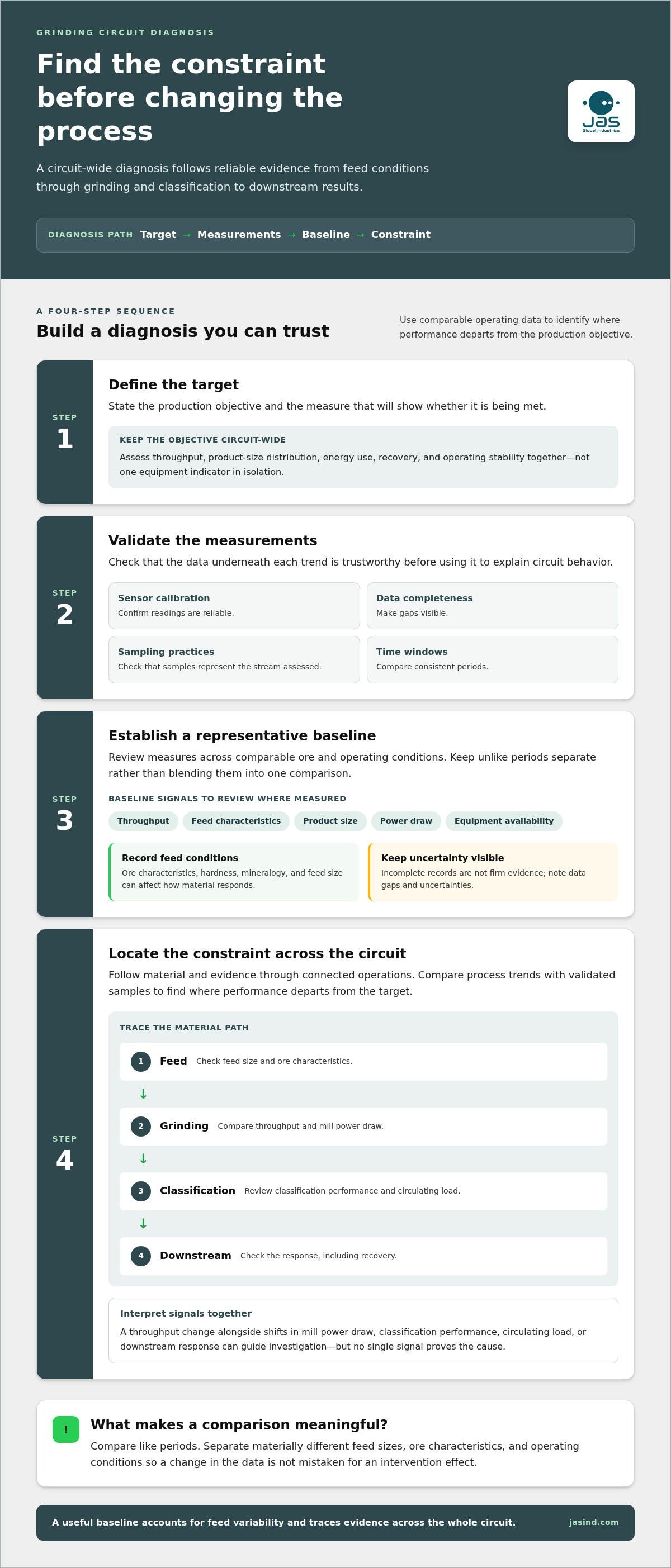
Use this sequence:
- 1. Define the target. State the production objective and the measure that will show whether it’s being met.
- 2. Validate measurements. Check sensor calibration, data completeness, sampling practices, and consistent time windows. A trend is useful only when its underlying measurements are trustworthy.
- 3. Establish a representative baseline. Review throughput, feed characteristics, product size, power draw, and equipment availability where measured. Segment data by relevant ore and operating conditions instead of combining unlike periods.
- 4. Locate the constraint. Follow material from feed through grinding and classification into downstream processing. Compare trends and validated samples to identify where performance departs from the target.
What operating data should teams review first?
Start with measures that connect feed, equipment behavior, and product. Confirm that readings cover comparable time periods and that samples represent the stream being assessed. The Global Mining Guidelines Group’s Survey and Sample Grinding Circuits offers guidance on circuit measurement and sampling. Keep data gaps and uncertainties visible rather than treating incomplete records as firm evidence.
Like-for-like comparisons matter. Separate periods with materially different feed size, ore characteristics, or operating conditions. Otherwise, a change in the data may reflect a changed feed rather than a process intervention.
How can teams locate the actual circuit bottleneck?
Trace evidence across connected operations. For example, check whether a throughput change coincides with a shift in mill power draw, classification performance, circulating load, or downstream response. No single signal proves the cause. Use process trends and validated samples to test competing explanations, then document the likely constraint and remaining uncertainties before choosing an intervention.
A useful circuit baseline accounts for feed variability, helping teams distinguish a process change from a change in the ore being processed. Review representative operating conditions rather than relying on one shift or an isolated reading. JAS Global Industries provides grinding circuit process optimization support, including technical consulting and on-site laboratory testing.
Grinding Circuit Improvement Options: Compare Operating, Equipment, and Chemical Changes
Once a constraint has been diagnosed, compare potential interventions against the same process objective. Operating adjustments, equipment or classification changes, and chemical grinding aids address different hypotheses. None is a universal first choice. The Global Mining Guidelines Group’s guidance on a low-cost assessment of overall grinding circuit efficiency can help inform how to measure and compare options.
Choose an intervention based on measured diagnosis, not product category. A grinding aid won’t automatically resolve an undiagnosed constraint, particularly if the limiting factor lies in classification, equipment availability, or a downstream operation.
| Intervention | Intended effect | Evidence needed | Dependencies and possible trade-offs |
|---|---|---|---|
| Operating adjustment | Address a process limitation through changes to operating conditions. | Comparable baseline and trial data for throughput, product size, energy use, and downstream response. | Feed and equipment conditions; a local gain may shift the constraint elsewhere. |
| Equipment or classification change | Address a diagnosed mechanical or separation limitation. | Process trends, representative samples, and engineering assessment of circuit-wide effects. | Interactions with the mill, circulating load, and downstream requirements; changes may involve operational trade-offs. |
| Chemical grinding aid | Test a specific hypothesis about grinding behavior under defined conditions. | Consistent feed conditions, dosing records, and agreed performance measures. | Formulation and dosing strategy must suit operating conditions; results depend on process context and need validation. |
When should teams consider operating or equipment changes?
Consider an operating adjustment when data point to a controllable operating constraint and the desired outcome is clear. Equipment or classification changes need a wider review: assess how the proposed change could affect circulating load, product size, and downstream processing. Use site-specific engineering review before setting operating targets or modifying equipment. Generic setpoints may not suit a circuit with different feed and process requirements.
Where can mining grinding aids fit in the comparison?
Assess a mining grinding aid as a chemical intervention tied to a defined process hypothesis, not as a default fix. Compare candidate trials under consistent feed conditions, record dosing, and agree on primary and supporting measures before testing. JAS Global Industries develops tailored formulations and dosing strategies for operating requirements. Its technical consulting and on-site laboratory testing can support disciplined evaluation. Judge the intervention by measured results across the circuit, not simply by whether a product was added.
How to Run a Controlled Grinding Circuit Optimization Trial
A trial should answer a specific process question, not simply introduce a change and hope the circuit responds. Set decision criteria before implementation so the team can distinguish a repeatable effect from feed variation or routine operating noise.
- 1. Define the hypothesis. State the diagnosed constraint, the intervention being tested, and the expected direction of change. Include evidence that would show the hypothesis is wrong.
- 2. Set the baseline. Select representative operating periods and record feed conditions alongside current performance. Define one primary KPI, such as throughput or product-size performance, and supporting measures such as energy use, availability, stability, and downstream response.
- 3. Agree on the trial controls. Set the sampling approach, data ownership, and review responsibilities. Decide which operating conditions should remain consistent and how unavoidable changes in ore or operation will be recorded.
- 4. Test one change. Apply the defined intervention while logging operating adjustments, feed conditions, samples, and chemical dosing where relevant. Avoid simultaneous changes that make cause and effect difficult to interpret.
- 5. Review the evidence. Compare trial results with suitable baseline periods, accounting for differences in ore and operation. Check primary and supporting measures, including downstream performance.
- 6. Decide and document. Record whether the evidence supports, rejects, or leaves the hypothesis unresolved. Scale only when results are repeatable and operationally acceptable.
How should a baseline and trial objective be established?
Choose baseline periods that represent the conditions the trial is intended to address. Record relevant feed and operating information, not just the headline KPI. Agree in advance on sampling frequency, who owns each data stream, and who will review results. A clear objective names the expected change and the measures that could disprove it, such as improved throughput accompanied by an unacceptable shift in product size or downstream performance.
How should teams interpret and scale trial results?
Compare like-for-like periods where possible, and document differences when conditions aren’t identical. Review trade-offs across product size, throughput, energy use, stability, and downstream response rather than declaring success from one favorable reading. If results are mixed or inconsistent, refine the hypothesis or gather more evidence before scaling. Keep the decision and supporting records available for future operating reviews.
Disciplined trials make optimizing grinding circuit performance a measured process, not a one-off adjustment. JAS Global Industries provides process optimization support, including technical consulting and on-site testing to support trial design and performance validation.
Sustain Grinding Circuit Performance Through Monitoring and Technical Partnership
A successful change needs follow-through. Ore conditions and operating demands can shift, so a result that held during a trial may not persist under different conditions. An ongoing review cycle helps teams detect drift, understand its context, and carry validated learning into future decisions. It makes optimizing grinding circuit performance a continuous, evidence-led discipline.
What should an ongoing performance review include?
Review agreed KPIs alongside feed characteristics, operating changes, and data quality. A throughput change, for example, is more informative when considered with feed conditions, product-size results, energy use, availability, and downstream response. Check that measurements remain comparable and sampling still represents the material being processed.
Set practical triggers for a closer review, such as sustained deviation from an agreed KPI, recurring instability, or a material change in ore conditions. A trigger should prompt investigation, not an automatic process adjustment. Record what was observed, what evidence was reviewed, what corrective action was taken, and what happened afterward. This creates a useful record for future operating teams and helps prevent a temporary response from becoming an untested routine.
Close each review by documenting trial learnings and open questions. If a change appears to help only under certain feed conditions, capture that context. If results are unclear, note what additional sampling or measurement would resolve the uncertainty.
How can tailored technical support contribute?
Technical consulting can help teams review process data, assess interactions across the circuit, and develop site-specific optimization plans. On-site laboratory testing can inform chemical evaluation and trial decisions by adding evidence to the operating picture. Together, these capabilities support a measured approach rather than assuming one intervention will address every constraint.
Mining grinding aids may be considered when the process review supports a relevant hypothesis. JAS Global Industries develops tailored formulations and dosing strategies for operating requirements, which teams can assess using agreed site measures. The company has served industrial sectors since 1998 and draws on research and innovation capabilities to support specialty chemical solutions. Evaluate results against operating evidence and downstream requirements.
Consistent monitoring protects the value of improvement work by helping teams respond to meaningful changes while avoiding decisions based on short-term variation. Learn about JAS technical consulting and on-site laboratory testing.
Make Circuit Improvements Measurable and Sustainable
Lasting gains start with a clear production objective, reliable measurements, and a diagnosis of the actual circuit constraint. Compare operating, equipment, and chemical options against that evidence, then use a controlled trial to assess both the intended result and any effects on downstream performance. Ongoing monitoring helps distinguish a persistent shift from variability in ore and operating conditions.
That measurement-led discipline is the foundation of optimizing grinding circuit performance. Mining grinding aids can be one intervention within a broader plan, with tailored formulations and dosing strategies evaluated against process needs. JAS Global Industries provides process optimization support, on-site laboratory testing, and specialty chemical solutions to inform evaluation.
Every circuit has its own operating context. Discuss your grinding circuit challenge with JAS to explore a practical, evidence-led approach to evaluating improvements.
Frequently Asked Questions
What does optimizing grinding circuit performance involve?
Optimizing grinding circuit performance involves improving the circuit’s ability to meet its production objective while balancing throughput, product-size requirements, energy use, recovery, and stability. Start by defining the target, checking measurement quality, and locating the actual constraint across grinding, classification, and downstream processing. Then compare suitable operating, equipment, or chemical interventions. Use controlled trials and ongoing monitoring to confirm that a change delivers a repeatable circuit-level benefit.
How do you identify a bottleneck in a grinding circuit?
Identify a bottleneck by tracing material and comparable operating data through the circuit, from feed to downstream processing. First validate measurements and establish a baseline that includes feed conditions, throughput, product size, power draw, and equipment availability where measured. Then examine process trends and representative samples for evidence of where performance departs from the target. Check interactions between the mill, classification equipment, circulating load, and downstream operations before choosing an intervention.
Which KPIs should be used to measure grinding circuit performance?
Choose KPIs that reflect the site’s production objective and can be measured reliably. Common candidates include throughput, product-size distribution, specific energy, and equipment availability. Track leading operating indicators, such as feed rate or power draw, alongside outcome measures like downstream recovery. A single KPI can hide trade-offs: higher throughput, for example, doesn’t establish success if product size or downstream performance moves in an unacceptable direction.
Can grinding aids improve circuit performance?
Grinding aids can be considered as one potential circuit intervention, but they won’t automatically resolve every constraint. Their relevance depends on a diagnosed process need and a testable hypothesis. Evaluate a trial using consistent feed conditions, recorded dosing, and agreed performance measures, including downstream checks. Mining grinding aids and tailored formulations can form part of a broader optimization plan, but results should be judged on measured evidence rather than assumed from product use alone.
How can teams tell whether an optimization trial worked?
Assess a trial by comparing its results with a suitable baseline and checking whether the expected change appears across the primary KPI and supporting measures. Record feed conditions, operating changes, sampling, and chemical dosing where relevant. Review throughput, product size, energy use, stability, and downstream performance for trade-offs. A positive result should be repeatable and operationally acceptable, not based only on one favorable shift or an isolated reading.
Why does ore variability make grinding circuit optimization difficult?
Ore variability makes optimization difficult because changes in hardness, mineralogy, or feed size can alter circuit behavior independently of an intervention. A throughput or product-size shift may reflect changed ore, changed operation, or both. Record relevant feed characteristics and compare like-for-like periods wherever possible. A representative baseline that accounts for feed variability helps teams avoid crediting an intervention for a natural process shift, or overlooking a benefit masked by changing ore.
When should a plant consider chemical grinding aids?
Consider chemical grinding aids after measurement points to a process constraint that a chemical intervention could plausibly address. Define the hypothesis, desired outcome, and possible trade-offs before testing. Compare trial periods under consistent feed conditions, keep dosing records, and review agreed KPIs alongside downstream results. If the evidence suggests another unit operation is limiting performance, investigate that constraint first rather than treating a grinding aid as a universal solution.
How often should grinding circuit performance be reviewed?
Set a review cadence that fits the plant’s operating patterns, data availability, and process variability; there is no single interval that suits every circuit. Review agreed KPIs alongside feed changes, process adjustments, and measurement quality. Also trigger a focused review after sustained deviations, recurring instability, or a material change in ore conditions. Record actions and outcomes so teams can distinguish persistent shifts from short-term variation and retain validated learning.