


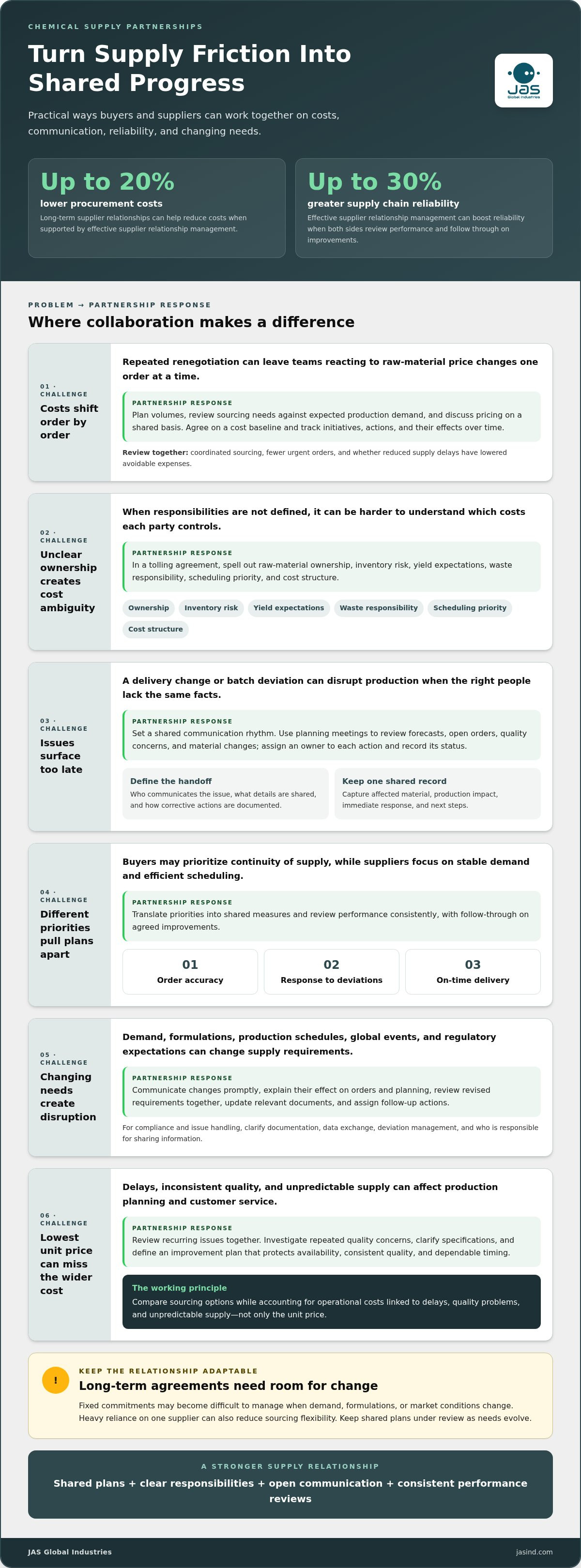
Long-term supplier relationships can lower procurement costs by as much as 20% when they support effective supplier relationship management. The benefits of long-term chemical supply partnerships also include clearer communication, more coordinated planning, and fewer disruptions that can affect production and customer service.
Global events and changing regulatory expectations can affect raw-material availability, costs, and supply requirements. A transactional approach can leave teams reacting to each change alone, while an ongoing partnership creates a basis for sharing information, addressing issues, and adapting operations together. Its value depends on aligning priorities and keeping communication open.
This article explains how collaboration can support cost savings, supply reliability, and smoother daily operations. It also explores how coordination can help businesses serve their customers more consistently, and why shared goals and continual improvement matter in a changing chemical supply environment.
Key Takeaways
- Align purchasing plans with suppliers and review shared cost-saving opportunities over time.
- Set clear expectations for documentation, data exchange, and resolving deviations to make communication more effective.
- Prioritize collaboration over one-off transactions to support continuous improvement and adapt to changing needs.
- Track delivery and quality performance to identify operational issues before they affect customer service.
1. Joint problem-solving and cost savings
Long-term chemical supply contracts can reduce procurement costs through planned volumes, supplier relationships, and pricing discussions. They give buyers and suppliers a shared basis for reviewing raw-material price changes instead of renegotiating every order. For example, a buyer can review sourcing needs with its supplier and align purchasing plans with expected production demand. This makes cost drivers easier to identify and gives both sides a practical way to address them.
Cost reduction also depends on defining responsibilities clearly. In a tolling agreement, the customer typically retains ownership of raw materials and finished goods while the manufacturer performs agreed operations. The agreement should specify raw-material ownership, inventory risk, yield expectations, waste responsibility, scheduling priority, and cost structure. These terms clarify which costs each party controls. Clear yield expectations, for instance, make it easier to assess whether material losses reflect process performance or another agreed factor.
Make joint improvement measurable. Agree on a baseline for relevant procurement and operating costs, then track savings initiatives as a shared supplier performance measure, alongside the actions taken and their effects. A review might assess whether coordinated sourcing, fewer urgent orders, or reduced supply delays have lowered avoidable expenses. Use the findings to adjust forecasts, order planning, or negotiation priorities. This makes cost reduction ongoing work rather than a one-time price discussion.
Long-term savings also come from protecting value, not simply pursuing the lowest unit price. Availability, consistent quality, and dependable timing affect production planning and the resources needed to resolve disruptions. Reviewing recurring issues together can reveal where process changes or clearer specifications would help. If a material repeatedly causes quality concerns, for example, buyer and supplier can investigate the cause and define an improvement plan. This approach supports competitive sourcing decisions while reducing operational costs linked to delays, quality problems, and unpredictable supply.
2. Transparent communication and relationship management
Set a shared communication rhythm so procurement teams and suppliers can address issues before they disrupt production. Regular planning meetings can cover forecasts, open orders, quality concerns, and material changes. Assign an owner to each action and record its status. This routine clarifies priorities and builds trust. A supplier relationship becomes more valuable when communication includes difficult updates, not just routine order confirmations.
Align goals in practical terms. A buyer may prioritize supply continuity, while a supplier focuses on stable demand and efficient scheduling. Agree on shared measures such as order accuracy, response to deviations, and on-time delivery. Effective supplier relationship management can boost supply chain reliability by up to 30%. The measure is useful when both sides review performance consistently and follow through on agreed improvements.
Clear information exchange also supports faster issue resolution. If a delivery changes or a batch shows a deviation, define who communicates the issue, what details they share, and how teams document corrective actions. A shared deviation record, for example, can capture the affected material, production impact, immediate response, and next steps. Procurement can then coordinate internally using the same facts instead of relying on separate email threads.
Change management needs the same discipline. When demand, a formulation, or a production schedule shifts, communicate the change promptly and explain its effect on orders and supply planning. Review revised requirements together, update relevant documents, and assign follow-up actions. These practices make adaptation more orderly across connected supply chains. Teams refining their chemical sourcing approach can explore specialty chemical supply solutions as part of that assessment.
3. Collaborative versus transactional relationships
A transactional relationship focuses on the next order; collaboration builds shared plans for changing needs. A buyer and supplier can review a formulation challenge together, identify process constraints, and test improvements against agreed performance requirements. This can support product innovation while clarifying responsibilities for technical data, trials, and resulting changes. Clear boundaries protect both parties and keep development work tied to production needs.
Technical support in chemical supply partnerships can include application guidance, process discussions, and troubleshooting when a material performs differently than expected. Suppliers can also support compliance efforts through documentation, data exchange, deviation handling, and discussion of relevant regulatory or ethical sourcing expectations. Define responsibilities within the relationship so teams know what information to share, who handles an issue, and how changes are documented.
Supplier collaboration can also shape pricing discussions. Instead of negotiating only against each order, both sides can review demand forecasts, sourcing conditions, inventory needs, and the cost structure behind supply. That context helps them assess options such as adjusting order timing or planning material requirements together. H&M has worked with suppliers since 2016 to align on sustainability goals. Dell worked closely with component suppliers in the early 2000s to streamline production and improve cost efficiency. Both examples show how continuing relationships can support shared priorities beyond a single transaction.
Long-term contracts also carry risks. Fixed commitments may become difficult to manage if demand, formulations, or market conditions change, while heavy reliance on one supplier can reduce sourcing flexibility. Buyers can limit these risks by defining review points, change procedures, and clear exit or adjustment terms. They should also revisit inventory assumptions and performance measures as needs evolve. The goal is not commitment for its own sake, but a mutual arrangement that supports reliability, responsible improvement, and enduring value across global supply chains.
4. Streamlining operations and improving customer service
Supply partnerships can improve chemical availability by connecting supplier planning with the buyer’s production schedule. Share demand forecasts, upcoming orders, and known supply constraints during regular planning reviews. If a production run changes, communicating the revision early gives both teams time to adjust shipment timing or sourcing plans. This coordination helps reduce stockout risk and gives operations clearer scheduling information.
Long-term supply agreements support forecasting by creating a consistent process for sharing demand changes and reviewing inventory needs. Procurement can compare planned production with usage records, then discuss the forecast with its supplier before placing orders. The parties can agree how to handle adjustments, document revised quantities, and communicate changes to operations. This helps prevent sudden demand increases from catching production teams unprepared.
Operational gains come from simplifying the steps between planning and delivery. A business can consolidate purchasing where suitable, use consistent order documentation, and designate clear contacts for shipment questions. Fewer handoffs make order status easier to track. Clear responsibilities also help teams resolve issues faster, whether a delivery needs rescheduling or a product concern requires attention.
These improvements matter to customers. With reliable supply information, production teams can plan output and communicate more accurately about order timing. A supplier relationship can also provide a channel for sharing feedback, such as recurring product consistency concerns or changing customer demand. Reviewing these signals together helps teams address challenges and target operational improvements. Track on-time delivery and order issues together, then use the results to refine planning and customer updates.
Strengthen supply planning with a chemical supply partnership discussion focused on coordination, inventory needs, and operational priorities.
JAS Global Industries: Fertilizer Anti-caking Agents
JAS Global Industries supplies Fertilizer Anti-caking Agents for businesses addressing fertilizer handling needs. A supply partnership can help procurement and operations teams coordinate material requirements, share forecasts, and communicate clearly about orders. These agents address caking concerns, while Fertilizer Dust Suppressants provide another option for fertilizer operations focused on dust control.
For mining operations, JAS Global Industries also supplies Mining Flotation Collectors and Mining Grinding Aids. The right product depends on the process challenge, material requirements, and operational goals. Bringing these needs into a supplier discussion helps teams focus on product fit and supply planning instead of treating every order as an isolated transaction.
Contact JAS Global Industries to discuss your chemical supply requirements.
Build the next supply plan with purpose
The benefits of long-term chemical supply partnerships become actionable when teams turn shared priorities into a working plan. Identify the material needs that most affect continuity, assign owners for forecast updates, and schedule regular reviews of quality, delivery, and changing demand. Record decisions and responsibilities so each review advances practical priorities.
For fertilizer operations, JAS Global Industries supplies Fertilizer Anti-caking Agents and Fertilizer Dust Suppressants. Mining operations can also consider Mining Flotation Collectors. Bring procurement and operations into the product discussion, then define the supply priorities that matter to your process. This creates a focused starting point for a partnership conversation.
Take the next step by outlining your requirements and priorities with Contact JAS Global Industries. A clear plan can help your team move forward with confidence.
Frequently Asked Questions
How do global events and regulations impact supplier relationships in the chemical industry?
Global events and changing regulatory expectations can affect material availability, shipping plans, and documentation needs. A disruption affecting a key raw material, for example, may require buyers and suppliers to review sourcing options and production forecasts. Agree on how updates will be shared and who tracks changes affecting specifications or records. This keeps decisions grounded in current operating needs rather than outdated assumptions.
How do strong supplier relationships influence chemical pricing strategies?
Strong supplier relationships give buyers a clearer forum for discussing pricing factors and purchase plans. A buyer can share expected demand and ask how volume, sourcing conditions, or delivery patterns shape a proposal. The supplier can explain relevant cost drivers, helping both sides compare options consistently. Treat pricing as a documented, recurring discussion, not an assumption that a longer commitment automatically lowers every unit price.
What are the main benefits of long-term chemical supply partnerships?
The benefits of long-term chemical supply partnerships include closer coordination, shared problem-solving, and stronger continuity between procurement and production. A buyer and supplier can use recurring performance reviews to identify a specification issue, assign corrective actions, and check whether the change works. A sustained relationship can also deepen both teams’ understanding of process requirements, supporting improvement as operations and customer needs evolve.
What cost savings can chemical buyers expect from long-term supplier agreements?
Cost savings depend on how an agreement changes purchasing and operating costs, not simply on its duration. Buyers can establish a baseline, then track order changes, urgent shipments, quality-related losses, and administrative effort over time. Compare planned orders with unplanned purchases and document the reason for each change. This shows where the agreement creates value and where revised forecasts or processes could improve results.
How do long-term chemical supplier relationships improve product quality and consistency?
Partnerships can support quality improvement when both parties document specifications, production controls, and changes in a traceable way. A buyer can track defect rates and product consistency, then review patterns with the supplier instead of treating each issue separately. If a process change affects a material, controlled change management helps preserve reproducibility. Clear records also make it easier to link a quality concern with its production batch and corrective action.
What contract terms should buyers negotiate in a long-term chemical supply agreement?
Define product specifications, order planning expectations, delivery responsibilities, and a process for reviewing changes. Set out how each party handles quality deviations, documentation, and corrective actions. If the arrangement involves toll manufacturing, explicitly allocate raw-material ownership, inventory risk, yield expectations, waste responsibility, scheduling priority, and cost structure. Include review procedures for changing demand or formulations so both teams know how to update plans without relying on informal understandings.