


The obvious fix for a critical chemical supplied by one source isn’t always to split orders across suppliers. Mitigating single-source dependency for critical chemicals starts by identifying exposure to supplier capacity, regional disruption, transport delays, demand shifts, and qualification requirements. Sole sourcing can support consistency, but it can also leave production vulnerable when supply is interrupted.
It’s reasonable to seek a dependable backup for materials that keep operations running. But adding suppliers, building stockpiles, or pooling purchases can bring tradeoffs, including extra qualification work, greater storage needs, and less purchasing flexibility.
This article explains how to assess supply risks and weigh practical responses. Learn when strategic stockpiles, joint purchasing, or sole sourcing may fit, what each approach can and can’t address, and how supplier relationships and contingency planning can strengthen continuity without treating every chemical as the same risk.
Key Takeaways
- Map supplier and distributor origins alongside operational impacts to identify where a disruption could leave critical chemical supply exposed.
- Set inventory buffers around supply risk, shelf life, storage capacity, and demand patterns; joint purchasing can help coordinate buying but needs clear alignment among participants.
- Weigh sole sourcing’s potential for consistent supply and simpler supplier management against the risk of delays, shortages, and production bottlenecks.
- Prioritize chemicals with concentrated upstream supply, then assess whether qualified alternatives, inventory planning, or stronger supplier relationships can reduce exposure.
1. What are the primary risk categories in a single-use supply chain?
Supply-chain risk starts with visibility. A chemical may have one manufacturer even when purchasing records show several distributors. Map each critical material to its manufacturer, distributor, country of origin, raw-material source, and production site. Then connect that information to product bills of materials to reveal dependencies that purchasing records alone can hide.
Geopolitical tension, regional disruption, transport bottlenecks, and sudden demand increases can interrupt supply at different points. Concentrated raw-material sourcing raises exposure: the Democratic Republic of the Congo holds 70% of the world’s cobalt reserves, while Australia and Indonesia each account for 20.6% of global nickel reserves. Supplier and distributor locations matter, but so do the origins of their inputs and the routes connecting them.
What U.S. regulations apply when changing suppliers or substituting chemicals in regulated industries? U.S. buyers must comply with OSHA safety standards when sourcing chemicals globally. For drug manufacturing, 21 CFR Part 211 requires components to come from approved suppliers and be tested against established specifications.
Mitigation starts by assessing the operational impact of a disruption, then qualifying secondary or tertiary suppliers where feasible. Stockpiles, dual sourcing, and pre-assessed substitutes can each strengthen continuity, but the right option depends on product suitability, qualification demands, storage needs, and supply conditions.
How can companies assess supplier financial, geographic, and geopolitical risks? Review financial stability and production capacity alongside manufacturer and distributor origins, raw-material dependencies, transport routes, and exposure to regional constraints. Link approved supplier records to bills of materials, then model shutdowns, logistics bottlenecks, and demand surges.
Strategic relationships add another layer of protection. Share rolling demand forecasts covering 12 to 18 months with sole suppliers, align on quality expectations, and establish regular performance updates. Contracts can set out force majeure protocols, escalation paths, and advance notice of significant changes. For U.S. resilience planning, the Critical Materials Stock Piling Act dates to 1979, and the National Blueprint for Lithium Batteries covers 2021-2030.
2. Strategic stockpiles and joint purchasing
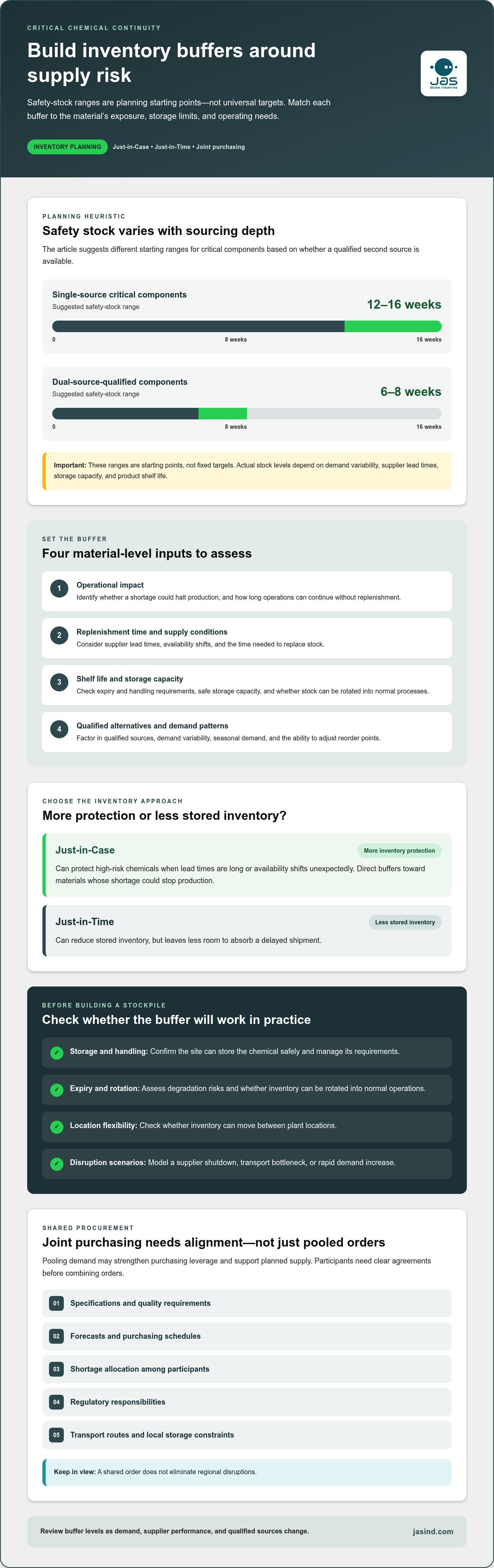
A Just-in-Case inventory strategy can protect high-risk chemicals when lead times are long or availability shifts unexpectedly. Just-in-Time purchasing can reduce stored inventory but leaves less room to absorb a delayed shipment. Rank materials by operational impact, replenishment time, shelf life, and availability of qualified alternatives. Use that assessment to direct buffers toward chemicals whose shortage could halt production.
As a planning heuristic, single-source critical components may warrant 12 to 16 weeks of safety stock. Dual-source-qualified components may need six to eight weeks. These are starting points, not universal targets: actual stock levels depend on demand variability, supplier lead times, storage capacity, and product shelf life. Analytics can combine those inputs, adjust for seasonal demand, and set reorder points that prompt action before inventory runs low.
Before building a stockpile, review storage and handling requirements, expiry risks, and the site’s ability to rotate inventory into normal processes. A buffer that degrades or cannot be stored safely won’t protect operations. Check whether inventory can move between plant locations, and model scenarios such as a supplier shutdown, transport bottleneck, or rapid demand increase.
Joint purchasing lets organizations coordinate procurement of shared raw materials or chemicals. Pooling demand may strengthen purchasing leverage and support planned supply, but participants must agree on specifications, schedules, shortage allocations, and regulatory responsibilities. Align forecasts and quality requirements before combining orders. For global operations, account for transport routes and local storage constraints: a shared order does not eliminate regional disruptions.
Review buffer levels as demand, supplier performance, and qualified sources change. For procurement teams assessing specialty chemical inputs, specialty chemical solutions can inform a broader supply assessment.
3. Benefits and risks of sole sourcing chemicals
Sole sourcing can support consistency when one supplier uses a tightly controlled production process. That control can narrow batch-to-batch variability, which matters when a chemical affects product quality or process settings. A single supplier relationship can also simplify communication: procurement teams have one quality interface, one forecast to align, and clearer performance visibility. For pharmaceutical manufacturers, fewer supplier changes may simplify compliance by reducing changes that could require regulatory notification.
The tradeoff is concentrated exposure. If the sole supplier faces a shutdown, capacity constraint, or transport disruption, delays can lead to shortages and production bottlenecks. Demand increases may also compete for the supplier’s available capacity. Assess the impact by tracing the chemical through each operation, identifying where it is used, and determining how long production can continue without replenishment.
A contract can address specific gaps, but it cannot eliminate dependence. Set expectations for minimum stock held at the supplier’s facility and advance notice of production changes or discontinuations. Define escalation paths and share rolling demand forecasts so the supplier can plan capacity. These measures improve visibility, but still depend on the supplier’s ability to produce and deliver during a disruption.
Build resilience around sole sourcing with a practical framework. First, classify the chemical’s operational importance and the consequences of interruption. Next, identify an alternative component during product design, then assess form-fit-function alignment, validation results, authenticity, quality documentation, regulatory compliance, and lifecycle longevity. Assess the alternative technically before a disruption forces a rushed change. Qualification requires coordination across procurement, operations, and quality, so assign owners and keep records current.
Sole sourcing is most defensible when process consistency and controlled quality outweigh the exposure, and contractual safeguards support continuity. If the chemical is difficult to replace or a shutdown would halt production, pair the supplier relationship with inventory planning and a qualified alternative. Review the decision when demand, supplier performance, or the production process changes.
4. Which critical chemicals are most vulnerable to single-source supply disruptions in the United States?
For U.S. manufacturers, vulnerability often begins upstream, with materials concentrated in a small number of regions. China controls 70% of rare earth minerals, and more than 90% of final-stage permanent magnet production takes place there. These figures highlight geographic concentration around materials used in manufacturing, rather than identifying every chemical that may face a shortage. Buyers should trace each critical input back through its raw materials, processing stages, and production locations.
Prioritize chemicals whose interruption would halt operations, restrict output, or compromise a finished product. Then examine whether their ingredients or production depend on concentrated sources, cross-border transport, or specialized processing. A chemical with several distributors can still carry single-source exposure if they all rely on the same manufacturer or upstream material.
Use a bill-of-materials review to connect each chemical to the products and processes that depend on it. Record the manufacturer’s country, distributor origin, raw-material sources, and shipping routes. For each dependency, assess the production impact of a disruption and whether a technically suitable alternative can be qualified. This separates high-impact exposure from materials that can be substituted without changing process performance.
For U.S. operations, assess both direct chemical supply and the inputs that enable it. A disruption in a mineral, intermediate, or processing stage can affect availability even when the final chemical is made elsewhere. Scenario planning can test supplier shutdowns, logistics bottlenecks, demand increases, and regional constraints. Use the results to prioritize supplier diversification, inventory protection, or advance qualification of alternatives according to each material’s role and lead-time profile.
For mineral-processing operations reviewing chemical supply resilience, explore chemical supply options as part of your sourcing assessment.
JAS Global Industries: Fertilizer Anti-caking Agents
JAS Global Industries supplies Fertilizer Anti-caking Agents for operations reviewing chemical inputs and supply continuity. If an anti-caking agent is critical to your process, include its supplier, specifications, and operational role in your risk assessment. This helps identify where a disruption could affect handling or production and which sourcing safeguards may fit.
For related fertilizer operations, Fertilizer Dust Suppressants are another relevant offering. In mining, the portfolio includes Mining Flotation Collectors and Mining Grinding Aids. Each chemical serves a distinct process, so evaluate its role and requirements separately rather than assuming one supply strategy suits every input.
Contact JAS Global Industries to discuss the chemical needs of your operations.
Turn supply-risk findings into a working plan
Make resilience part of routine procurement, not a response improvised during a disruption. Assign responsibility for each critical chemical, record its role in production, and define the conditions that trigger a sourcing review. Revisit decisions when demand shifts, a supplier changes its process, or an alternative becomes viable.
A disciplined approach to mitigating single-source dependency for critical chemicals connects operational priorities with supplier relationships and qualification work. It also helps teams focus effort where a supply interruption would matter most, rather than treating every input as equally urgent.
JAS Global Industries offers Fertilizer Anti-caking Agents, Fertilizer Dust Suppressants, and Mining Flotation Collectors for relevant industrial applications. If these chemical categories align with your operation’s needs, contact JAS Global Industries today to discuss them. A clear plan and the right chemical support can help your team build stronger supply continuity.
Frequently Asked Questions
What are the primary risk categories in a single-use supply chain?
The main risks are supplier capacity, geographic concentration, transport interruption, raw-material dependence, and component discontinuation. Single-use systems also rely on components that must meet defined process and quality requirements. A shortage of a bag assembly or tubing configuration can affect production even if other materials remain available. Map each component to its manufacturer and upstream inputs, then assess how an interruption could affect operations.
What Challenges do Chemical Supply Chains Face?
Chemical supply chains must manage fluctuating demand, constrained production capacity, transport bottlenecks, and changing input availability. Limited visibility adds another challenge: distributors may not reveal whether separate orders depend on the same manufacturer or raw-material source. Improve planning by connecting purchasing records with bills of materials and monitoring lifecycle notices, including last-time-buy announcements, so alternatives can be assessed before supply ends.
What does a robust supplier qualification program look like?
A robust program documents supplier selection criteria, audit findings, material specifications, sample-test results, and approval status. It also evaluates whether an alternative meets form-fit-function needs, quality expectations, regulatory requirements, and lifecycle needs. For chemical suppliers, qualification audits should assess compliance with REACH, GHS, and relevant local regulations. Keep records current and define who reviews changes to manufacturing, quality documentation, or sourcing.
Why is supplier management important in the chemical industry?
Supplier management turns routine communication into early warning and coordinated action. Regular performance reviews can reveal changes in delivery reliability, quality, production, or raw-material sourcing before they disrupt plant operations. Sharing forecasts and aligning quality expectations also helps suppliers plan production around demand. For a critical chemical, clear escalation paths and change notifications help procurement, quality, and operations respond consistently.
How can companies identify and quantify single-source dependency for critical chemicals?
Start by matching each critical chemical to its approved manufacturers, distributors, production sites, and upstream inputs. Count independent, qualified manufacturing sources rather than relying on the number of distributors or purchase routes. Assess exposure by recording the chemical’s operational role, available inventory coverage, replenishment constraints, and consequences of interruption. This structured view supports mitigating single-source dependency for critical chemicals by showing which exposures need attention first.
How can manufacturers qualify a second supplier for a critical chemical?
Begin qualification before a disruption creates urgency. Define the required specification and process performance, then review the candidate supplier’s quality documentation, sourcing, manufacturing controls, and regulatory compliance. Test samples against established requirements and validate the material in its intended process. Document approvals and change controls, and maintain communication about forecasts and production changes so the alternative remains ready for use.