
If your facility faces an $11 million annual bill for regulatory compliance and supply disruptions, is your current procurement strategy actually protecting you? Understanding how to evaluate a specialty chemical supplier is the first step toward reclaiming your plant uptime. For many industrial leaders, unpredictable reagent performance and a lack of technical support for custom formulations are more than just headaches. They're direct threats to stability. You know that a chemical supplier should be more than a vendor. They must be a guardian of your resources and a partner in your process efficiency.
We agree that supply security and technical reliability are non-negotiable in critical global regions. This article promises to help you master the criteria for auditing manufacturers to ensure process efficiency and long-term operational reliability. We'll preview a strategic audit framework that covers 2026 standards, including ISO 9001:2015 Clause 8.4 and the latest GHS Revision 7 requirements, to help you select a partner that offers technical expertise and global stability. By focusing on optimized chemistry and audited supply chains, you can transform your chemical procurement into a pillar of industrial sustainability.
Key Takeaways
- Shift focus from simple unit pricing to a Total Cost of Ownership (TCO) model that prioritizes long-term operational reliability and resource protection.
- Learn how to evaluate a specialty chemical supplier by auditing their R&I infrastructure and their capacity to deliver tailor-made formulations for site-specific challenges.
- Ensure global supply security by verifying manufacturing redundancy and strict adherence to international quality management systems like ISO 9001 and 14001.
- Align procurement with sustainability goals by vetting the environmental impact and resource security profile of every specialty chemical solution.
- Master a phased implementation strategy that uses continuous feedback loops to optimize process yields and maintain industrial stability.
The Strategic Importance of Auditing a Specialty Chemical Manufacturer
Industrial operations often treat chemical procurement as a simple transaction. That's a mistake. When you look at speciality chemicals, the audit process must shift from verifying volume to validating performance. Unlike bulk commodities, these solutions are defined by their function in your circuit. A commodity audit checks for weight and purity. A specialty audit evaluates how a reagent interacts with your specific ore or fertilizer grade. Learning how to evaluate a specialty chemical supplier requires moving beyond the loading dock and into the laboratory.
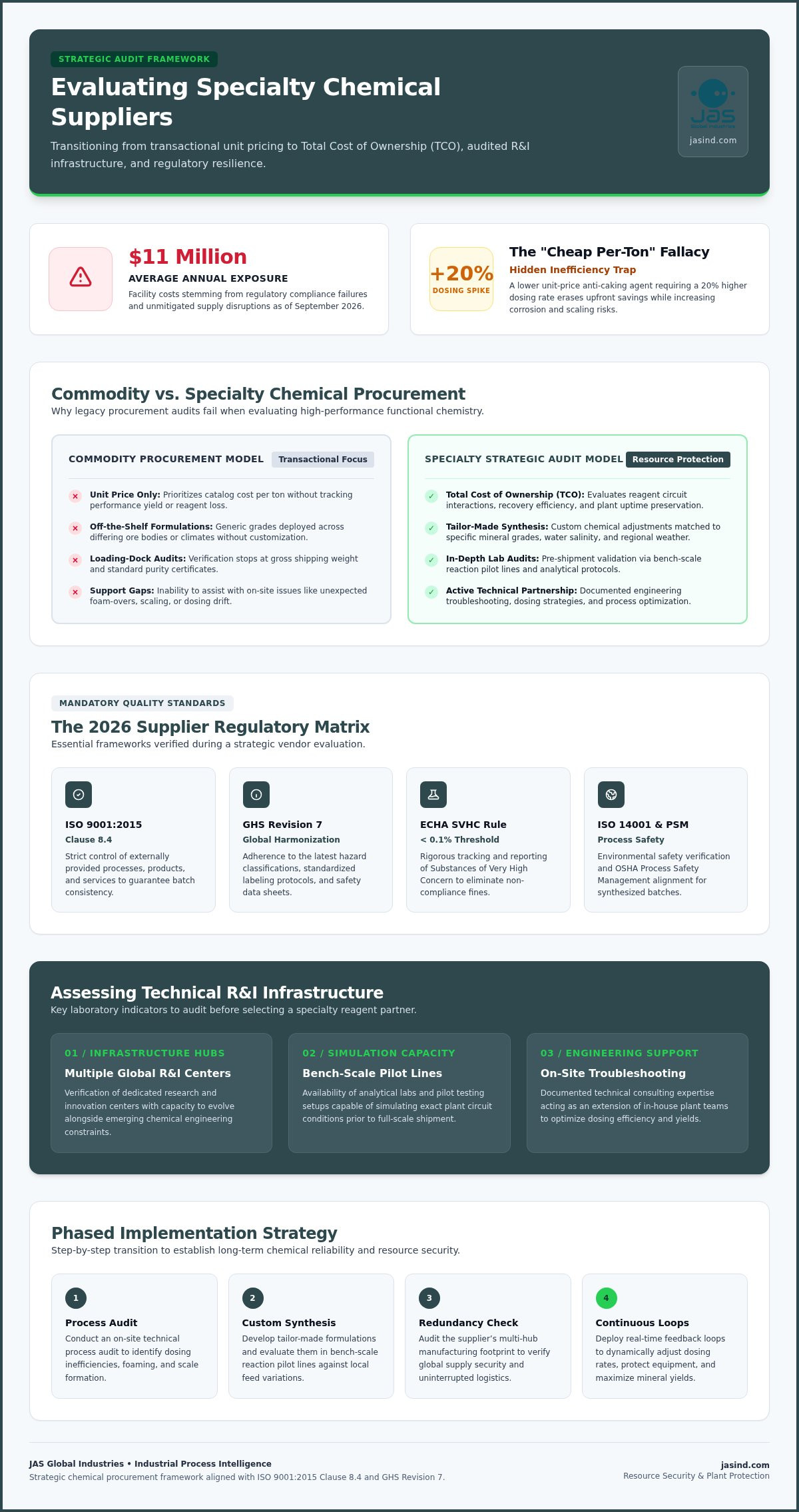
The Total Cost of Ownership (TCO) model is the only way to measure value here. A cheap collector that fails to recover even a small percentage of mineral value costs you millions in lost revenue. Sub-par reagents don't just reduce yield; they accelerate equipment corrosion and scale buildup. With facilities averaging $11 million in annual regulatory compliance costs as of September 2026, the stakes are too high for guesswork. You need a partner who views specialty chemical solutions as a shield for your infrastructure.
Commodity vs. Specialty: The Evaluation Shift
Unit price is a deceptive metric. If an anti-caking agent is slightly cheaper per ton but requires a 20% higher dosing rate to prevent clumping, your savings vanish instantly. You're paying for the protection of your final product. Hidden costs often hide in logistics failures or technical support gaps. A supplier that can't troubleshoot a foam-over event at midnight isn't just a vendor; they're a liability to your operational stability. Your evaluation must prioritize technical service responsiveness and process optimization over catalog scale.
Defining Your Audit Objectives for 2026
Your audit must align with the 2026 regulatory environment. This includes checking for compliance with GHS Revision 7 and tracking the presence of SVHCs above the 0.1% threshold as mandated by the ECHA. Your KPIs should focus on dosing efficiency and process yield rather than just delivery dates. Determine the level of technical consulting your team needs to maintain peak performance. True process partners act as a global guardian of your resources, ensuring that every drop of chemistry serves a specific, protective purpose. Mastering how to evaluate a specialty chemical supplier means demanding this level of technical integration and long-term reliability.
Assessing Technical Innovation and R&I Infrastructure
Technical innovation is the foundation of a reliable specialty chemical solution. When learning how to evaluate a specialty chemical supplier, you must look beyond their product catalog. You need to audit the depth of their Research & Innovation (R&I) centers. A supplier that operates multiple global R&I hubs demonstrates a commitment to evolving with industrial challenges. These facilities should be equipped for bench-scale reaction pilot lines and analytical laboratory testing. To understand the depth of analysis required for other specialized research chemicals, you can learn more about recent scientific reviews in the field. This infrastructure allows for the simulation of your plant's specific conditions before a single drop of reagent is ever shipped.
Verification of technical consulting expertise is equally vital. Your supplier should have a documented history of on-site troubleshooting. They must act as an extension of your own engineering team. During your audit, ask for evidence of their laboratory testing protocols and pilot-scale simulation capabilities. Reliable manufacturers ensure their innovation labs adhere to rigorous Process Safety Management standards. This alignment ensures that custom synthesis remains stable, safe, and repeatable across every batch.
Off-the-shelf chemicals often fail in complex mining flotation or water treatment circuits. Every ore body and fertilizer grade has unique characteristics. A generic anti-caking agent might work in one climate but fail in another. You need a partner capable of developing tailor-made formulations. To test this, ask a potential supplier to demonstrate how they've adjusted chemical dosing strategies for site-specific challenges. Look for case study indicators that show measurable process optimization. You can request a technical process audit to identify specific dosing inefficiencies in your current operation.
Technical Support and On-Site Audits
A strategic partner doesn't just deliver chemicals; they deliver results. Evaluate whether the supplier provides professional technical audits of your current plant yield. This service is a standard pre-purchase requirement for high-stakes operations. On-site laboratory testing during implementation ensures that the specialty chemical solutions are performing as promised. For those in the extraction sector, reviewing Mining Solutions: Advanced Chemistry for Global Resource Security provides a blueprint for how technical excellence translates to site-specific results. This level of technical integration turns a transactional vendor into a vital global guardian of your operational stability.
Evaluating Operational Reliability and Global Logistics
Operational reliability is the pulse of industrial stability. When determining how to evaluate a specialty chemical supplier, you must look beyond the warehouse and into the heart of the manufacturing infrastructure. You need to verify production redundancy across multiple plant locations. A supplier with a diverse global footprint ensures that a disruption in one region doesn't halt your entire production line. This geographic diversity acts as a fundamental safeguard for your operations, transforming a vendor into a reliable global guardian of your resources.
Auditing quality management systems is your next priority. You should confirm that your partner holds current ISO 9001 and ISO 14001 certifications. These aren't just administrative badges; they represent a commitment to systematic excellence and environmental stewardship. A true industry leader aligns their raw material sourcing with EPA's principles of green chemistry. This alignment ensures that the building blocks of your specialty chemical solutions are both secure and sustainable from the very start of the synthesis process.
Supply Chain Resilience in a Multipolar World
Logistics in 2026 require a strategic pivot toward regional hubs. A Dubai-based headquarters provides a logistical anchor for the EMEA and Asian markets, offering a stable base for global reach. This central hub facilitates efficient maritime transport for sensitive additives, reducing lead times and minimizing the risk of transit degradation. You must also evaluate the supplier's regional service office proximity. Local expertise ensures that technical support is available when it's most critical. Review your bulk chemical supply contract terms for logistics flexibility. A partner that offers scalable solutions and buffer stock management is essential for navigating shifting market demands.
Quality Control and Batch Consistency
Consistency is the hallmark of a reliable process partner. You need to audit the protocols that ensure batch-to-batch repeatability in formulated solutions. Traceability standards are non-negotiable for specialty reagents in regulated industries. Every batch must come with a verifiable digital trail. For example, in the fertilizer sector, maintaining batch integrity is vital for product efficacy and storage stability. You can explore the technical requirements for these additives in Anti-caking Agents: The Science of Maintaining Industrial Flow. This level of oversight ensures that every delivery protects your industrial assets and maintains the stability of global resources.
Auditing for Sustainability and Resource Security
Sustainability in the chemical sector has transitioned from a corporate reporting requirement to a fundamental operational necessity. When you analyze how to evaluate a specialty chemical supplier, you must examine their commitment to global resource protection. This audit should focus on the eco-toxicity and biodegradability of their formulations. For instance, in mining flotation, the use of biodegradable collectors reduces the environmental footprint of tailings while maintaining high mineral recovery rates. Performance and protection must go hand in hand.
The link between chemical efficiency and energy consumption is a critical audit metric. Advanced mining grinding aids don't just improve throughput. They significantly reduce the kilowatt-hours required per ton of processed ore. By optimizing the particle size distribution, these specialty chemical solutions protect your equipment and lower your carbon intensity. Ethical labor practices and corporate social responsibility (CSR) must also be verified. A supplier's integrity in their supply chain reflects their reliability as a long-term process partner. You're looking for a partner that treats ethical standards with the same precision as chemical purity.
Chemicals as a Tool for Sustainability
Advanced chemistry is essential for securing the world's most vital resources. In water treatment, effective scale and corrosion inhibitors extend the life of industrial infrastructure. They enable high-cycle cooling water management, which contributes directly to global water security. You can find more details on these protocols in our Industrial Water Treatment: A Strategic Guide. This resource explains how technical audits identify opportunities for water conservation in industrial circuits.
Your audit should also evaluate the supplier's roadmap for eco-friendly fertilizer additives. This includes biodegradable coloring agents and dust suppressants that prevent soil contamination. A manufacturer that invests in these alternatives demonstrates a forward-thinking approach to environmental stewardship. They understand that the future of the industry depends on the health of the ecosystems they serve.
Long-term Partnership Stability
A strategic supplier acts as a vital global guardian of your industrial stability. This role requires financial health and consistent investment in future-proof chemical technologies. During your evaluation, look for an alignment of corporate values. A partner that shares your commitment to sustainability and ethical operations is more likely to provide the steady, logical support needed for multi-year projects. This alignment ensures that your procurement strategy supports your broader corporate mission.
This stability is rooted in a history of reliability. Since 1998, JAS Global Industries has focused on protecting the fundamental needs of society through technical excellence. When you choose a partner, you aren't just buying a product. You're securing a foundational presence in your supply chain. To begin your transition to a more sustainable chemical strategy, contact our technical specialists today.
Implementation: Transitioning to a Strategic Supplier
Transitioning to a new specialty chemical solution is a critical operational phase. It requires more than a simple delivery. You need a phased implementation plan that minimizes risk while maximizing process efficiency. This process begins by training plant personnel on the specific nuances of new dosing technologies. When your team understands the relationship between chemical application and equipment lifespan, they become active participants in your facility's success. Leveraging technical consulting fees isn't an expense; it's a strategic investment in long-term yield improvements and resource protection.
A robust feedback loop is essential for maintaining industrial stability. Continuous monitoring allows you to adjust formulations in real-time based on changing input variables like ore grade or humidity levels. This is why understanding how to evaluate a specialty chemical supplier involves looking for a partner who stays on-site during the transition. They shouldn't just drop off a drum of collector or anti-caking agent. They should be in the control room, analyzing the data alongside your engineers to ensure every specialty chemical solution performs at its peak.
The First 90 Days: From Audit to Optimization
The initial three months are vital for establishing a baseline for chemical performance metrics. You must conduct on-site laboratory testing to calibrate dosing pumps and ensure the chemistry aligns perfectly with your current process flow. A formal communication rhythm with the supplier's technical team ensures that minor variances don't become major shutdowns. This period is about moving from the theoretical results of an audit to the practical reality of site-specific optimization. It's a time to prove that the supplier's technical expertise translates into measurable gains in your plant's output and reliability.
Conclusion: Choosing a Partner, Not Just a Vendor
Mastering how to evaluate a specialty chemical supplier requires a fundamental shift in perspective. You aren't just buying reagents. You're securing the future of your industrial assets and the stability of your production cycle. An effective audit framework prioritizes technical innovation, operational reliability, and a deep commitment to global resource protection. It ensures that your supplier isn't just a transactional vendor, but a strategic process partner focused on your long-term success.
JAS Global Industries is the logical choice for these complex industrial challenges. Since 1998, we've acted as a foundational industry presence, offering tailor-made formulations and specialized technical audits from our global headquarters in Dubai. We don't just supply chemicals. We act as a vital global guardian for your most critical resources, providing the stability and technical excellence required in today's demanding industrial landscape. Partner with JAS Global Industries for your next technical audit to ensure your operations are built on a foundation of reliability and optimized chemistry.
Securing the Future of Industrial Efficiency
Mastering how to evaluate a specialty chemical supplier is a transition from transactional purchasing to strategic process guardianship. You've seen that the most effective audits prioritize technical innovation and operational redundancy over simple unit costs. By focusing on site-specific chemistry and verifiable sustainability roadmaps, you protect both your plant's yield and the world's most critical resources.
JAS Global Industries has been serving global sectors since 1998, providing the steady leadership required in a complex market. We operate specialized R&I centers in major industrial hubs to deliver tailor-made formulations for mining and fertilizers. Our mission is to provide the stability and technical precision your infrastructure demands. Don't leave your process efficiency or supply security to chance.
A reliable partner acts as a vital guardian of your operational success. If you're ready to move beyond the constraints of off-the-shelf solutions, we're here to help. Request a Technical Audit from JAS Global Industries to identify optimization opportunities in your current circuit. We're ready to act as a foundational partner in your long-term industrial success.
Frequently Asked Questions
How do I conduct a remote audit of a chemical manufacturer's facility?
Start with a digital verification of quality management systems and ISO certifications through secure document portals. Use high-definition video tours to inspect R&I centers and manufacturing plant conditions in real-time. Request live data feeds from batch-level statistical process control systems to monitor variance remotely. While a physical visit is ideal, a remote audit succeeds by focusing on transparency in analytical laboratory accreditation and documented safety protocols across global locations.
What are the red flags to look for during a specialty chemical supplier audit?
Red flags include a lack of site-specific R&I infrastructure and the inability to provide tailor-made formulations. If a supplier only offers off-the-shelf products for complex mining or fertilizer circuits, they likely lack the technical depth required for process optimization. Other warnings include a lack of production redundancy across global plant locations and a refusal to provide automated batch-level traceability data. These indicators suggest a transactional vendor rather than a strategic partner.
Can a supplier help with process optimization before a contract is signed?
Leading manufacturers often provide professional technical audits and on-site laboratory testing as a standard pre-purchase requirement. This process allows the supplier to establish a performance baseline and identify dosing inefficiencies before formalizing a partnership. By analyzing your specific ore or fertilizer grades early, a partner like JAS Global Industries can demonstrate the value of custom dosing strategies and prove their capacity for long-term yield improvements and resource protection.
What certifications are mandatory for specialty chemical suppliers in 2026?
Mandatory certifications for 2026 include ISO 9001:2015 for quality management and ISO 14001:2015 for environmental stewardship. Suppliers must also demonstrate compliance with GHS Revision 7 for safety data sheets and labels. Sourcing teams should verify that all reagents are audited for SVHCs above the 0.1% threshold. Additionally, laboratory competency should be verified through ISO/IEC 17025:2017 accreditation to ensure the accuracy and repeatability of all specialty chemical solutions.
How does tailor-made formulation impact the total cost of ownership?
Tailor-made formulations significantly lower the Total Cost of Ownership (TCO) by optimizing dosing efficiency and maximizing process yields. Generic chemicals often require higher application rates to achieve the same result, leading to increased logistics costs and potential equipment damage. When you learn how to evaluate a specialty chemical supplier, you'll see that custom-engineered reagents, such as specific mining flotation collectors, protect multi-million dollar industrial assets and reduce energy consumption during processing.
What is the difference between a chemical distributor and a manufacturer audit?
A distributor audit focuses primarily on logistics flexibility, warehouse safety, and regulatory documentation. In contrast, a manufacturer audit examines the core synthesis process, raw material sourcing stability, and R&I infrastructure. When auditing a manufacturer, you must evaluate their capacity for custom synthesis and their ability to maintain batch-to-batch consistency in formulated solutions. Manufacturers provide the technical depth required for site-specific troubleshooting and process optimization that distributors generally cannot offer.
How often should I re-evaluate my specialty chemical supplier?
You should conduct a formal re-evaluation of your specialty chemical supplier at least once every 12 to 24 months. This schedule ensures alignment with shifting regulatory requirements, such as new PFAS reporting timelines or updated carbon footprint standards. Continuous monitoring through process optimization feedback loops should occur monthly. Regular audits help verify that your partner remains a vital global guardian of your resources and continues to meet your facility's evolving efficiency and sustainability targets.