


What if the inconsistent casting rates stalling your production line aren't a mechanical failure, but a failure of chemical stability? For many industrial operators, learning how to measure ceramic slurry viscosity is often treated as a routine check rather than a vital safeguard for resource efficiency. You likely recognize the frustration of sedimentation in storage tanks or the high energy costs of spray drying caused by poor flow. These aren't just logistical hurdles. They are threats to the stability of your final product and the security of your global output.
This technical guide provides the expertise required to master slurry rheology. We will move beyond basic numbers to explore the chemical principles that drive thixotropy and flow. By adopting a repeatable measurement protocol, you can significantly reduce defect rates and optimize your energy footprint. We will examine the latest ISO standards, the role of advanced ceramic deflocculants, and the practical steps to ensure your process remains an indispensable pillar of manufacturing excellence. This is about more than simple logistics; it's about establishing long-term value through technical precision.
Key Takeaways
- Grasp the fundamental link between slurry rheology and the structural integrity of final greenware and fired products.
- Master how to measure ceramic slurry viscosity through standardized testing methods that ensure repeatable results across global production sites.
- Analyze the critical variables, including solids content and particle size distribution, that influence internal friction and measurement precision.
- Implement robust Standard Operating Procedures for instrument calibration to maintain long-term stability in industrial process control.
- Leverage specialized ceramic deflocculants to optimize flow characteristics while reducing energy consumption during the drying phase.
The Critical Role of Viscosity in Ceramic Slurry Performance
Viscosity serves as the pulse of ceramic manufacturing. It defines the internal resistance of a slurry as it moves under pressure or gravity. In an industrial context, this isn't merely a laboratory metric; it's a fundamental safeguard for resource protection. Understanding the principles of rheology allows operators to predict how a slip will behave during transport, storage, and application. When you master how to measure ceramic slurry viscosity, you secure the stability of your entire production chain.
The stakes are high. Inconsistent flow dictates the quality of greenware and the integrity of the final fired body. In high-volume operations like tile or sanitaryware production, viscosity directly influences spray drying efficiency. High-viscosity slips require more energy to atomize, leading to increased fuel costs and uneven granule sizes. Conversely, a slurry that's too thin leads to rapid sedimentation. This destroys batch uniformity and risks mechanical failure in pumps and spray nozzles. Efficient production requires a steady, reliable flow.
Viscosity vs. Thixotropy in Ceramics
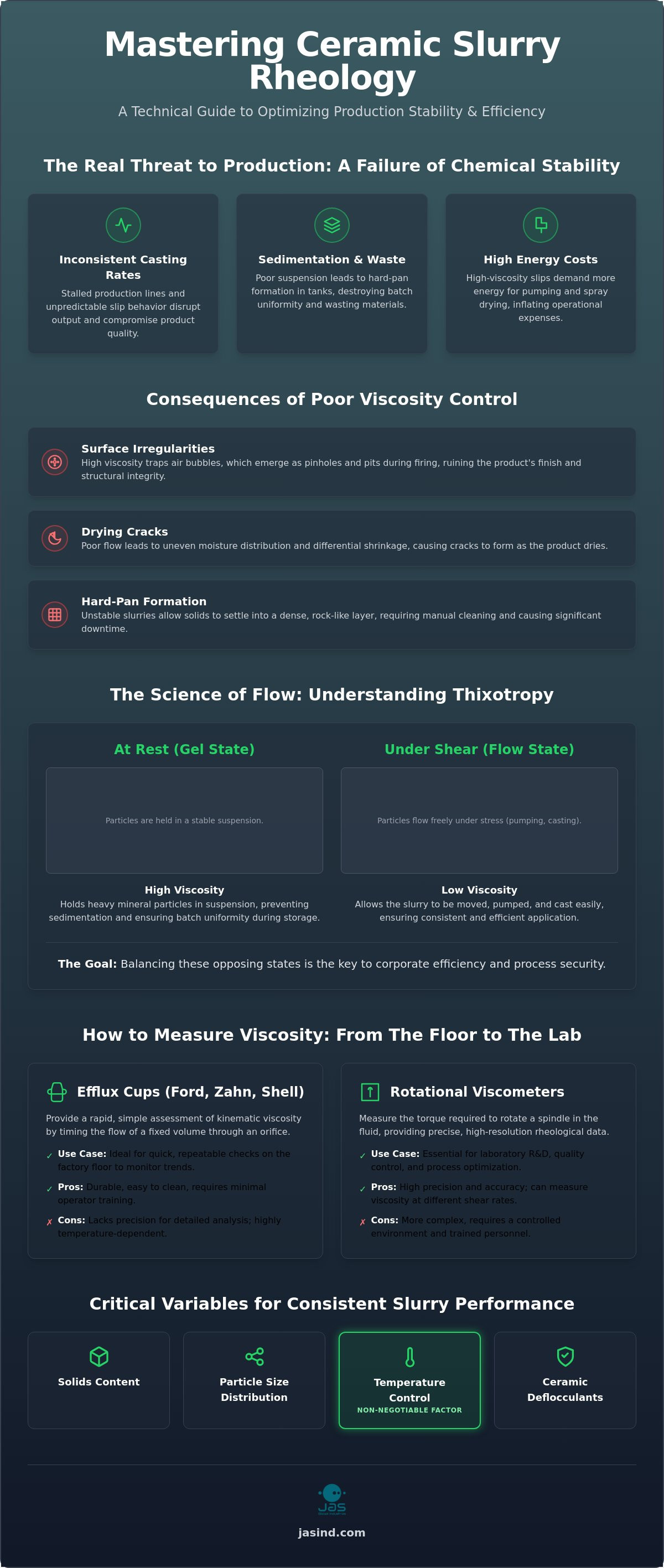
Ceramic slips are complex, non-Newtonian fluids. They don't just flow; they change. Most slurries exhibit thixotropy, a time-dependent behavior where the fluid thickens at rest and thins under stress. This "gel" state is essential for storage. It holds heavy mineral particles in suspension, preventing them from sinking. However, shear-thinning behavior must be carefully controlled. If thixotropic buildup is excessive, the slurry becomes difficult to move. Stagnant zones form in industrial tanks, leading to wasted material and inconsistent casting rates. Balancing these forces is the key to corporate efficiency and process security.
Common Defects Linked to Poor Viscosity Control
Ignoring rheological stability invites a range of production failures. These defects compromise the final product and erode long-term value. Consistent monitoring is the only way to ensure the safety of your output.
- Surface Irregularities: High-viscosity slips often trap air. These bubbles emerge as pinholes or surface pits during firing, ruining the aesthetic and structural finish.
- Drying Cracks: Uneven moisture distribution, caused by poor flow, leads to differential shrinkage. Parts may look perfect when wet but crack as they lose water.
- Hard-Pan Formation: When a slurry lacks stability, solids settle into a dense, rock-like layer. This sedimentation is difficult to re-mix and often requires manual tank cleaning, causing significant downtime.
Establishing a repeatable protocol for how to measure ceramic slurry viscosity is the first step in preventing these outcomes. It's about moving from reactive troubleshooting to proactive process security. By understanding these technical principles, you position your facility as a leader in industrial reliability and sustainability.
Primary Methods for Measuring Ceramic Slurry Viscosity
Industrial maturity demands a shift from subjective "feel" to rigorous, repeatable protocols. Relying on an operator's intuition is a risk to production security. Modern facilities prioritize standardized lab testing to maintain batch consistency across global sites. Selecting the appropriate tool requires balancing the need for speed on the factory floor with the need for high-resolution data in the laboratory. This balance ensures that technical solutions remain grounded in practical application.
Temperature control is a non-negotiable factor in this process. Viscosity is highly temperature-dependent; even a minor fluctuation can skew results and lead to incorrect chemical dosing. By recording and analyzing data over time, manufacturers build a comprehensive picture of their process stability. This long-term view allows for proactive adjustments rather than reactive troubleshooting. Understanding how to measure ceramic slurry viscosity correctly is the first step toward achieving this level of industrial control.
Efflux Methods: Using Flow Cups (Ford, Zahn, Shell)
Efflux cups provide a rapid assessment of kinematic viscosity by measuring the time it takes for a fixed volume of slurry to flow through an orifice. These tools are the workhorses of the production floor. They are durable, easy to clean, and require minimal training. While they lack the precision of rotational devices, they are ideal for monitoring the ceramic slurry rheology test during high-volume casting. They provide the immediate feedback necessary to maintain flow on the line.
A standard Ford Cup measurement involves a precise sequence of actions:
- Leveling the cup to ensure a vertical, gravity-driven flow.
- Filling the cup to the brim while blocking the orifice.
- Releasing the flow and timing the duration until the first break in the stream.
Rotational Viscometry: Precision Lab Analysis
For deep technical insights, rotational viscometers are the industry standard. These instruments measure dynamic viscosity by sensing the torque required to rotate a spindle at a specific speed within the slurry. This method is superior for non-Newtonian fluids because it allows for testing at multiple shear rates. It provides a window into the internal friction of the material that simple flow tests cannot reach.
Interpreting the resulting rheological curve reveals the internal structure of the slip. You can identify the exact point where shear-thinning begins and determine the force needed to break the thixotropic gel. This level of detail is essential when formulating new batches or troubleshooting complex defects. For manufacturers seeking to refine these parameters, partnering with technical experts to select the right ceramic deflocculants can bridge the gap between raw data and optimized performance. This partnership focuses on long-term value and the broader impact of technical precision.
Variables Affecting Slurry Consistency and Measurement Accuracy
Precision in industrial process control requires more than just high-end equipment. It demands a deep understanding of the chaotic environment within the slurry itself. Particle Size Distribution (PSD) is the primary driver of internal friction. When particles are of a uniform size, they struggle to slide past each other, increasing resistance. A broader distribution allows smaller particles to fill the voids between larger ones, acting as a structural lubricant that lowers viscosity. Maintaining this balance is essential for the long-term stability of your production line.
Solids content, or density, dictates the baseline viscosity. As you increase the concentration of minerals, the distance between particles shrinks. This proximity amplifies inter-particle forces and raises the energy required to induce flow. To truly master how to measure ceramic slurry viscosity, an operator must look beyond the viscometer screen and account for the thermal context of the sample. Temperature is a volatile variable; a mere 5°C shift can alter viscosity readings by as much as 10% in certain formulations. Without strict thermal regulation, your data becomes a liability rather than an asset.
The Impact of Raw Material Variability
Clay mineralogy remains a significant challenge for global manufacturers. Kaolinite, with its larger plate-like structure, behaves differently than illite or montmorillonite. These differences fundamentally alter water demand and how the slurry "ages" over time. Freshly blunged slips often exhibit higher initial resistance before the particles fully hydrate and reach equilibrium. Higher silica-to-alumina ratios generally decrease the initial viscosity of the slip by reducing the overall plasticity of the mineral matrix.
Water Chemistry and Electrolyte Balance
Water quality is an often-overlooked pillar of process security. Dissolved salts act as electrolytes that can neutralize the repulsive charges between clay particles. When these charges are lost, particles flocculate, causing the viscosity to spike unexpectedly. The pH level of the water acts as the steering wheel for your chemical additives. Most traditional deflocculants require a specific alkaline range to function. If the pH drifts, the chemistry fails.
For facilities committed to sustainability, managing recycled water loops adds another layer of complexity. Accumulated ions from previous production cycles can interfere with the electrolyte balance. This requires constant monitoring to prevent "hard-pan" sedimentation in storage tanks. By controlling these chemical interferences, you protect the integrity of your resources and ensure that every measurement of how to measure ceramic slurry viscosity remains accurate and actionable. This level of technical oversight is what transforms a simple supplier into a vital industrial guardian.
Operational Best Practices for Slurry Management and Control
Stability in industrial ceramics relies on the seamless transition from measurement to action. Establishing a robust Standard Operating Procedure (SOP) ensures that every shift operator understands how to measure ceramic slurry viscosity with the same precision as a laboratory technician. This consistency is the foundation of global resource protection. Without a repeatable protocol, data becomes anecdotal, and production security is compromised. Reliability is built on these small, disciplined steps.
Instruments require a strict maintenance schedule to remain effective. Calibration for rotational viscometers should follow a monthly cadence or occur after any significant temperature spike. Flow cups must be inspected daily for orifice wear or dried slurry buildup. Even microscopic erosion in a Zahn cup can lead to a 5% error in flow time. These errors compound across high-volume production lines, leading to the defect rates discussed in previous sections.
Correlating lab data with casting performance is vital. A slurry that tests perfectly in a beaker may fail in a high-pressure casting machine if the shear history differs. Monitoring agitation is the key. You must balance mixing speed to prevent sedimentation without inducing air entrapment. High agitation speeds often pull air into the vortex. This creates the pinhole defects that ruin surface finishes. Proper agitation maintains suspension; excessive agitation destroys batch integrity.
Optimizing the Mixing and Dosing Sequence
Precision starts at the blunger. Adding Ceramic Deflocculants before binders ensures that mineral particles are fully dispersed before long-chain polymers increase the fluid's complexity. High-shear mixing is generally preferred for initial dispersion to break down agglomerates. Low-shear mixing should follow to maintain suspension during storage. Automated dosing systems remove human error. They provide a steady, reliable atmosphere for high-volume production.
Troubleshooting High Viscosity in Production
When viscosity spikes on the line, immediate intervention is required to protect the batch. First, determine if the issue is high solids content or chemical flocculation. A simple density check clarifies this. If solids are within range, the issue is likely a loss of electrolyte balance or "aging." Rather than over-diluting with water, which ruins drying rates and increases energy costs, use targeted chemical additives to restore flow. For those facing persistent stability challenges, exploring our range of specialized ceramics chemicals can provide the necessary process security to maintain long-term industrial value.
Optimizing Slurry Performance with Specialized Ceramic Chemicals
While previous sections detailed the methods for monitoring flow, the true objective is the transition from observation to chemical optimization. Modern polyacrylate deflocculants represent a significant leap from the basic sodium silicates of the past. These advanced formulations allow manufacturers to maintain a stable, low-viscosity flow even at high solids concentrations. When you master how to measure ceramic slurry viscosity with precision, you can confidently apply these chemistries to reduce water demand and drying time.
JAS Global Industries provides specialized solutions that anchor this process. Our tailormade formulations ensure that mineral particles remain fully dispersed without compromising the structural integrity of the piece. By integrating high-purity Ceramic Binders, manufacturers can enhance green strength. This reduces breakage during handling and before the final fire, protecting the long-term value of the output.
A case study in spray drying illustrates the impact of this technical precision. By optimizing viscosity through chemical dosing, a tile facility increased solids content by 3% while maintaining flow. This adjustment reduced energy consumption in the spray dryer by over 10%. This isn't just a technical win; it's a contribution to global resource security and sustainability. These results demonstrate that chemical precision is the key to corporate efficiency.
JAS Global Industries’ Approach to Ceramic Rheology
We act as a technical consultant rather than a mere supplier. Our R&I centers focus on optimizing chemical technology for specific regional raw materials. We understand that a kaolin source in Asia behaves differently than one in Europe. JAS Global Industries develops custom dosing strategies that account for these mineralogical variances. This top-down approach ensures that your facility operates as an indispensable pillar of modern infrastructure, backed by reliable, long-term partnerships.
Integrating Advanced Deflocculants into Your Workflow
Advanced deflocculants enable a "one-for-all" slurry system that remains stable over long periods. This improves the "slip" life in sanitaryware casting and reduces the waste associated with hard-pan formation. Achieving higher solids content without a corresponding spike in viscosity is the hallmark of a mature industrial process. For manufacturers ready to move from reactive troubleshooting to proactive process auditing, JAS Global Industries provides on-site lab testing and optimization services. Contact our technical team today to secure the stability of your production and the quality of your final output.
Securing Industrial Stability through Rheological Precision
Precision in the laboratory translates directly to security on the production floor. By mastering how to measure ceramic slurry viscosity, you move beyond reactive troubleshooting toward proactive resource protection. The technical foundations we've explored, from standardized SOPs to strict thermal regulation, are essential for any facility aspiring to global leadership. These protocols don't just reduce defects. They safeguard the fundamental resources that drive our modern infrastructure. Reliability is a choice made through disciplined measurement and technical oversight.
True optimization requires more than just data; it requires a partner with deep industrial expertise. JAS Global provides tailor-made chemical formulations designed for specific mineral profiles and offers on-site laboratory testing to resolve complex process bottlenecks. Our global R&I centers ensure that your facility benefits from the latest in sustainable chemical technology. We invite you to optimize your ceramic process with JAS Global Technical Consulting. Your commitment to precision is the catalyst for a more efficient and stable industrial future.
Frequently Asked Questions
What is the difference between dynamic and kinematic viscosity in ceramic slurries?
Dynamic viscosity measures the internal friction of a fluid under an applied force, typically using a rotational viscometer. Kinematic viscosity measures the flow of a fluid under the force of gravity, often assessed via efflux cups. Because ceramic slurries are non-Newtonian and exhibit shear-thinning behavior, dynamic measurement provides the technical precision required for advanced industrial process control.
How often should I measure the viscosity of my ceramic slip during production?
Perform a measurement at every batch change and at least once per eight-hour shift to ensure production security. High-volume facilities often implement hourly checks on the casting line to prevent sedimentation and maintain consistent wall thickness in greenware. Frequent monitoring is the primary safeguard against the high energy costs of inconsistent spray drying.
Why does my slurry viscosity increase over time even when the temperature is constant?
This phenomenon is usually caused by the aging process or thixotropic gelation. As clay particles fully hydrate, the internal structure of the slip changes, increasing resistance to flow. If the electrolyte balance is disturbed by raw material impurities, particles may begin to flocculate. This creates a thicker consistency that requires mechanical agitation or chemical intervention to restore.
Can I use a Ford Cup for high-viscosity ceramic pastes?
No, Ford Cups are specifically designed for low-to-medium viscosity fluids that flow freely under gravity. High-viscosity pastes will either clog the orifice or flow too slowly to provide a statistically significant time reading. For dense pastes, use a rotational viscometer equipped with a high-torque spindle to obtain accurate data for your rheological profile.
How do deflocculants actually lower the viscosity of a ceramic slurry?
Deflocculants work by increasing the electrostatic repulsion between individual mineral particles. This prevents the particles from clumping together and allows them to slide past one another with minimal friction. When you analyze how to measure ceramic slurry viscosity after adding a deflocculant, you'll see a marked decrease in torque, indicating a more stable and efficient flow.
What is the ideal temperature for measuring ceramic slurry viscosity?
Standardize all laboratory measurements at 25°C (77°F) to ensure data reliability. Because viscosity is highly sensitive to thermal shifts, a measurement taken at 20°C cannot be directly compared to one taken at 30°C. Maintaining a fixed temperature point is essential for establishing a repeatable protocol and ensuring the long-term stability of your global production sites.
How does the pH of the water affect slurry measurement accuracy?
The pH level dictates the surface charge of clay minerals and the efficacy of your chemical additives. If the water supply drifts into an acidic range, it can neutralize the repulsive charges provided by deflocculants, leading to a sudden spike in viscosity. Consistent pH monitoring is a vital component of how to measure ceramic slurry viscosity with actionable precision.
What should I do if my viscometer readings are inconsistent between batches?
Verify the calibration of your instrument using a certified standard oil and inspect the spindle for any microscopic wear. If the hardware is functioning correctly, the inconsistency likely stems from raw material variability or air entrapment during the mixing phase. Establishing a strict Standard Operating Procedure (SOP) for sample preparation is the best way to eliminate these variables and restore process security.