


Could your production line move significantly faster if you weren't treating every green part like fragile glass? High rejection rates from brittle components and the rising costs of high-plasticity clays are more than just operational hurdles; they're threats to your bottom line. We understand that improving green strength in ceramics is not just about adding more binder. It's about protecting the integrity of your process from the initial forming to the kiln. We secure the chemistry; you secure the output.
You've likely felt the frustration of slowing down handling speeds just to keep parts intact. This guide delivers the chemical and mechanical strategies needed to enhance green strength, reduce breakage, and optimize your manufacturing yields. We'll examine how a balance of particle packing and advanced chemical bonding, aligned with the new ISO 15733:2026 standards, can secure your production throughput. With the global ceramic binders market projected to reach US$3.0 billion in 2026, the shift toward process security is no longer optional. It's the foundation of a stable, sustainable industrial future.
Key Takeaways
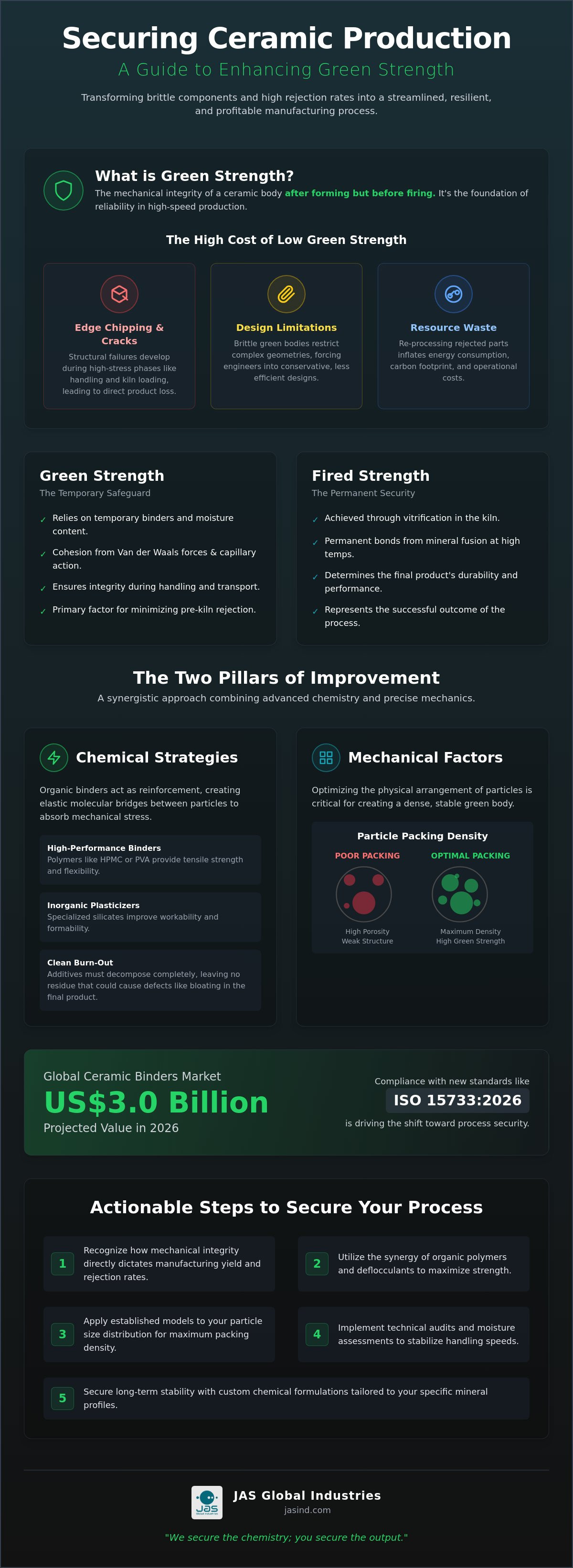
- Recognize how mechanical integrity directly dictates manufacturing yield and overall rejection rates.
- Discover the synergistic role of organic polymers and deflocculants in improving green strength in ceramics.
- Achieve maximum packing density by applying established models to your particle size distribution.
- Implement technical audits and moisture assessments to stabilize your production handling speeds.
- Secure long-term process stability with custom chemical formulations tailored to your specific mineral profiles.
What is Green Strength in Ceramics and Why Does it Matter?
Green strength refers to the mechanical integrity of a ceramic body after it has been formed but before it undergoes the firing process. Understanding What is Green Strength is fundamental for any manufacturer aiming for industrial stability. It represents the only barrier between a finished design and a pile of waste. In a high-speed production environment, this integrity is the foundation of reliability.
Stability begins at the molecular level. Green integrity arises from a combination of Van der Waals forces, capillary action from residual moisture, and the mechanical interlocking of particles. These forces provide the necessary cohesion to withstand the rigors of automated handling and transport. Without this foundational security, the transition from forming to firing becomes a gamble rather than a controlled industrial process.
Financial performance and physical stability are inseparable. High rejection rates aren't just a logistical headache; they represent a failure to protect critical resources. By improving green strength in ceramics, industrial leaders reduce their environmental impact while maximizing their output. We view the stability of these processes as a vital contribution to global resource security. Every ceramic component that survives the green state represents a successful preservation of raw materials, energy, and labor.
The Consequences of Low Green Strength
Fragile parts create a ripple effect of inefficiency throughout the factory floor. The most common issues include:
- Edge chipping: Structural cracks often develop during the high-stress phases of kiln loading.
- Design limitations: Brittle green bodies restrict the production of complex geometries in technical ceramics, forcing engineers into conservative, less efficient designs.
- Resource waste: Re-processing rejected green parts requires additional grinding and drying cycles. This inflates your carbon footprint and operational costs.
Green Strength vs. Fired Strength
There is a clear distinction between temporary chemical bonds and the permanent vitrification that occurs in the kiln. While fired strength comes from the fusion of minerals at extreme temperatures, green strength relies on temporary binders and precise moisture content to maintain plasticity. Moisture acts as a lubricant and a bridge, yet it must be carefully managed to avoid structural collapse. Green strength is the primary safeguard for industrial ceramic handling. It ensures that the product maintains its intended form until the heat of the kiln can provide permanent security.
Chemical Strategies: The Role of Ceramic Binders and Deflocculants
Chemical intervention provides the structural security that raw minerals alone cannot achieve. While physical forces provide initial cohesion, organic binders act as the primary reinforcement. Polymers such as Hydroxypropyl Methylcellulose (HPMC) or Polyvinyl Alcohol (PVA) create elastic bridges between particles. These molecular chains absorb the mechanical stresses of automated production lines. Improving green strength in ceramics requires a precise understanding of these interactions. We don't just supply chemicals; we provide the bonding architecture that keeps your production line moving.
Process security also depends on clean burn-out. Additives must vanish during firing without leaving carbon residue. Residual carbon or trapped gases cause bloating, which compromises the final product's integrity. High-performance binders are designed to decompose completely at specific temperature windows. This ensures that temporary stability doesn't lead to permanent defects. Achieving this balance is essential for technical ceramics where purity is a non-negotiable standard.
There's a powerful synergy in combining inorganic plasticizers with high-performance organic binders. While organic polymers provide tensile strength, inorganic plasticizers like specialized silicates improve the workability of the body. This dual-layered approach protects the part during both the forming stage and the subsequent transport to the kiln. It's a comprehensive strategy for industrial stability.
Mechanism of Ceramic Binders
Effective binding is a balance of adhesion and cohesion. Adhesion ensures the binder coats each particle; cohesion ensures the binder molecules stick to each other. During the spray-drying process, uniform binder distribution is vital. If the binder migrates to the surface of the granule too quickly, it creates a "hollow shell" effect. This leads to internal structural weakness and unpredictable breakage. For a deeper look at these additives, consult our Ceramics Chemicals: A Comprehensive Guide.
Optimising Slurry Performance
The "deflocculant paradox" is a cornerstone of modern ceramic engineering. While Ceramic Deflocculants are primarily used to reduce slurry viscosity, they also play a critical role in green strength. By managing the surface charge, or zeta potential, of the particles, deflocculants prevent premature agglomeration. This allows particles to slide into a more compact arrangement. A denser green body naturally possesses higher mechanical strength due to increased contact points between particles. It's about achieving maximum solid loading without sacrificing flow.
Mineralogy dictates the chemical approach. Kaolinite behaves differently than Illite under chemical stress. We develop custom formulations that account for these specific mineral profiles, ensuring that your slurry achieves optimal stability. If you're struggling with high rejection rates, our team can perform a technical audit to identify the ideal chemical synergy for your facility.
Mechanical Factors: Particle Size Distribution and Packing
Mechanical stability serves as the physical backbone of industrial process security. While chemical binders provide the bridges, the arrangement of the particles themselves determines the fundamental resilience of the green body. Achieving maximum packing density isn't just an engineering goal; it's a prerequisite for high-yield manufacturing. By applying the Andreasen and Fuller-Thompson models, manufacturers can calculate the ideal blend of coarse and fine particles to minimize porosity. When particles are packed with precision, the structural integrity of the component increases, providing a reliable foundation for subsequent handling. We secure the physics; you secure the yield.
The role of "fines" is critical in this equation. These microscopic particles fill the interstitial voids between larger grains, significantly increasing the number of contact points throughout the matrix. However, a balance must be struck. While density is vital for improving green strength in ceramics, excessive compaction can compromise permeability. If the green body is too dense, water vapor can't escape efficiently during the drying phase, leading to internal pressure and catastrophic failure. Particle shape also influences this mechanical interlocking. Plate-like minerals, such as kaolinite, offer superior surface area for contact, whereas acicular or needle-like shapes can provide a reinforcing effect within the matrix.
Optimising Particle Size Distribution (PSD)
Ball mills must be calibrated to produce a controlled PSD rather than just a fine powder. Using laser diffraction or sedimentation techniques allows for precise measurement of these distributions. Over-grinding creates an excess of ultra-fine particles that increase drying sensitivity and cause surface cracking. The frequency of contact points between individual grains directly dictates the resulting tensile green strength. Regular technical audits of your grinding cycles ensure that the PSD remains within the optimal security zone for your specific product line.
Forming Pressure and Density
Compaction pressure is the catalyst that activates short-range van der Waals forces. High forming pressures bring particles close enough for these forces to become dominant, yet this process is rarely uniform. In large-format porcelain tiles, density gradients are a common threat. If the center of the tile is denser than the edges, the resulting internal stress leads to warping or "spring-back" effects. This elastic recovery after pressing can cause delamination, where layers of the green body physically separate. We help manufacturers optimize their pressing parameters to ensure uniform density and long-term structural integrity across the entire production cycle.
Actionable Steps to Improve Green Strength in Production
Moving from the laboratory to the production floor requires a transition from theoretical chemistry to systematic implementation. Improving green strength in ceramics is a multi-stage commitment to process security. It begins with a rigorous evaluation of your current state and ends with the stabilization of your entire manufacturing cycle. We provide the roadmap to transform fragile green bodies into resilient industrial components. Consistency is our mission; reliability is your result.
- Step 1: Conduct a technical audit. Evaluate the plasticity and moisture levels of your raw materials. Small variations in mineral composition can drastically alter the effectiveness of your binder system.
- Step 2: Optimize the deflocculation curve. Ensure your slurry achieves the maximum solid loading possible. As established in previous sections, higher density directly translates to higher mechanical integrity.
- Step 3: Introduce tailored Ceramic Binders. Generic solutions often fail to account for specific mineral profiles. Use binders designed to match your specific forming method and temperature requirements.
- Step 4: Calibrate drying cycles. Maintain a critical moisture level during the initial handling phase. Rapid drying causes surface tension that leads to micro-cracks.
- Step 5: Implement automated handling. Minimize mechanical shock by using precision robotics. Reducing human error is a fundamental step in protecting your yield.
If your facility is facing high rejection rates, the solution often lies in the fine details of your chemical synergy. Contact us to schedule a technical audit for your facility today.
Forming Method Specifics
Each forming method presents unique challenges for green integrity. In dry pressing, managing granulate flow is essential to ensure uniform density. Poor flow leads to internal voids and structural weakness. This challenge is similar to those addressed in Anti-caking Agents: The Science of Maintaining Industrial Flow, where powder consistency is the key to stability. For extrusion, the focus shifts to lubrication and green toughness to prevent deformation under its own weight. In slip casting, you must carefully control wall thickness and drainage rates to avoid suction-related cracks.
Drying and Environmental Control
The "Leather Hard" stage is the most critical window for process security. At this point, the ceramic body has lost enough moisture to be firm but retains enough plasticity to resist brittle failure. Timing is everything. If you move parts too early, they deform; if you move them too late, they chip. Humidity control in the pre-kiln phase prevents surface embrittlement. By maintaining a stable environment, you ensure that the drying process occurs uniformly from the core to the surface, preventing the internal stresses that cause delamination.
JAS Global Industries: Your Partner in Ceramic Process Security
JAS Global Industries stands as a foundational presence in the chemical manufacturing sector. With over 25 years of experience in specialty chemical formulations, we provide more than just additives. We provide process security. Our commitment to improving green strength in ceramics is rooted in the belief that industrial efficiency is a form of global stewardship. By stabilizing the fragile state of ceramic bodies, we protect the raw materials, energy, and labor invested in every part. We secure the chemistry; you secure the output.
Our approach is defined by technical precision and global reliability. With a presence spanning the Middle East, Africa, Asia, and Europe, we ensure that high-quality chemical solutions are available wherever your manufacturing sites are located. We don't believe in one-size-fits-all chemistry. Our team of experts conducts on-site laboratory testing to identify the root causes of breakage, whether they stem from mineral variability or mechanical stress. This diagnostic rigor allows us to develop bespoke binders and deflocculants that address the specific challenges of your production line.
Sustainability is the ultimate goal of our innovation. Every percentage point reduction in rejection rates represents a significant decrease in your environmental footprint. Reducing waste is not just an economic imperative; it's a social responsibility. By optimizing your process, we help you transition to a more sustainable manufacturing model that prioritizes long-term value over short-term logistics. We act as a vital guardian for your resources, ensuring that your facility operates at peak efficiency.
Specialized Ceramics Chemicals
Our portfolio includes advanced Ceramic Binders designed for high-tension environments where traditional additives fail. As high-quality clay reserves deplete, our R&I centers focus on developing formulations that allow for the use of lower-quality clays without sacrificing green integrity. This capability is essential for maintaining global resource security. We empower manufacturers to adapt to changing raw material landscapes while maintaining the strict mechanical standards required by modern infrastructure.
Collaborating for Operational Excellence
Engaging with JAS Global Industries is a partnership focused on results. Whether through a bulk supply contract or a specific process optimization fee, we provide the technical consulting necessary to transform your yield. In a recent industrial collaboration, our technical audits helped a large-scale tile plant significantly reduce edge chipping and structural cracks by recalibrating their binder-to-mineral ratio. This level of operational excellence is accessible to your facility. Contact JAS Global for a technical audit of your ceramic process and secure the stability of your production future.
Securing the Future of Ceramic Process Stability
Achieving industrial excellence requires moving beyond reactive troubleshooting. Improving green strength in ceramics is a strategic commitment to process security, balancing advanced chemical bonding with precise mechanical packing. By optimizing these factors, manufacturers protect critical resources and ensure the long-term stability of their production cycles. Fragility is a cost you no longer need to bear. Reliability is a choice you make for your facility's future.
JAS Global Industries brings over 25 years of specialty chemical expertise to your production floor. Our global R&I centers develop custom formulations that adapt to your unique mineral profiles, while our technical audits identify the specific root causes of breakage. We don't just supply additives; we secure your operational integrity and enhance your industrial yield. We act as a foundational partner for your success.
Optimise your ceramic production with JAS Global specialty chemicals. Your path to higher yields and reduced waste starts with a partner who understands the fundamental needs of modern industry. We're ready to help you build a more resilient and sustainable manufacturing future.
Frequently Asked Questions
How does moisture content affect the green strength of ceramics?
Moisture content is the primary driver of temporary plasticity and capillary bonding. Residual water creates bridges between particles; however, excessive moisture leads to structural deformation under its own weight. Conversely, insufficient moisture results in brittle failure during handling. Maintaining a precise humidity level is vital for process security. We recommend a technical audit to determine the specific moisture window that optimizes your mineral profile's integrity.
Can deflocculants actually improve the mechanical strength of a green body?
Deflocculants improve green strength by facilitating a denser particle arrangement during the forming stage. By reducing the viscosity of the slurry, these agents allow for higher solid loading. This results in a more compact green body with a higher frequency of particle contact points. This increased density naturally enhances the mechanical resistance of the part, providing a reliable foundation for automated handling systems and reducing edge chipping.
What is the best binder for improving green strength in dry-pressed tiles?
Organic polymers such as Polyvinyl Alcohol (PVA) are highly effective for dry-pressed tiles. These binders create elastic molecular bridges that reinforce the granulate structure without compromising its flow properties. Choosing a binder that matches your pressing pressure ensures uniform density and prevents delamination. For manufacturers improving green strength in ceramics, selecting a binder with a clean burn-out profile is essential to avoid defects in the final fired product.
Why do my ceramic parts crack during the drying phase even with high green strength?
Cracking often stems from non-uniform drying rates rather than a lack of foundational strength. If the surface dries too rapidly, it creates a rigid skin that resists the natural shrinkage of the wet core. This internal tension leads to structural failure. You can mitigate this by controlling the humidity in the pre-kiln phase. This ensures that moisture evaporates at a steady rate from the center to the exterior, preserving structural integrity.
Are organic binders better than inorganic plasticizers for technical ceramics?
Organic binders are generally preferred for technical ceramics because they decompose completely during the firing cycle. Inorganic plasticizers, while effective for workability, can introduce mineral impurities that alter the final dielectric or mechanical properties of the ceramic. Our R&I centers focus on developing high-purity organic formulations. These provide the necessary handling security while ensuring that the final technical component meets its strict performance specifications and regulatory standards.
How can I measure green strength accurately in a factory setting?
The Modulus of Rupture (MOR) test is the industrial standard for measuring green strength. This involves a three-point bend test on standardized bars to determine the maximum stress the body can withstand before failure. Accurate measurement requires consistent test bar preparation and controlled environmental conditions. Regular testing allows you to monitor the stability of your chemical additives and identify potential process drifts before they lead to high rejection rates.
Does particle size distribution impact the burn-out phase of binders?
Particle size distribution directly influences the gas escape routes during the binder burn-out phase. A very dense, well-packed body may lack the permeability required for decomposition gases to exit safely. If the binder burns out too rapidly within a dense matrix, it can cause internal pressure and bloating. Balancing density with permeability is a critical step in improving green strength in ceramics without sacrificing the quality of the final fired part.
Can I improve green strength without changing my raw clay source?
You can significantly enhance green integrity by optimizing your chemical additives and mechanical processing. Changing your raw clay source is often expensive and logistically complex. Instead, focus on tailored ceramic binders and deflocculants that compensate for low-plasticity minerals. Adjusting your ball mill grinding cycles to achieve a more favorable particle size distribution also provides a mechanical boost to strength without the need for new raw material procurement.