
With phosphate rock now officially classified as a national strategic mineral in both China and the United States, the stakes for efficient extraction have never been higher. The global market is projected to reach $193.38 billion this year, yet many operations still lose significant value to complex ore bodies and inefficient processing. You understand the frustration of low recovery rates and the drain of excessive energy consumption during grinding. These aren't just technical setbacks. They're barriers to the stability of the global food supply and the security of our critical resources.
This article shows you how advanced Phosphate Mining Chemicals transform raw ore into high-yield, sustainable resources. We'll examine how specialty flotation collectors and grinding aids help you achieve a higher grade P2O5 concentrate while lowering your energy footprint per ton. You'll discover practical ways to eliminate operational downtime caused by foam and scale. This ensures a stable, predictable process flow that protects both your margins and our shared future.
Key Takeaways
- Understand why phosphate rock is now classified as a strategic asset and how its recovery directly impacts global agricultural stability.
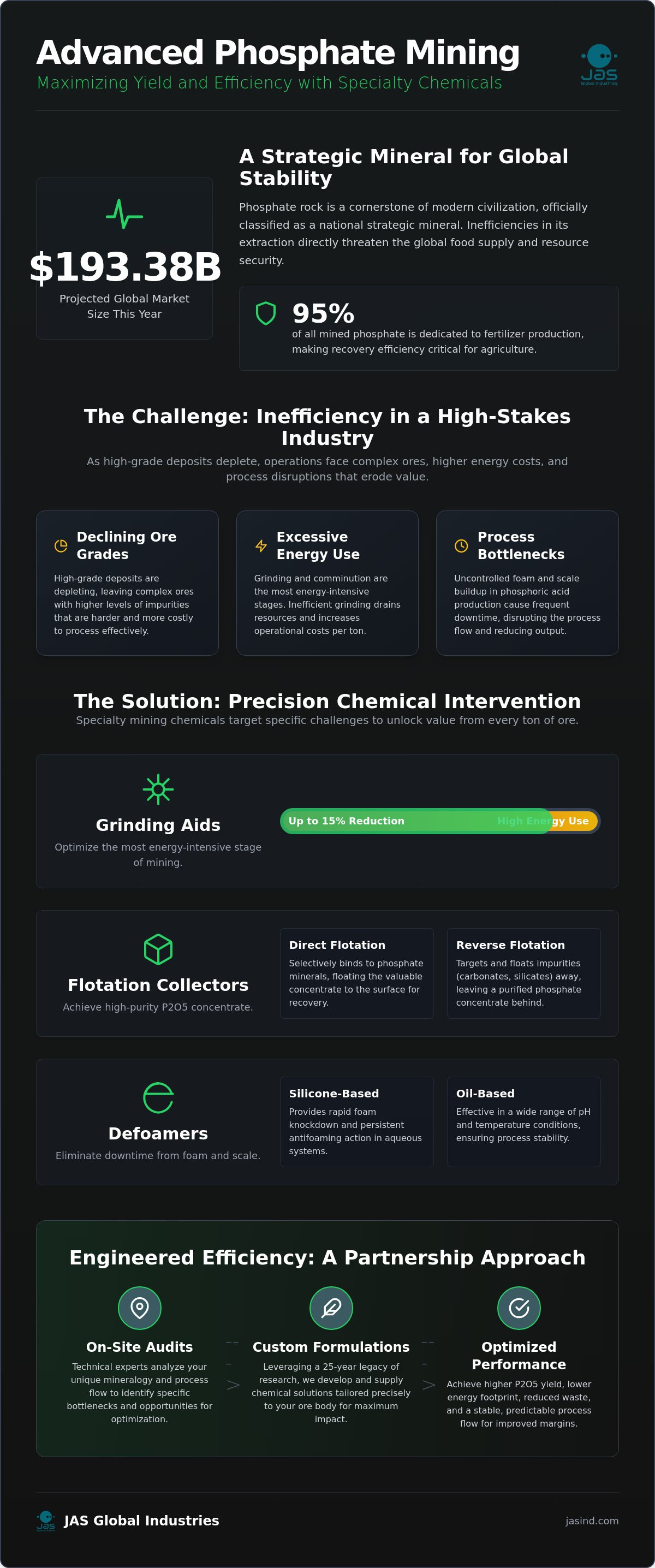
- Learn how specialized Phosphate Mining Chemicals like collectors and grinding aids can reduce energy consumption by up to 15% while maximizing P2O5 yield.
- Identify the specific chemical solutions, including silicone and oil-based defoamers, required to overcome foam and impurity challenges in phosphoric acid production.
- Discover the value of on-site technical audits and custom formulations in addressing the unique mineralogical bottlenecks of individual ore bodies.
- Explore how a 25-year legacy of research and global innovation centers provides the technical foundation for optimizing complex beneficiation circuits.
The Strategic Role of Phosphate Mining in Global Resource Security
Phosphate rock isn't just a commodity. It's a cornerstone of modern civilization. As global production reached an estimated 250 million metric tons in 2025, the industry faces a pivot point. We've moved past the era of easy extraction. Today, we must master the art of strategic mineral enrichment. Since 95% of all mined phosphate is dedicated to fertilizer production, any inefficiency in the mine translates directly to instability in the global food supply. This makes the optimization of recovery processes a matter of national and global concern.
Declining ore grades present a significant hurdle. High-grade deposits are depleting, leaving behind complex ores with higher impurity levels. This reality demands a shift from simple mechanical extraction to sophisticated chemical intervention. Without precision chemistry, these lower-grade resources remain locked away or wasted in tailings. We view this challenge as an opportunity to implement more resilient systems. By focusing on mineral enrichment rather than simple removal, we ensure that finite resources are utilized to their absolute maximum potential.
From Apatite to Agriculture
The journey from a geological deposit to a nutrient-rich field is complex. It begins with the extraction of Phosphate minerals, primarily apatite, which must be processed into high-purity phosphoric acid. This transition is the heartbeat of the agricultural supply chain. High-purity concentrate is non-negotiable for downstream fertilizer production. It ensures that the final product is both effective for the farmer and safe for the soil. Reliable mining solutions act as the bridge in this process. They stabilize the supply chain by ensuring that even challenging ores meet the strict quality standards required for phosphoric acid plants.
The Global Demand for High-Yield Beneficiation
Mining efficiency is a matter of global security. When recovery rates drop, fertilizer availability tightens and food prices climb. This creates a ripple effect that touches every corner of the globe. Utilizing advanced Phosphate Mining Chemicals allows operators to extract more value from every ton of rock moved. It's about maximizing the utility of a finite resource. Beyond yield, these specialty chemicals play a vital role in environmental stewardship. They significantly reduce waste in tailings management by ensuring that valuable minerals are recovered rather than discarded. By optimizing the beneficiation process, we reduce the overall environmental footprint of the mine. We don't just see these chemicals as industrial additives. We view them as essential tools for resource protection and long-term sustainability.
Advanced Flotation and Grinding: The Chemistry of Mineral Enrichment
The transition from raw ore to high-grade concentrate is a delicate chemical journey. While the scale of global operations is immense, the success of a mine often rests on molecular-level interactions. Precision is the priority. A properly balanced flotation circuit ensures that valuable P2O5 concentrate is recovered while unwanted gangue minerals are rejected to the tailings. Achieving this balance requires a deep understanding of how Phosphate Mining Chemicals interact with specific mineralogy. It isn't just about extraction; it's about the responsible stewardship of a finite resource through technical excellence.
Direct vs. Reverse Flotation Circuits
Mineral separation relies on the strategic use of reagents to manipulate surface chemistry. Flotation collectors are specialty surfactants that bind to specific mineral surfaces. In a direct flotation circuit, these collectors selectively hydrophobize the phosphate minerals, allowing them to attach to air bubbles and rise to the surface. Conversely, reverse flotation targets carbonates or silicates, floating the impurities away from the desired concentrate. This process requires highly selective Mining Depressants to inhibit the flotation of gangue minerals. The stability of the resulting froth is managed by Mining Frothers, which ensure consistent bubble size and mineral carry-over. Every dosing decision impacts the final grade, making real-time adjustments essential for maintaining a stable process flow.
Energy Optimization through Grinding Aids
Comminution is typically the most energy-intensive stage of any mining operation. According to U.S. Geological Survey phosphate data, the sheer volume of rock processed annually makes energy efficiency a critical pillar of sustainability. Mining Grinding Aids play a vital role here by preventing material re-agglomeration within ball mills. These chemical additives reduce the "cushioning effect" of fine particles, allowing the grinding media to strike the ore more effectively.
- Energy Reduction: Optimized grinding circuits can reduce energy consumption by up to 15%.
- Particle Distribution: Proper chemistry ensures a narrow particle size distribution, which is the foundation of flotation efficiency.
- Carbon Footprint: Lower energy usage per ton directly reduces the operational carbon footprint.
By preventing the build-up of fine material on grinding media, these additives ensure that the mill operates at peak mechanical efficiency. This technical approach protects both the equipment and the environment. Operators looking to enhance their recovery rates often find that tailored chemical programs provide the most reliable path to operational stability. When grinding and flotation work in harmony, the result is a higher grade concentrate and a more resilient supply chain.
Overcoming Operational Bottlenecks: Defoamers and Impurity Management
Operational stability is the bedrock of a productive mine. While flotation and grinding are central to recovery, secondary bottlenecks often dictate the ultimate success of a facility. Managing organic matter and ultra-fine particles is a technical necessity. These impurities create physical barriers to efficiency. They cause unpredicted downtime. They degrade product quality. By utilizing high-performance Phosphate Mining Chemicals, operators can mitigate these risks and maintain a steady, predictable process flow.
The "Foam Problem" remains a primary concern in both flotation cells and downstream phosphoric acid production. Organic matter in the rock reacts during processing, creating stable, persistent foam that disrupts filtration and reduces reactor volume. A comprehensive review of flotation reagents highlights how specific impurities demand targeted chemical responses. Standard defoamers often fail in these environments. We prioritize the selection of defoamers based on their persistence and chemical compatibility with the circuit. Silicone-based defoamers offer high efficiency at low dosages, while oil-based alternatives provide cost-effective stability in specific phosphoric acid circuits.
Scaling and corrosion pose a different set of challenges. These issues threaten the integrity of expensive infrastructure. Protecting pumps, pipes, and heat exchangers requires advanced industrial water treatment techniques. Scale inhibitors prevent the precipitation of calcium and magnesium salts, ensuring that process water remains a tool rather than a liability. Managing "slimes" is equally critical. These ultra-fine particles interfere with reagent performance by consuming high quantities of collectors. Effective dispersion and desliming are essential for maintaining the selectivity of the beneficiation process.
Strategic Defoaming in Phosphoric Acid Plants
Standard chemical solutions often break down in high-temperature, acidic environments. Phosphoric acid plants require defoamers with specific retention times to prevent carry-over into downstream stages. Tailoring these formulations ensures that foam control remains effective throughout the entire reaction cycle. This precision improves plant throughput. It also protects workers by preventing hazardous boil-overs and ensuring a stable operating environment.
Flocculants for Tailings and Water Recovery
Water is a vital global resource. In arid mining regions like Dubai, water recovery isn't just an operational goal; it's a social responsibility. Mining Flocculants, specifically high-molecular-weight polymers, accelerate solid-liquid separation in thickeners. This allows for the rapid return of process water to the plant. By optimizing this recovery, we reduce the environmental footprint of tailings dams and ensure the long-term sustainability of mining operations in water-stressed environments. We don't just process minerals; we protect the resources that sustain the communities where we operate, and for those interested in portable water security, you can learn more about QuenchSea and its manual desalination technology.
Engineering Efficiency: Custom Formulations and Technical Audits
Every mine possesses a unique mineralogical fingerprint. Treating Phosphate Mining Chemicals as generic commodities is a strategic error that often leads to suboptimal recovery and unnecessary reagent consumption. Off-the-shelf solutions fail to account for the specific impurities and textures of a particular ore body. We believe in a partnership rooted in technical precision. By moving beyond transactional supply—similar to how leading facilities choose professional-grade equipment from J Racenstein—we act as guardians of your resource, ensuring that every molecule of reagent contributes to maximum mineral enrichment.
Long-term operational reliability requires a structured chemicals management plan that evolves alongside the mine. As you move deeper into an ore body, the mineralogy changes. Your chemical strategy must adapt. Measuring ROI in this context isn't just about the price per kilogram of reagent. It's about the net value of the increased concentrate grade and the reduction in process waste. True efficiency is found where chemical performance meets operational stability.
The On-Site Laboratory Audit
Identifying mineralogical bottlenecks requires a hands-on approach. Our technical audit process is designed to find efficiency where others see routine. It follows a rigorous, three-step path to implementation:
- Step 1: Ore Characterization. We perform detailed mineralogical mapping to understand the relationship between phosphate and gangue minerals.
- Step 2: Bench-Scale Testing. We conduct exhaustive flotation tests with varied reagent dosages to find the optimal chemical balance for your specific ore.
- Step 3: Pilot-Scale Verification. We confirm these results in a continuous flow environment to ensure seamless industrial implementation.
Precision Dosing and Automation
Modern mining demands real-time responsiveness. The era of static, manual dosing is ending. Precision dosing systems now allow for immediate adjustments based on fluctuations in the feed ore. By integrating chemical performance data directly into the plant's digital control system, operators can maintain peak efficiency regardless of ore variability. This reduces chemical waste. It protects the environment. It ensures a predictable process flow that secures your margins. To see how these strategies can be applied to your specific site, we invite you to consult with our technical specialists today.
This level of automation creates a foundational industry presence. It transforms the chemical circuit into a self-optimizing system that prioritizes resource security. When data drives dosing, the result is a more resilient and sustainable operation that meets the fundamental needs of a growing global population.
Partnering for Performance: JAS Global Industries’ Specialty Solutions
Since 1998, JAS Global Industries has operated as a vital guardian of industrial resource stability. With a legacy spanning over 25 years, we've evolved from a chemical supplier into an indispensable partner for the global phosphate industry. Our mission is clear. We secure global food resources through technical excellence and ethical responsibility. By integrating deep industrial expertise with a sense of global purpose, we ensure that your operations don't just meet targets but set new standards for efficiency.
Our comprehensive portfolio addresses every challenge within the beneficiation and production circuits. We provide the essential Phosphate Mining Chemicals required to transform raw ore into high-value concentrate. This protection extends beyond the mine site and into the hands of the end-user. We manage the entire lifecycle of the mineral, providing everything from flotation collectors and frothers to anti-caking agents that maintain the integrity of finished fertilizer products during global transit.
Tailor-Made Chemical Formulations
We don't believe in generic answers. Our dedicated R&I centers focus on developing custom reagents specifically for your unique phosphate rock compositions and site-specific water chemistry. This commitment to tailor-made formulations ensures that your process remains both cost-effective and sustainable over the long term. We prioritize chemical technologies that maximize yield while minimizing the total environmental footprint of the mine. Beyond the laboratory, JAS Global Industries maintains the robust infrastructure necessary to provide reliable global logistics and supply chain management for large-scale mining contracts.
A Global Support Network
Reliability is rooted in presence. We leverage a strategic network of offices across Dubai, Europe, and Asia to provide rapid, on-site support whenever it's needed. Our technical consulting isn't a mere service; it's a strategic investment in your process optimization. By identifying hidden bottlenecks and refining chemical dosing through on-site audits, we help you achieve a stable and predictable process flow. We act as a foundational industry presence, focused on long-term value and the broader human impact of our technical solutions.
The stability of global food security depends on the efficiency of your recovery rates. Protecting these resources requires a partner with the wisdom and scale to deliver consistent results. We invite you to contact JAS Global Industries for a comprehensive mining process audit. Together, we can secure the future of global agriculture through industrial precision and shared responsibility.
Securing the Future of Global Mineral Recovery
Efficient extraction is no longer an operational option; it's a strategic necessity for global stability. Advanced Phosphate Mining Chemicals bridge the critical gap between complex geology and high-yield concentrates. By eliminating bottlenecks like persistent foam and energy-intensive grinding, operators protect both their margins and the global food supply. This transition from simple extraction to precision mineral enrichment ensures that finite resources are utilized to their absolute maximum potential.
Success in modern mining requires more than generic reagents. It demands a partner with deep technical integration and a commitment to long-term stability. With over 25 years of industrial expertise and global R&I centers dedicated to process optimization, JAS Global Industries provides the specialized formulations needed for even the most complex ore bodies. Partner with JAS Global Industries for tailor-made phosphate mining solutions to ensure your operation remains a resilient pillar of global resource security. Let's build a more sustainable and productive mining future together.
Frequently Asked Questions
What are the primary chemicals used in phosphate flotation?
The primary chemicals include collectors, frothers, and depressants. Collectors like fatty acids are used to selectively hydrophobize the phosphate minerals, allowing them to attach to air bubbles. Frothers manage the stability and size of those bubbles to ensure minerals reach the surface. Depressants are essential for inhibiting the flotation of unwanted gangue minerals like carbonates or silicates.
How do grinding aids improve energy efficiency in phosphate mining?
Grinding aids improve efficiency by preventing the re-agglomeration of fine particles within the ball mill. This chemical intervention reduces the "cushioning effect" that often absorbs grinding energy without breaking rock. By keeping the grinding media clean and effective, these additives can reduce energy consumption by up to 15%. This results in a lower carbon footprint for the comminution process. Much like the precision required by the experts at Caffeine Lab to achieve the perfect grind for extraction, industrial aids ensure that every strike of the grinding media is effective.
Why is foam control critical in phosphoric acid production?
Effective foam control prevents reactor overflows and maintains consistent plant throughput. Organic matter present in the phosphate rock reacts during acidulation, creating stable, persistent foam that can disrupt filtration. Utilizing specialized defoamers ensures that the reactor volume is fully utilized. This protects the safety of the operational environment and ensures that production targets are met without unexpected downtime.
Can custom chemical formulations improve the grade of low-quality phosphate ore?
Yes, custom formulations target specific impurities to enhance the grade of complex or low-quality ores. By tailoring Phosphate Mining Chemicals to the unique mineralogical fingerprint of a specific deposit, operators can achieve higher P2O5 grades. This precision makes lower-grade resources economically viable. It transforms challenging ore bodies into high-yield assets for the global fertilizer industry.
What is the role of flocculants in phosphate tailings management?
Flocculants accelerate solid-liquid separation to maximize water recovery and reduce waste. These high-molecular-weight polymers bind fine particles together, allowing them to settle rapidly in thickeners. This process is vital for recycling process water back into the plant, which is a major priority in arid regions. Efficient flocculation also reduces the overall environmental footprint of tailings storage facilities.
How does JAS Global Industries support mining process optimization?
JAS Global Industries provides technical audits and R&I centers to solve complex beneficiation challenges. We analyze specific ore bodies to develop tailor-made chemical programs that maximize recovery and grade. Our team offers on-site technical consulting to ensure that chemical dosing is precise and integrated into the plant's digital systems. This partnership approach prioritizes long-term operational stability and resource security.
Are these mining chemicals environmentally safe for long-term use?
Our specialty chemicals are formulated to be sustainable and compliant with rigorous environmental regulations. We prioritize the development of reagents that maximize mineral recovery while minimizing chemical carry-over into the environment. This focus on responsible chemistry protects the ecosystems surrounding the mine. It ensures that mining operations can maintain their social license to operate while securing critical global resources.
What is the difference between a frother and a collector in phosphate mining?
Collectors manipulate mineral surfaces while frothers manage air bubble stability. A collector is a surfactant that binds to the phosphate mineral to make it water-repellent and ready for flotation. In contrast, a frother acts on the air bubbles within the flotation cell to control their size and persistence. Both are essential Phosphate Mining Chemicals that must work in harmony to ensure a high-grade concentrate.