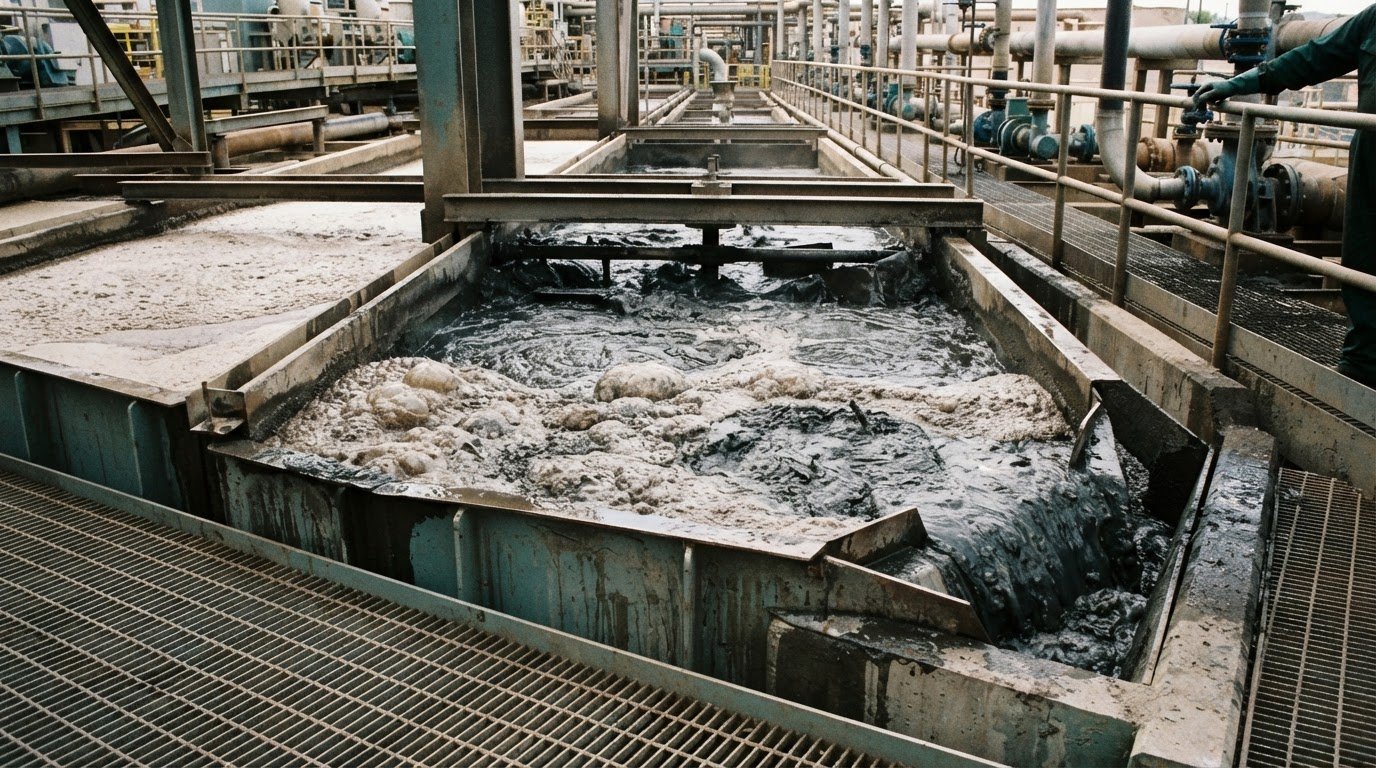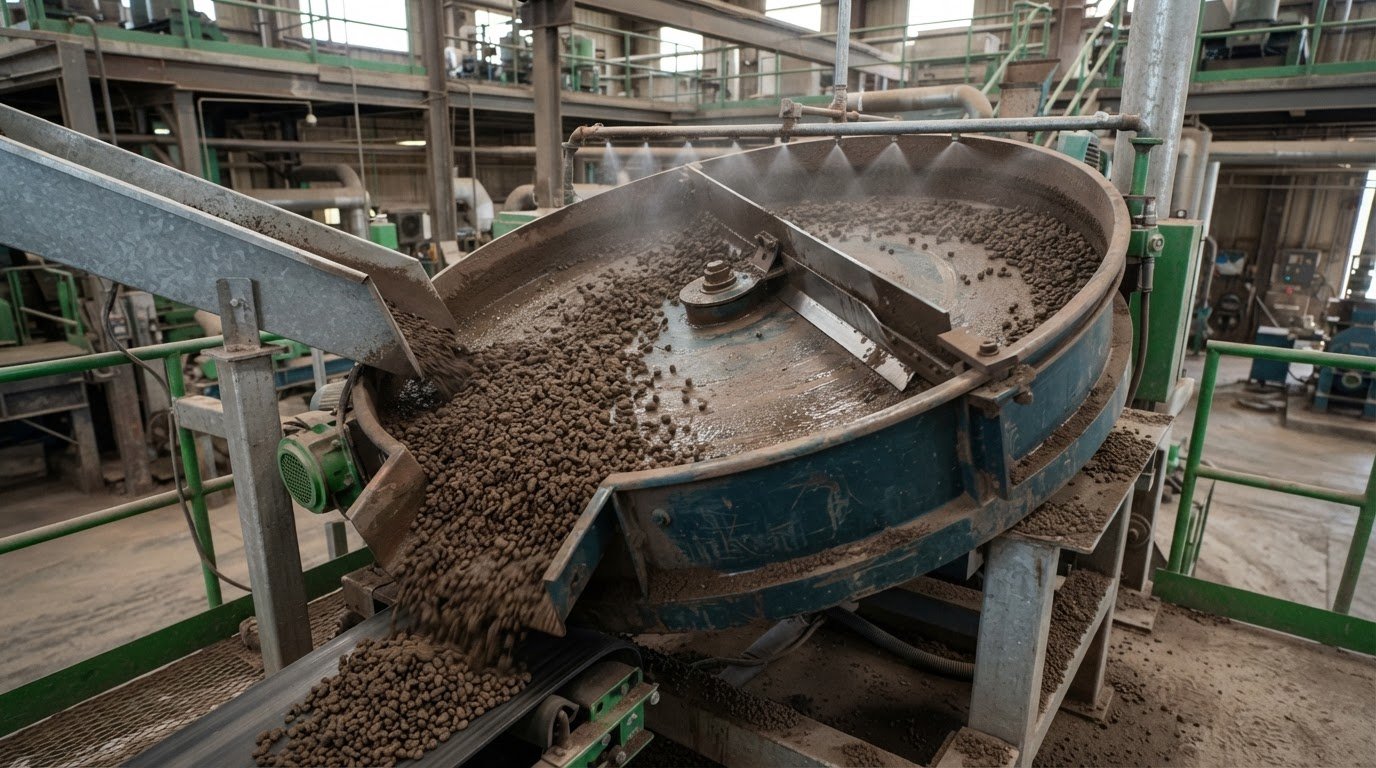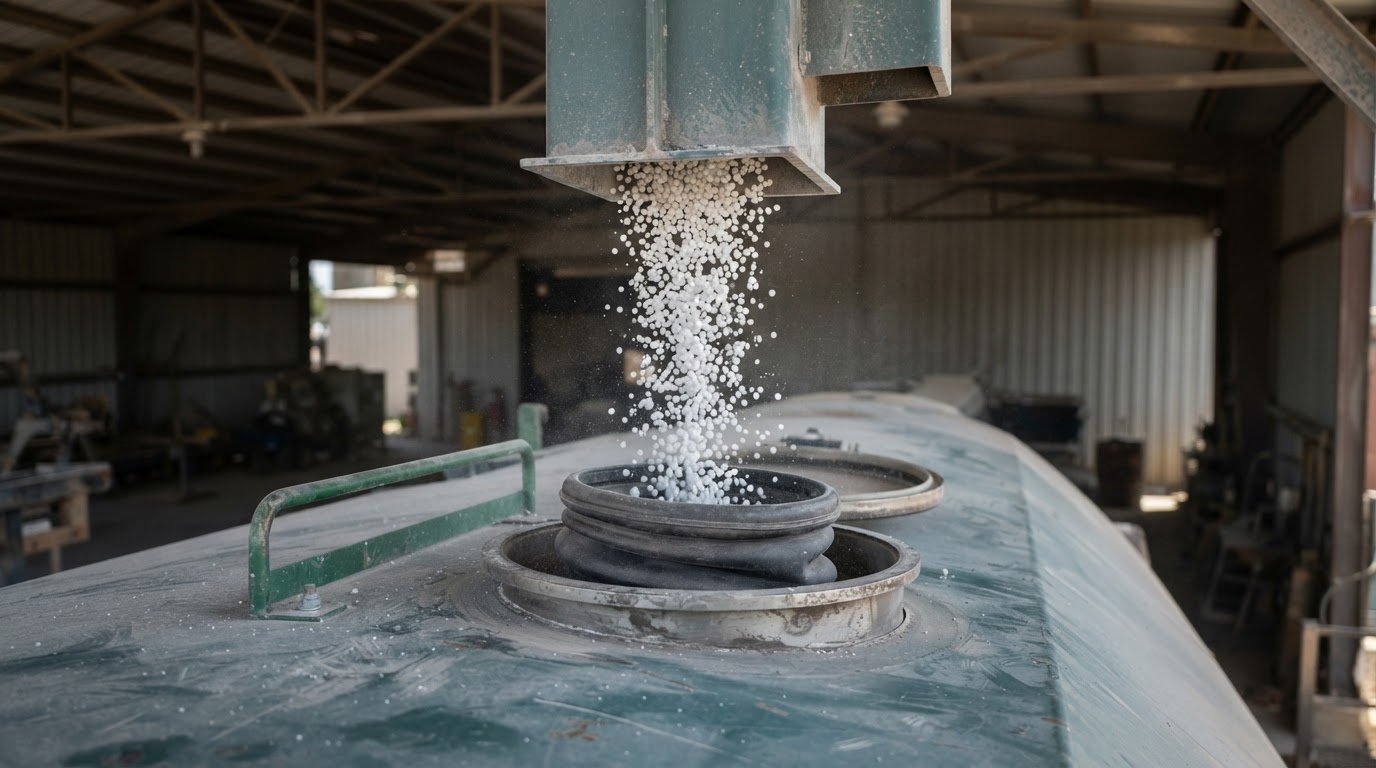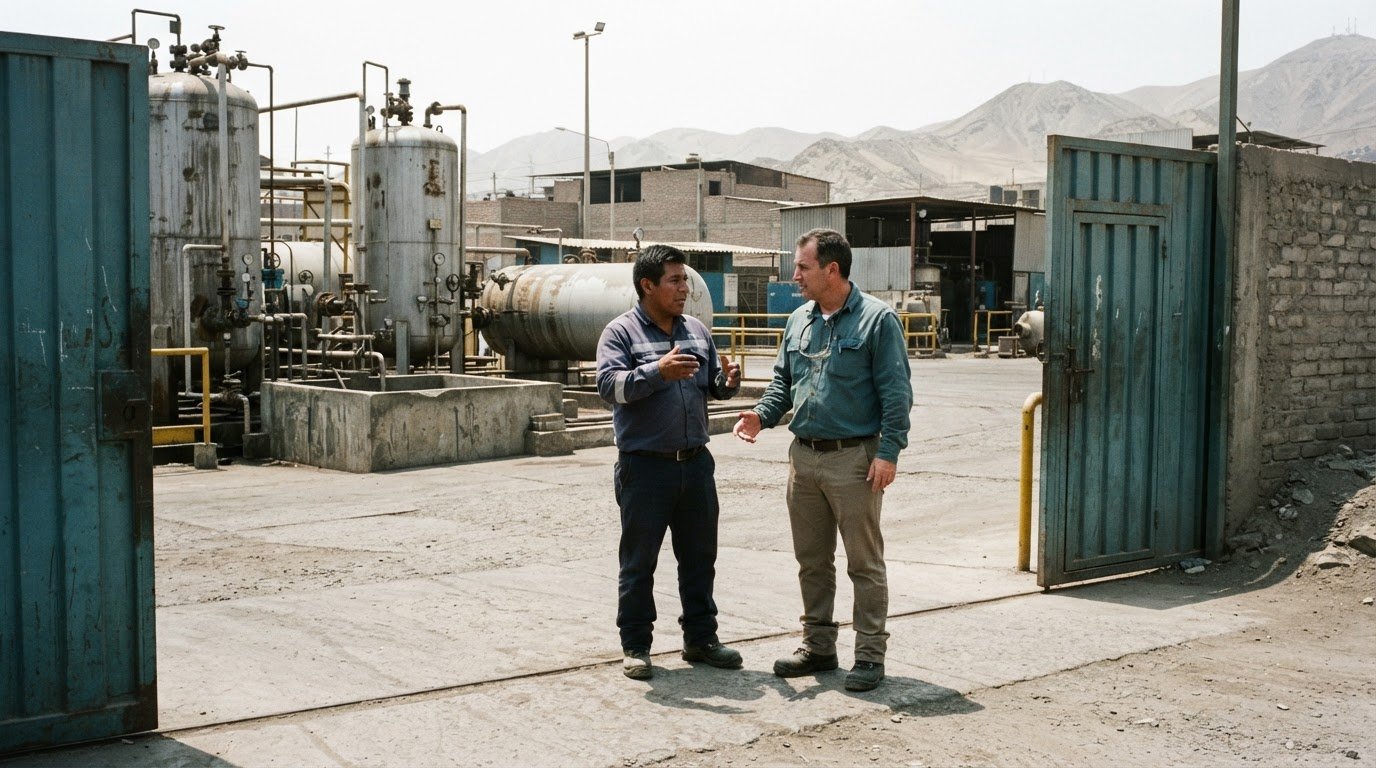

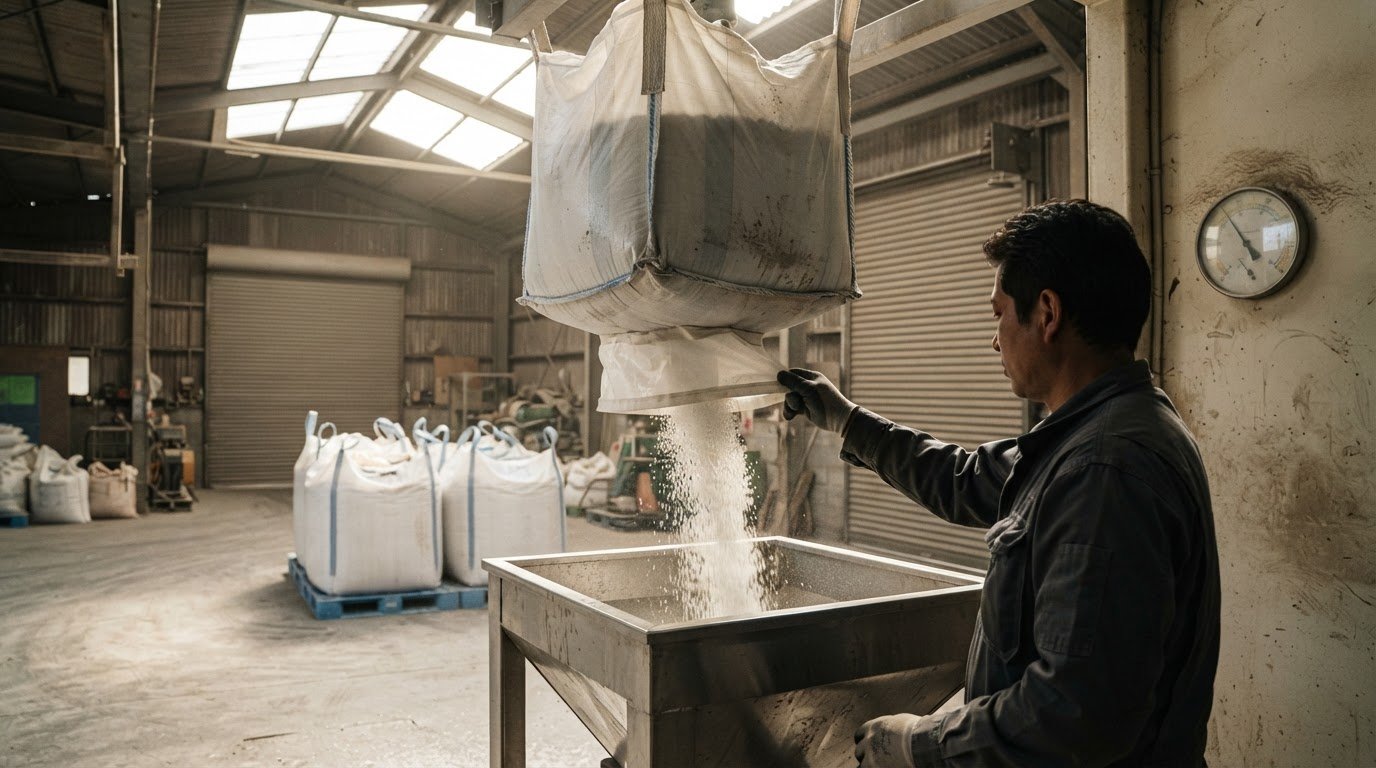
Moisture can turn free-flowing fertilizer into a solid mass, even when it’s stored carefully. Preventing fertilizer caking during storage starts with keeping relative humidity well below 50% where possible, limiting moisture exposure and reducing the pressure and temperature swings that encourage granules to bond. Caking can develop as moisture dissolves material at granule contact points, then the material recrystallizes and forms solid bridges.
If fertilizer cakes despite good storage practices, moisture is only part of the picture. Product composition, particle strength, packaging, handling and warehouse conditions can all contribute. This article explains how critical relative humidity affects moisture absorption, why caking forms and which practical controls can reduce the risk. It also covers how moisture-resistant packaging, stable temperatures, sensible stacking and anti-caking treatments work together to protect product flow during storage.
Key Takeaways
- Recognize how particle contact, pressure, dust and product properties combine to form hardened bridges, then target the causes in your process.
- Use critical relative humidity as a product-specific warning point, not a single threshold for every fertilizer.
- Assess anti-caking treatment for even coverage and compatibility with the fertilizer, while keeping dust control and product performance in view.
- Reduce storage risks with moisture-resistant packaging, stable warehouse conditions and careful stacking practices.
1. What Causes Caking in Fertilizers?
Fertilizer cakes when granules bond at contact points. Moisture, pressure and chemical interactions can create capillary adhesion or crystalline bridges, while dust and damaged particles add more binding surfaces. Storage time, temperature and fertilizer composition also influence how strongly these bonds form.
Coatings can help separate granules and limit moisture exchange. Powder treatments such as diatomaceous earth, clay and talc form a surface barrier. Liquid anti-caking additives can also reduce bonding. The right choice depends on the fertilizer’s properties and storage conditions, because no single coating suits every product.
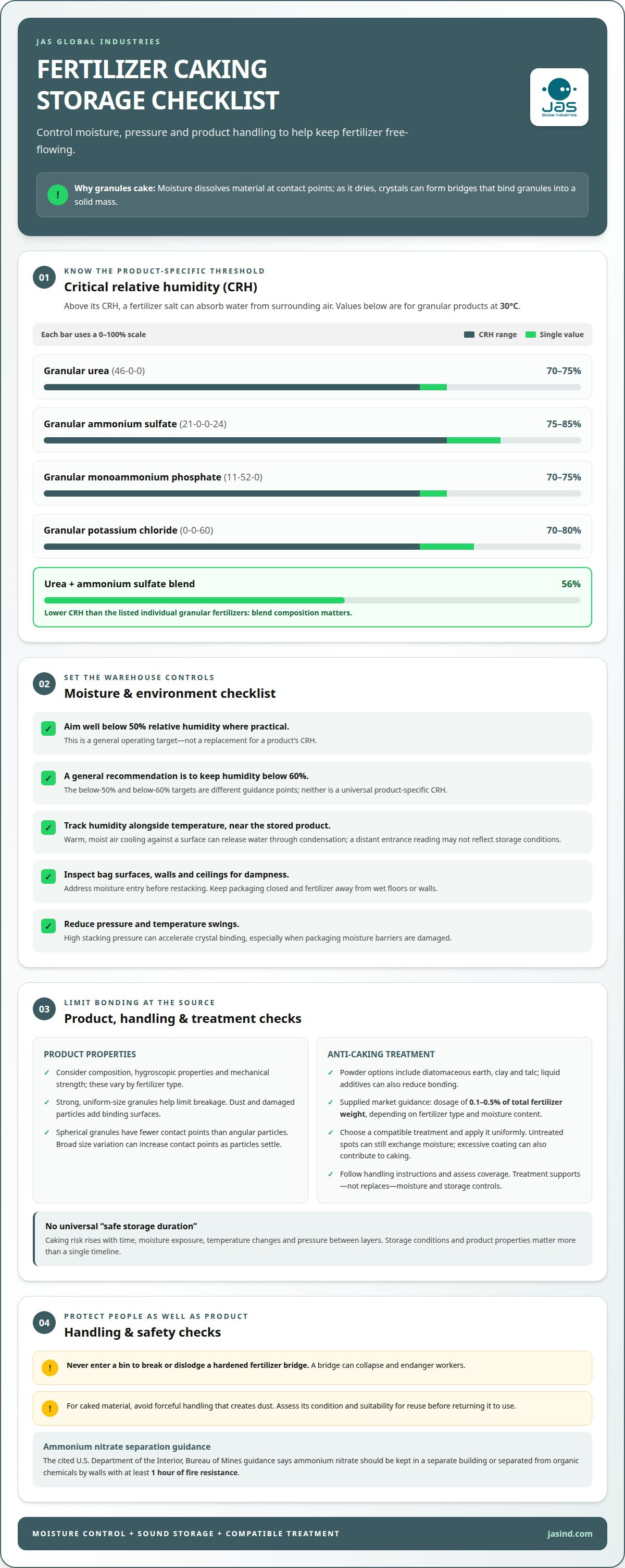
Application matters as much as the additive. The recommended dosage in the supplied market guidance is 0.1–0.5% of total fertilizer weight, depending on fertilizer type and moisture content. Granules need a uniform coating, since untreated spots can still exchange moisture and form bridges. Excessive coating can also contribute to caking.
To protect nutrient efficiency and product quality, choose a treatment compatible with the fertilizer and apply it at an appropriate rate. Follow the additive’s handling instructions, control application conditions and assess the treated product for uniform coverage. A coating should support, not replace, moisture and storage controls.
There is no universal storage duration before caking becomes likely. Risk rises with time, moisture exposure, temperature changes and pressure between layers. Storage conditions and product properties matter more than a single timeline.
In the United States, the cited U.S. Department of the Interior, Bureau of Mines guidance says ammonium nitrate should be kept in a separate building or separated from organic chemicals by walls with at least 1 hour of fire resistance. Hardened fertilizer bridges can collapse and endanger workers; never enter a bin to break one manually.
Treatment costs depend on formulation, application rate and process requirements; pricing is provided after a quote request. Effectiveness depends on correct, uniform application alongside sound moisture and storage controls. For caked material, avoid forceful handling that creates dust, and don’t enter a bin to dislodge hardened fertilizer. Assess the product’s condition and suitability for reuse before returning it to use.
2. Critical relative humidity and fertilizer moisture absorption
Fertilizer salts can absorb water from the surrounding air when relative humidity exceeds their critical relative humidity (CRH). Moisture dissolves material on granule surfaces; as it dries, crystalline bridges can form. This physical process can turn separate particles into solid masses. The National Institute for Occupational Safety and Health (NIOSH) also notes that powders can cake as humidity or moisture content rises. Keeping warehouse humidity below a product’s CRH helps limit moisture absorption, but does not eliminate condensation or packaging risks.
CRH depends on fertilizer composition. At 30°C, granular urea (46-0-0) has a CRH of 70–75%, while granular ammonium sulfate (21-0-0-24) has a CRH of 75–85%. Granular monoammonium phosphate (11-52-0) is also 70–75% at 30°C; granular potassium chloride (0-0-60) is 70–80%. A urea and ammonium sulfate blend has a lower CRH of 56%, showing why blend composition matters.
For storage humidity control, aim well below 50% relative humidity where practical. Another general recommendation is to keep humidity below 60% to help prevent dissolution and recrystallization. These are different operating targets, not interchangeable product-specific CRH values. Use the lower target where feasible, especially for blends with lower CRH. Track warehouse humidity alongside temperature, since warm, moist air cooling against a surface can release water through condensation.
Measure humidity near stored product, not only at a distant entrance. Inspect bag surfaces, walls and ceilings for dampness, then address moisture entry before restacking. Keep packaging closed and separate fertilizer from wet floors or walls. These steps limit environmental exposure and help protect moisture content and product flow. Where treatment is part of a wider control plan, fertilizer anti-caking treatments can help reduce particle bonding, alongside humidity and packaging controls.
3. Causes of fertilizer caking
Fertilizer caking develops when granules bond through salt bridges, capillary adhesion or both. Moisture can dissolve material where particles touch; as it dries, crystals bind those contact points. The resulting mass may restrict flow through equipment or form a hardened bridge inside a storage bin.
Fertilizer type affects caking risk because chemical composition, hygroscopic properties and mechanical strength vary. Urea, ammonium nitrate and other hygroscopic materials can take up moisture readily, while product temperature and storage pressure also affect bonding. Handling matters, too: broken granules create dust, which can collect between particles and contribute to bridge formation.
Granule shape and size matter as well. Spherical granules have fewer contact points than angular particles, reducing opportunities for bonding. Uniform particle size and strong granules also help limit breakage and caking risk. Products with a broad range of particle sizes may settle unevenly, leaving smaller particles between larger ones and increasing contact points under pressure.
Warehouse and transport conditions can introduce moisture even without a spill. Warm, moist air that cools rapidly can release water onto fertilizer surfaces. In shipping containers, temperature swings can cause condensation on the ceiling, which may drip onto upper layers of bagged product. High stacking pressure can then accelerate crystal binding, especially if packaging moisture barriers are damaged.
Production residues are another potential source of caking. Dust or adhesive material left on equipment can transfer to granules and act as a binding layer. Over-coating can also contribute, so treatments must be applied evenly and without excess. Reducing unnecessary handling, limiting particle breakage and keeping production lines clean address these causes before product enters storage.
4. Moisture-resistant packaging and warehouse conditions
Choose packaging that limits moisture entry during storage and distribution. Inner-lined plastic bags, composite material bags and vacuum-sealed packaging can protect fertilizer from external moisture. Multi-layer bags or bags with an internal moisture-resistant liner provide another barrier. For woven polypropylene bags, BOPP film lamination can limit moisture transfer; HDPE or LLDPE liners can help isolate granules from container condensation.
Warehouse conditions matter after packing, too. Store fertilizer in a dry, ventilated space with a constant temperature not exceeding 25°C. Raise bags on dry wooden or plastic pallets, rather than placing them directly on concrete, where ground moisture can wick upward. Monitor temperature and reduce large swings that can cause condensation. Keep storage bins clean and dry before loading, and avoid loading during hot, humid conditions.
Protect loads in transit as well as in storage. Cover fertilizer shipments with waterproof tarps to reduce exposure to rain and humid air. Vibration and impact can break particles, creating dust that collects between granules and contributes to bridges. Shock-absorbing devices or cushioning materials during transport help reduce breakage and dust generation. On arrival, inspect packaging for tears, dampness or signs of water ingress.
Blending can change moisture tolerance because ingredients may respond differently to ambient humidity. A blend’s behavior cannot be judged from one component alone; consider the finished mixture, its packaging and the conditions it will encounter. Keep blends protected during mixing and distribution, since exposed surfaces can absorb moisture before sealing. Avoid transferring damp material into dry bags, where residual moisture may encourage caking.
Pair packaging with controlled storage and careful handling to reduce moisture exposure from filling through delivery. For support with treatment as part of a broader caking-control plan, explore fertilizer anti-caking agents.
JAS Global Industries
JAS Global Industries helps fertilizer operations address caking and dust-control needs with specialty chemical solutions. Its Fertilizer Anti-caking Agents and Fertilizer Dust Suppressants can support operations facing challenges with moisture exposure, handling or product movement during storage and distribution.
Turn to JAS Global Industries when storage controls alone are not enough or when treatment needs to suit a particular fertilizer and production process. The company develops tailor-made formulations, supporting an approach that considers product conditions alongside chemical treatment. Anti-caking agents work best as part of a broader plan that also manages humidity, packaging, temperature and handling.
Contact JAS Global Industries to discuss fertilizer caking and the treatment needs of your operation.
Build caking prevention into your operating plan
Make preventing fertilizer caking during storage part of routine process planning, rather than waiting until product flow becomes difficult. Set clear responsibilities for monitoring storage conditions, handling product and reviewing packaging performance. Recording where and when caking appears can help identify recurring exposure points and guide adjustments across production, transport and storage.
When process controls need additional support, JAS Global Industries offers Fertilizer Anti-caking Agents and Fertilizer Dust Suppressants for fertilizer operations. Its Mining Flotation Collectors serve a different industrial application. Start the discussion with your fertilizer type, process conditions and the storage challenges you need to address.
Contact JAS Global Industries to discuss your fertilizer caking-control needs. A coordinated approach can help your operation protect product flow and maintain dependable handling.
Frequently Asked Questions
What Causes Caking in Fertilizers?
Caking occurs when particles stick together and harden into aggregates. Moisture, pressure between stored layers, damaged granules and production residues can all contribute. Fine dust between larger granules creates extra binding points, while compression can make those contacts harder to separate. To prevent fertilizer caking during storage, start by identifying which of these conditions are present in your handling and storage process.
What Are Anti-Caking Agents?
Anti-caking agents are treatments that help fertilizer granules stay separate and flow freely. They can form a barrier on particle surfaces or reduce bonding associated with moisture and contact. Powder coatings and liquid treatments are different approaches, and selection depends on the fertilizer and process. These additives support good storage practices; they do not eliminate the need to manage moisture exposure.
What Are Fertilizer Additives?
Fertilizer additives are materials used during processing or handling to support a particular product or process function. Examples include anti-caking agents, dust suppressants and granulation aids. Their roles differ: an additive intended to address dust is not automatically an anti-caking treatment. The right choice depends on the challenge and how the additive fits the fertilizer’s production and handling process.
Why Do These Phenomena Occur?
Granules respond to their surroundings and to one another. Moisture can soften or dissolve material at contact points, and drying can leave solid bonds. Pressure brings particles into closer contact, while temperature changes can encourage moisture to condense on surfaces. These mechanisms can act together, so a product may cake even when no single storage factor seems extreme on its own.
Why Does It Matter?
Caking can interfere with fertilizer flow through bins, conveyors and application equipment. Hardened masses may require extra handling and interrupt product movement. Breaking them apart can also generate dust, potentially affecting working conditions. For agricultural operations, consistent flow supports reliable storage, distribution and application, while helping reduce disruption from blocked equipment or material that no longer moves freely.
How Should Fertilizer Be Stored to Prevent Caking?
A routine for preventing fertilizer caking during storage should protect product from moisture and avoid unnecessary handling. Use a dry, ventilated warehouse, keep bags off damp floors and shield them from rain. Rotate inventory so older product is used first. Clean and dry bins before refilling, check for residue or moisture, and promptly address damaged packaging to limit exposure during storage and movement.