


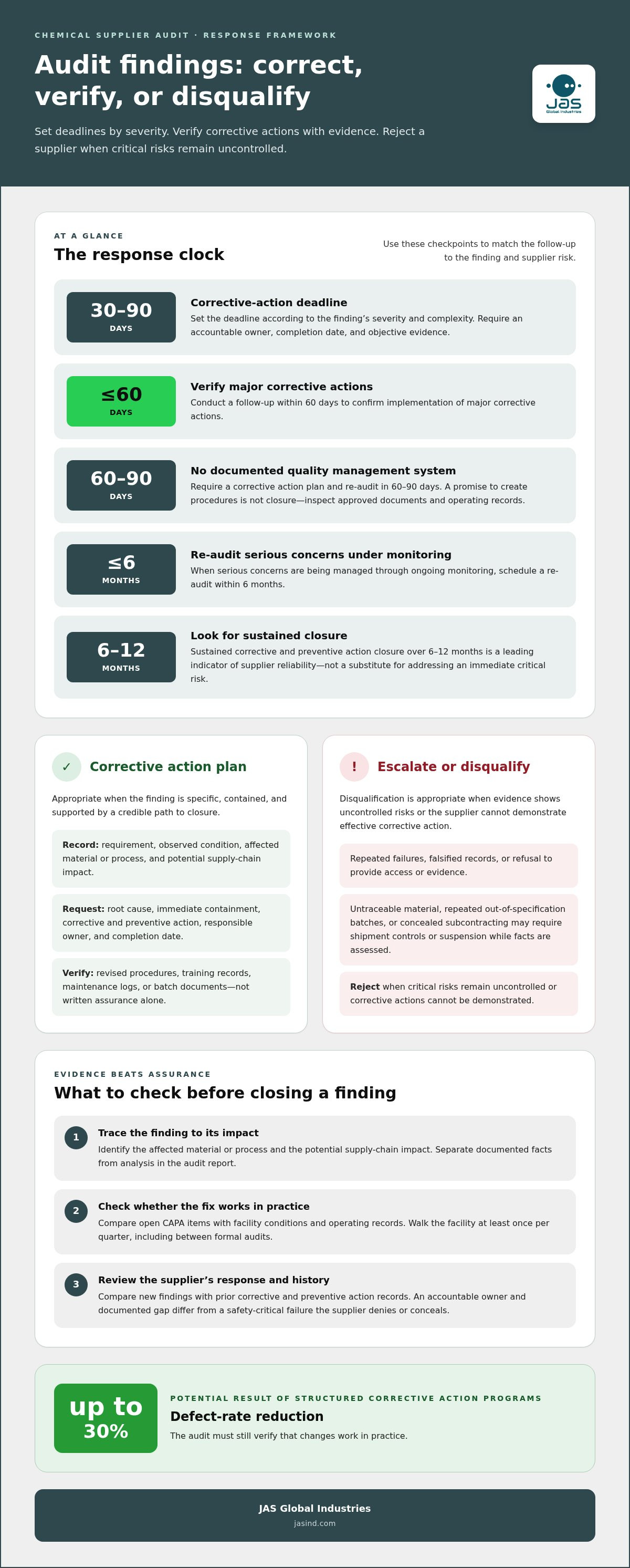
A failed audit isn’t automatically a reason to reject a supplier, but serious safety, compliance, or traceability failures need decisive action. The red flags during a chemical supplier audit should be assessed by their risk and whether the supplier can correct them: set corrective action deadlines of 30 to 90 days, depending on the finding, and follow up within 60 days to verify major corrective actions. Reject a supplier when critical risks remain uncontrolled or corrective actions can’t be demonstrated.
Take documentation gaps, inconsistent batch records, and missing or outdated certifications seriously. The key is to distinguish a fixable lapse from a pattern that could put product quality, worker safety, or supply continuity at risk.
This article explains how to assess audit findings, address documentation and traceability gaps, review regulatory compliance and certification, and decide when to require a corrective action plan or reject a supplier. It also covers practical ways to document findings, set follow-up expectations, and base supplier decisions on evidence.
Key Takeaways
- Separate correctable gaps from critical risks, and set corrective action deadlines based on the severity and complexity of each finding.
- Review Safety Data Sheets, product classifications, labels, and compliance records for consistency with the markets the chemicals serve.
- Trace each shipment to its specific production lot, and compare batch records with certificates of analysis before accepting material.
- Look beyond paperwork: inspect housekeeping, protective equipment, emergency access, and chemical storage conditions at the facility.
- Assess whether the supplier’s quality system records non-conformances and closes corrective actions, rather than relying on certification claims alone.
1. When should a failed audit result in supplier disqualification versus a corrective action plan?
A failed audit calls for a corrective action plan when the finding is specific, contained, and supported by a credible path to closure. Disqualification is appropriate when evidence points to uncontrolled risks, repeated failures, falsified records, or refusal to provide access or corrective action evidence. Assess the supplier’s response alongside the original concern. A documented gap with an accountable owner differs from a safety-critical failure the supplier denies or conceals. Use red flags during a chemical supplier audit to judge both the severity of the finding and the supplier’s willingness to address it.
For each finding, record the requirement, observed condition, affected material or process, and potential supply chain impact. Ask the supplier to identify the root cause, immediate containment, corrective action, preventive action, responsible owner, and completion date. A chemical supplier corrective action plan should typically set deadlines of 30 to 90 days, depending on finding complexity. Require objective evidence, such as revised procedures, training records, maintenance logs, or batch documents, rather than written assurance alone.
Use risk to set the response. A missing signature on an otherwise complete record may warrant correction and targeted review. Untraceable material, repeated out-of-specification batches, or concealed subcontracting may require shipment controls or supplier suspension while facts are assessed. When red flags during a chemical supplier audit involve major non-conformities, conduct a follow-up audit within 60 days to verify implementation. Serious concerns managed through ongoing monitoring call for a re-audit within 6 months.
- Keep the relationship conditional: assign owners, deadlines, and evidence requirements in the CAPA record.
- Escalate repeated failures: compare new findings with prior corrective and preventive action records.
- Disqualify when control is absent: assess whether the supplier can protect product integrity and worker safety.
When a supplier has no documented quality management system, require a CAPA and re-audit in 60-90 days. A promise to create procedures is not closure; inspect approved documents and operating records during follow-up. Structured corrective action programs can achieve defect rate reductions of up to 30%, but the audit must verify that changes work in practice.
Keep the decision trail clear. Audit reports should distinguish facts from analysis, identify each finding’s severity, and record the supplier’s response. Walk facilities with fresh eyes at least once per quarter, even between formal audits. Compare conditions with open CAPA items, then document whether actions remain effective. Sustained corrective and preventive action closure over 6-12 months is a leading indicator of supplier reliability, not a substitute for addressing an immediate critical risk.
2. What documentation gaps most commonly fail a chemical supplier audit?
Review the supplier’s current Safety Data Sheets (SDS), product specifications, batch and quality records, applicable regulatory documents, certifications, calibration certificates, and corrective action records. Compare each document with the material, manufacturing facility, destination market, and audit findings. Investigate missing, inconsistent, or altered records.
An SDS must match the product’s current composition and hazard classification. According to OSHA, Safety Data Sheets under the Hazard Communication Standard must include all 16 sections, with non-applicable sections explicitly identified. Check that section details agree with the product label, shipping information, and technical documentation. A missing section, conflicting hazard statement, or unexplained revision date is a red flag, not a clerical detail.
For chemicals supplied to Europe, confirm whether REACH obligations apply and whether required registrations are in place with ECHA. Check that product classifications and labels align with CLP requirements. For U.S. food facilities, 21 CFR § 117.475 requires documentation of supplier audit details, conclusions, and corrective actions. Calibration certificates should show valid dates, technician credentials, and traceability to recognized standards.
Cross-border records should let the buyer connect the ordered material, supplier, shipment, and destination. Compare commercial and shipping records with product names, grades, quantities, and lot identifiers; resolve differences before release. Don’t treat a polished certificate as proof by itself. Check its issuer, dates, product scope, and identifiers against supporting records. An expired certification, or one covering a different facility, does not support the same claim. If records appear falsified, such as through altered dates or inconsistent signatures, preserve them and escalate through the buyer’s quality process.
Financial, cybersecurity, and business continuity reviews should examine different risks. Watch for sudden payment-term changes, delayed replies, departing account contacts, or price increases that outpace market rates. Check financial health through three sources quarterly. For suppliers handling sensitive data or connected systems, assess security assurance, incident response, and recovery plans; response taking more than a week, a recovery point objective exceeding 1 hour, or a recovery time objective exceeding 4 hours are listed warning thresholds. Also review how the supplier would maintain production, records, and communications during disruption.
- Match every document to the correct product and facility.
- Record missing evidence, discrepancies, and the action needed to resolve each gap.
- Retain the original file when a record appears altered, then document the review.
For specialty chemical procurement, connect audit documentation to the intended process and material scope. Reviewing specialty chemical inputs against clear specifications helps keep supplier records relevant to operational needs.
3. Material traceability, batch records, and certificates
Assess raw-material traceability by following a finished product backward through batch records to incoming materials and their suppliers. Compare supplier identifiers, receipt records, production dates, and lot numbers; require 90-day advance notice of changes to manufacturing processes, formulations, or packaging. Missing links are red flags during a chemical supplier audit because they can prevent a buyer from identifying affected material.
Traceability must work in both directions. Select a finished batch and trace it back to raw-material lots, then choose an incoming lot and identify every finished batch that used it. Check that physical container labels match receiving records, production logs, and certificates of analysis. These red flags during a chemical supplier audit can make it harder to isolate affected material during an investigation or recall.
Certificates should describe the specific material and batch being delivered. For example, a Certificate of Analysis issued for a 500 MT lot does not provide meaningful batch-level assurance for a 20 MT chemical container order. Compare the certificate’s lot identifier with container markings, packing lists, and production records. Resolve mismatches before accepting the certificate as evidence of the delivered batch’s quality.
Review batch histories for rejected, reworked, and released material. An internal batch rejection rate of 1-3% is described as typical for a reputable manufacturer with strong quality control. A rate above 5% can signal systemic quality problems or reluctance to answer honestly. Ask how the supplier calculates the rate, which batches it includes, and whether rejected material was scrapped, reprocessed, or released under an approved decision.
Examine production reports for the last 30 days, including quantities produced, scrap rates, and corrective actions. Compare reported output with batch logs and inventory movements. Differences can reveal incomplete records, unexplained rework, or production lots that lack a clear disposition. The target for supplier documentation completeness is 100%; identify each missing record and its effect on lot-level assurance.
- Test the traceability path: select a lot and match its physical label to receiving, production, and shipment records.
- Assess rejection trends: review rate definitions and compare reported failures with batch dispositions.
- Record changes: check whether process, formulation, or packaging changes received advance notice and documented review.
If material traceability is missing, require implementation of lot tracking within 60 days. Verify the new system through a sample trace from receipt to shipment, rather than accepting a procedure document alone. Incoming material rejection rates below 1% are reported for companies with well-developed audit and qualification programs, compared with 3%-5% for companies with less oversight. Treat a rising rejection pattern as a signal to examine supplier controls and sourcing records.
Two consecutive lot rejections warrant an immediate supplier re-audit. Focus on the failed characteristics, raw-material sources, batch records, and release decisions. Determine whether the failures share a cause and whether corrective changes restored control across subsequent batches.
4. What are the regulatory red flags to watch for in a chemical supplier audit?
In the United States, relevant requirements include OSHA’s Hazard Communication Standard and, for covered processes, Process Safety Management under 29 CFR 1910.119. An auditor should assess the supplier’s chemical hazard communication, process controls, storage practices, and emergency protections against the materials and operations at the facility.
Common red flags include an outdated or incomplete Safety Data Sheet, workers handling chemicals without required protective equipment, blocked emergency exits, and leaking or damaged containers. Compare written procedures with operating practice during the inspection. A mismatch can signal weak training or controls that fail to protect workers and materials.
OSHA’s Hazard Communication Standard requires Safety Data Sheets to include all 16 sections, with non-applicable sections explicitly identified. Check that the SDS is current and follows GHS Revision 7 or later, then compare its hazard information with container labels and the chemicals present. A mismatch between the SDS and the physical label demands investigation before the material is handled or stored.
Walk the manufacturing and warehouse areas systematically. Note visible spills, dust buildup, standing water, clutter, rust, tears, leaks, or bulging drums and bags. These conditions can indicate poor housekeeping or container maintenance. Check that fire extinguishers are accessible and show inspection dates, exits are clear, and eyewash stations and safety showers are accessible and functional. Missing or inaccessible gloves, goggles, respirators, or chemical-resistant aprons near handling areas are direct safety concerns.
Inspect chemical segregation and handling controls. Confirm that flammable, non-flammable, food-grade, non-food-grade, and toxic chemicals are separated as required by the facility’s storage plan. Check that chemicals that could become combustible when exposed to moisture or air are kept apart. Look for labeled containers, compatible storage locations, and handling instructions workers can follow. A safe written procedure is ineffective if operating practice contradicts it.
For covered facilities, OSHA’s Process Safety Management standard, 29 CFR 1910.119, calls for documentation such as process hazard analyses and management-of-change systems. It is particularly relevant to operations involving large quantities of flammable liquids with a flashpoint below 100°F. Review the process hazard analysis and change records, then compare them with equipment and current production. Missing reviews or equipment changes without corresponding records signal a breakdown in process control.
- Use 5S as a visual check: assess Sort, Set in order, Shine, Standardize, and Sustain across work areas.
- Record specific observations: identify the location, condition, affected chemical, and control requiring action.
- Assess community protection: include spill prevention and emergency response arrangements around the facility.
Housekeeping findings matter because clutter, spills, and obstructed safety equipment can expose employees and visitors to harm. Connect each observation to the relevant chemical, storage area, or manufacturing step, then record the evidence and required corrective action in the audit report.
5. Quality management systems and ISO certification checks
Verify a chemical supplier’s quality management system by comparing its procedures with actual production, inspection, and release records. Check that each certification is current and covers the legal entity, facility, and processes relevant to the supplied material.
ISO 9001 is a quality management system standard relevant to chemical suppliers. Ask how the supplier controls specifications, approves changes, manages non-conformances, and reviews corrective actions. Then sample records from a recent production run. For example, compare the approved procedure with inspection results and the final release decision. A certificate cannot replace evidence that the management system operates consistently.
Confirm a certification’s scope before relying on it. The certificate should identify the correct facility and activities, show valid dates, and match the supplier named in the purchasing relationship. If production takes place at another site, assess whether that site falls within the certification scope. A mismatch between the certificate and the manufacturing location is a material audit finding.
ISO 14001 covers environmental management, while IATF 16949 is a common certification for automotive-sector quality. Apply each standard only where it fits the supplier’s work and your application. Review environmental controls, quality records, and customer-specific requirements against the actual operations. For example, a supplier’s environmental certificate does not demonstrate control of batch consistency or product release.
Test whether quality controls produce reliable records. Review internal audits, management reviews, complaint investigations, rejected batches, and corrective action closure. A supplier claiming no quality incidents in recent years may be failing to record non-conformances. Customer rejection or return rates above 2% of production output can signal systemic process-control problems. Compare the supplier’s trend analysis with production and complaint records, then ask how identified causes changed the process.
- Trace scope: match the certificate to the facility, legal entity, and supplied process.
- Test implementation: compare written procedures with actual batch and inspection records.
- Review performance: examine complaints, returns, audit findings, and corrective action closure.
Escalate immediately if expired certification, repeated unresolved findings, or unreliable records leave a critical process uncontrolled. Record the gap, affected material, evidence reviewed, and required response. A certificate is useful only when the system behind it supports consistent quality and traceable decisions.
For process-specific chemical needs, explore chemical solutions for your application as part of a controlled supplier qualification process.
JAS Global Industries: Fertilizer Anti-caking Agents
JAS Global Industries offers Fertilizer Anti-caking Agents for operations assessing chemical inputs and supplier fit. After identifying audit concerns, buyers can use the same disciplined approach to define the material requirements, review quality documentation, and assess whether an offering suits their process. Clear specifications help align purchasing decisions with handling and production needs, while ongoing supplier evaluation keeps quality and traceability in view. JAS Global Industries also offers Fertilizer Dust Suppressants, Mining Flotation Collectors, and Mining Grinding Aids. These offerings are relevant to fertilizer and mining operations seeking specialty chemical solutions tied to their process requirements. Contact JAS Global Industries to discuss your application, or visit jasind.com.
Turn audit findings into stronger sourcing decisions
Use each audit as a decision point, not a paperwork exercise. Clear requirements, evidence-based follow-up, and open communication help procurement and quality teams align on supplier risk. Red flags during a chemical supplier audit matter most when they reveal a gap between a supplier’s claims and its records or operating practices. Make the next step practical: define material requirements, document qualification criteria, and apply them consistently across sourcing decisions.
For operations sourcing specialty chemicals, JAS Global Industries offers Fertilizer Anti-caking Agents, Fertilizer Dust Suppressants, and Mining Flotation Collectors. Match the product category to the application and purchasing specification, since each serves distinct process needs. A clearly defined scope keeps supplier review focused on the qualities that matter to your operation.
Contact JAS Global Industries to discuss a relevant chemical offering. Take the next sourcing decision with clarity and confidence.
Frequently Asked Questions
How Should You Address Red Flags Once Identified?
Address any immediate exposure first, then assign an owner to the finding and record the evidence. For example, if a shipment’s identity is uncertain, pause its release while the quality and procurement teams reconcile the relevant records. Keep the supplier response, internal assessment, and disposition together so future decisions rely on the same facts. Treat repeated or concealed problems as escalation signals, not isolated paperwork errors.
How can you tell if a supplier’s quality management system is genuinely robust?
Look for evidence that leaders use the system to make operating decisions, not simply maintain a certificate. Review management meeting records for decisions linked to recurring defects, customer complaints, or process changes. Then ask production and quality staff to explain the same control in their own words. If procedures, leadership decisions, and shop-floor practice conflict, the system is not functioning as a consistent management tool.
What Facility-Level Red Flags Should You Spot During the Initial Factory Walkthrough?
Notice whether people, materials, and finished goods follow clear routes through the facility. Unmarked staging areas, changing storage locations, or production areas that differ from the site map can make oversight difficult. Compare actual staffing with headcount records for the past 12 months; volatility of 25% or more over the prior six months can signal pressure on labor conditions or management capacity. Record where you observed each discrepancy.
What Quality Warning Signs Should You Look For During The First Supplier Visit?
Listen for whether different employees describe the same quality controls consistently. Answers that sound coached or conflict with production records deserve follow-up, especially if workers can’t explain how a deviation reaches a supervisor. Compare headcount records for the past 12 months with staffing observed during the visit; volatility of 25% or more over the prior six months can indicate strain. If answers appear coached, an unannounced follow-up audit within 30 days is recommended.
What are the regulatory red flags to watch for in a chemical supplier audit?
Check whether the supplier’s stated compliance matches the chemical’s destination and end use. For European supply, assess whether REACH obligations apply and whether product classifications and labels align with CLP requirements. Chemicals used in regulated end applications may also require evidence of applicable GMP or EU food contact regulations. In the United States, assess relevant OSHA requirements against the facility’s processes and chemical hazards, rather than treating one certification as universal compliance.
What documentation gaps most commonly fail a chemical supplier audit?
Gaps often appear where documents should connect. A calibration certificate, for example, may lack valid dates, technician credentials, or traceability to recognized standards. Compare the equipment identifier on the certificate with the instrument used for release testing. Also check whether the document revisions cited in work instructions match the copies operators use. A mismatch may mean staff are following an obsolete method, even if the supplier retains a newer controlled document elsewhere.
What supply chain transparency issues signal regulatory risk?
Unclear ownership, inconsistent company addresses, unknown raw-material origins, or undisclosed subcontracting weaken accountability. For high-risk materials, map the supplier, manufacturing site, subcontractors, and source records to the delivered lot. U.S. Customs and Border Protection enforces the Uyghur Forced Labor Prevention Act using a rebuttable presumption standard. European importers should also assess exposure under the EU Corporate Sustainability Due Diligence Directive and Germany’s Supply Chain Due Diligence Act.
When Does Restricted Access During a Visit Become a Red Flag?
Restricted access becomes a serious concern when the supplier blocks areas, records, or staff needed to assess the relevant process, without a clear safety or confidentiality basis. Record what was withheld and how that limits the audit conclusion. If access is restricted, demand a full-access re-audit within 30 days. Until the review is complete, base approval decisions on the unresolved risk, not on assurances about areas you couldn’t assess.