

Surfactants are the invisible molecular bridges that sustain global food and water security. While many view them as simple soaps, a high-performance industrial surfactant is a precision tool required for modern infrastructure. You likely deal with the frustration of vague definitions that fail to distinguish between household cleaning and complex mineral flotation. Inefficient chemical dosing due to a poor understanding of the Critical Micelle Concentration (CMC) remains a primary cause of process waste as of May 2026.
This reference guide empowers you to master molecular science and optimize industrial applications. We bridge the gap between fundamental mechanisms and global process optimization. You'll gain clarity on which ionic charges suit specific mineral needs and how to comply with the EU Detergents and Surfactants Regulation 2026/405. We examine the March 2026 Producer Price Index of 417.773 and the accelerating shift toward bio-based alternatives. From fertilizer anti-caking to water treatment, we provide the technical roadmap for your operational success.
Key Takeaways
- Understand how the molecular dual-nature and the HLB scale dictate the success of industrial emulsions and dispersions.
- Master the mechanics of micelle formation to achieve precision dosing and eliminate chemical waste in large-scale processes.
- Identify the specific ionic charges required to optimize mineral flotation circuits and fertilizer anti-caking treatments.
- Learn how a precision surfactant functions as a vital guardian of global food security through advanced surface modification.
- Prepare for the industry shift toward bio-based chemistry and upcoming regulatory mandates like the EU Digital Product Passport.
What is a Surfactant? Defining Surface Active Agents
Surfactants, or Surface Active Agents, are the fundamental chemical additives that drive modern industrial efficiency. At their core, they're amphiphilic compounds designed to reduce interfacial tension between two immiscible phases. While consumer-facing platforms often mislabel them as simple wetting agents for herbicides, their role is far more critical. They act as the "quiet giants" of global infrastructure. Without them, the large-scale recovery of minerals and the stabilization of fertilizers would be physically impossible.
The industry has evolved significantly. We've moved from the basic carboxylate soaps of the past to the advanced polyether-based formulated solutions of May 2026. This evolution is reflected in the market's complexity. The U.S. Producer Price Index for surfactants reached 417.773 in March 2026. This signals a sophisticated, high-value sector focused on precision performance rather than bulk commodity supply. By framing these additives as essential contributors to Global Food Security and Water Security, we recognize their role as vital guardians of modern society.
The Molecular Anatomy of an Amphiphile
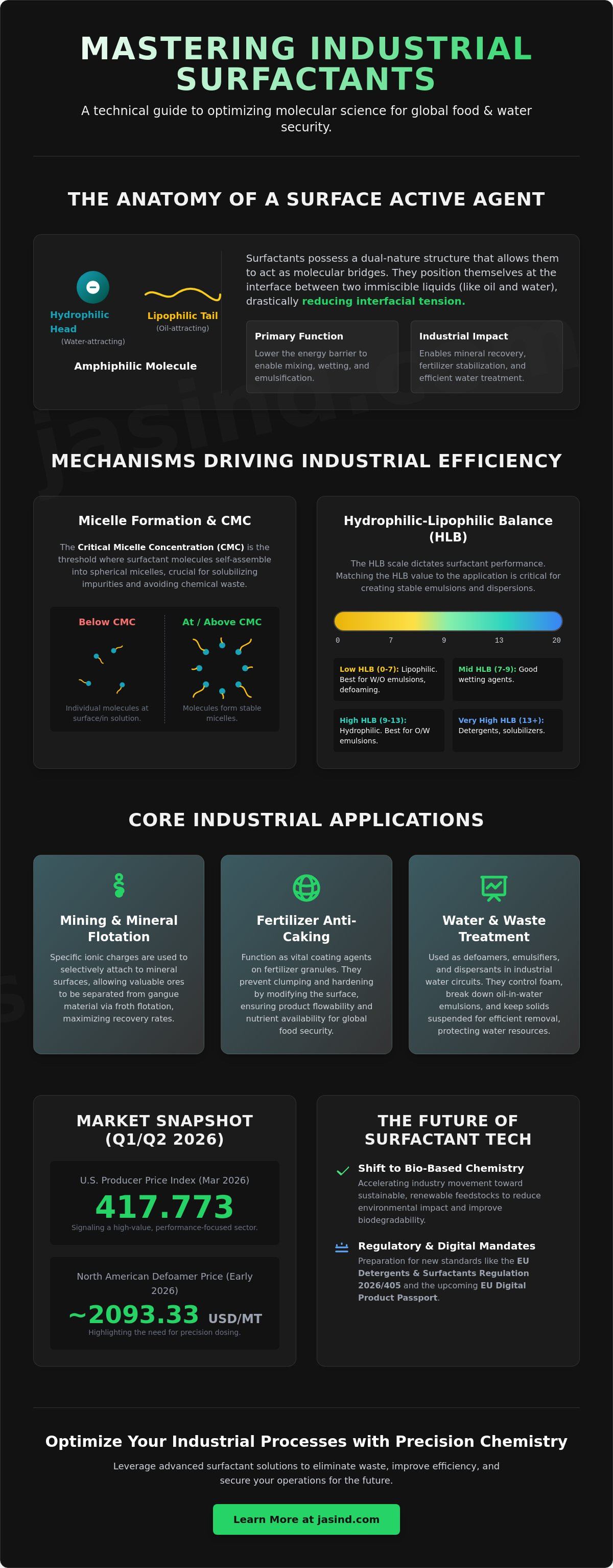
Every surfactant molecule possesses a dual-nature. It consists of a polar, hydrophilic head group and a non-polar, lipophilic hydrocarbon chain. This specific geometry dictates how the molecule behaves when introduced to a system. In aqueous phases, the tails seek to escape the water while the heads remain anchored. This unique amphiphilic structure allows surfactants to bridge the gap between immiscible liquids by orienting themselves at the interface. This molecular alignment is the foundation for creating stable emulsions and effective dispersions in mining and ceramic manufacturing.
The Role of Interfacial Tension in Industrial Systems
Interfacial tension is the physical manifestation of surface energy. It's the reason liquids resist spreading and instead form beads. In industrial settings, high surface tension is an obstacle to efficiency. It increases the "work" required to expand a surface area or to wet a solid substrate. By introducing a surfactant, we lower this energy barrier. The results are immediate and measurable:
- Faster wetting of mineral surfaces in flotation circuits.
- Better coverage of anti-caking agents on fertilizer granules.
- Reduced energy consumption in grinding and milling operations.
Lowering surface tension isn't just about chemistry; it's about process optimization. These molecular adjustments ensure that nutrients remain viable and accessible, transforming raw chemical science into a pillar of societal stability.
Surfactant Mechanisms: How Micelles and HLB Drive Efficiency
Industrial efficiency in chemical processing isn't achieved through volume alone; it's a product of molecular precision. To optimize resource recovery and infrastructure stability, you must understand how these molecules organize themselves in a solution. It's not enough to simply add a chemical and hope for a reaction. Successful process engineers focus on the transition from individual molecules to organized structures that drive performance. This transition is governed by two primary concepts: Micelle formation and the Hydrophilic-Lipophilic Balance (HLB).
A single surfactant molecule can simultaneously act as an emulsifier, a dispersant, and a foaming agent depending on the system's needs. This multi-functional nature makes them indispensable in environments where mineral separation and fertilizer stabilization occur. By managing the concentration and the chemical "weight" of these agents, industries can reduce waste and ensure long-term sustainability in their operations.
Micelle Formation and Critical Micelle Concentration (CMC)
As you increase the concentration of a surface-active agent in a liquid, the molecules eventually reach a tipping point known as the Critical Micelle Concentration (CMC). At this specific threshold, the molecules self-assemble into spherical aggregates called micelles. The hydrophobic tails retreat into the center of the sphere, while the hydrophilic heads face outward toward the water. This self-assembly is vital for solubilizing hydrophobic impurities that would otherwise remain untouched.
Industrial dosing strategies must be built around the CMC to avoid significant chemical waste. Dosing far beyond the CMC doesn't linearly increase performance; instead, it often leads to unnecessary expenditure. This is a critical consideration for global operations, especially with North American defoamer prices reaching approximately USD 2093.33/MT in early 2026. Monitoring these thresholds ensures that you're using exactly what's required to protect global food and water infrastructure without inflating operational costs.
The HLB Scale: Matching Chemistry to Application
The Hydrophilic-Lipophilic Balance (HLB) scale is a 0 to 20 rating system that determines a surfactant's primary function. Lower values (4 to 6) indicate a preference for oil-dominated systems, making them ideal water-in-oil emulsifiers. Higher values (12 to 15) indicate high water solubility, which is necessary for detergents and specialized wetting agents. Non-ionic surfactants, which accounted for a 43% market share in 2026, are often favored for their versatile HLB ranges and low CMC values.
JAS Global Industries utilizes precise HLB data to formulate high-performance fertilizer anti-caking agents that create a durable moisture barrier. In the mining sector, selecting a collector with an HLB between 8 and 12 is often the difference between successful mineral recovery and a failed flotation circuit. Matching the chemistry to the specific mineral surface ensures that every drop of chemical contributes to global resource security.
Technical Classification: Ionic vs. Non-Ionic Surfactants
The classification of a surfactant is defined by the electrical charge of its hydrophilic head group. This charge isn't a mere chemical detail; it dictates how the molecule interacts with surfaces, minerals, and other additives. In the pursuit of Global Food Security and Water Security, selecting the correct ionic class is a matter of mission-critical precision. Using the wrong charge can lead to immediate process failure, sediment buildup, or ineffective resource recovery.
Anionic surfactants carry a negative charge. They are the true workhorses of the industry, particularly in mining flotation collectors and detergent systems. Their ability to bind to positively charged mineral surfaces makes them essential for phosphate and potash mining. Conversely, cationic surfactants possess a positive charge. These are specialized tools used primarily in asphalt emulsification and as biocides in water treatment. Because most naturally occurring surfaces are negatively charged, cationics provide exceptionally strong adhesion.
Non-ionic surfactants, which held a 43% revenue share in 2026, carry no electrical charge. This neutrality grants them superior stability across wide pH ranges and makes them immune to the interference of hard water minerals like calcium and magnesium. Amphoteric, or zwitterionic, surfactants are the most versatile. They carry both positive and negative charges depending on the pH of the environment. This makes them ideal for sensitive home care chemicals where mildness and compatibility are paramount.
Specialty Surfactants: Polyethers and Block Copolymers
High-performance industrial coatings and dispersant agents now rely heavily on synthetic polyether surfactants. These advanced structures offer a level of precision that traditional oils cannot match. Block copolymers are particularly effective because engineers can tailor their molecular weight to suit specific dispersant needs. In fertilizer manufacturing, these advanced structures act as granulation aids. They prevent re-agglomeration by creating a steric barrier around particles, ensuring that nutrients remain free-flowing and ready for distribution.
Ionic Compatibility and Formulation Stability
A common cause of industrial process failure is the accidental mixing of anionic and cationic agents. When these opposite charges meet, they often neutralize and precipitate out of the solution, rendering the chemistry useless. Non-ionic agents serve as vital "compatibilizers" in these complex systems, allowing different ionic species to co-exist without reaction. The electrostatic attraction or repulsion between the ionic head group and the mineral substrate determines the efficiency of the adsorption process in mining circuits. Understanding these interactions is how we continue manufacturing relationships and distributing quality across the global supply chain.
Industrial Applications: Surfactants in Mining, Fertilizer, and Water
While retail platforms often focus on DIY cosmetics or simple garden sprays, the true power of a surfactant lies in large-scale resource management. These chemical additives are the essential pillars of modern infrastructure. They don't just "clean"; they optimize the recovery of raw materials and protect the integrity of global food supplies. In heavy industry, a surfactant is a precision tool used to manipulate surface energy at a massive scale.
The industrial demand remains robust. As of early 2026, the global surfactants market is valued at US$ 48.7 billion. This growth is driven by the need for specialized solutions in mining, water treatment, and fertilizer manufacturing. These sectors don't require generic wetting agents. They require formulated additives that can withstand extreme pH levels and high mineral concentrations.
Surfactants in Mineral Flotation and Recovery
Mining is a game of precision. In mineral flotation circuits, surfactants serve as collectors and frothers to separate valuable minerals from waste rock. Collectors selectively attach to minerals like phosphate or potash, rendering their surfaces hydrophobic. This allows the minerals to hitch a ride on air bubbles and rise to the surface. Frothers then stabilize the resulting "froth," ensuring the valuable payload doesn't sink back into the gangue. This process is the foundation of Mining Solutions: Enhancing Global Mineral Recovery.
Fertilizer Anti-Caking and Dust Suppression
Caking is a significant threat to global food security. It occurs when moisture causes crystal bridging between fertilizer granules, turning a free-flowing product into a solid block. Surfactants modify the surface energy of these granules to create a durable moisture barrier. This prevents bridging and ensures the product remains easy to distribute. Additionally, advanced dust suppressants reduce product loss during maritime transport. You can maintain product integrity through Fertilizer Anti-caking: Ensuring Quality and Flowability.
Water Treatment, Paints, and Coatings
Water security relies on surfactants for scale inhibition and reverse osmosis efficiency. These chemicals prevent mineral buildup on membranes, extending the life of desalination plants. In the world of paints and coatings, dispersant agents are the key to shelf stability. They ensure color uniformity by preventing pigment particles from clumping together. Whether you are managing a mining circuit or a water treatment facility, the right chemistry is vital. Connect with our technical experts at JAS Global Industries to optimize your industrial process.
The Future of Surfactant Technology: Sustainability and Security
The trajectory of the chemical industry is no longer defined solely by performance; it's defined by responsibility. We've entered an era where the transition to bio-based solutions is a regulatory and ethical mandate. In 2026, the global natural surfactant market is valued at US$ 23.6 billion. This sector is projected to reach US$ 38.1 billion by 2035, growing at a CAGR of 5.5%. This shift reflects a collective move away from petroleum-based derivatives toward sustainable chemistry that protects the planet's most vital resources.
Compliance is the new baseline for industrial excellence. The EU Detergents and Surfactants Regulation (EU) 2026/405, which entered into force on March 22, 2026, introduces the mandatory Digital Product Passport (DPP). This requirement ensures total transparency in the supply chain, from raw material sourcing to biodegradability. JAS Global Industries has prepared for this shift for over twenty-five years. Since 1998, we've focused on manufacturing relationships and distributing quality, ensuring our partners stay ahead of evolving global standards.
Sustainable Formulations: The 'JAS Cares' Approach
Our Research and Innovation (R&I) centers are the heartbeat of the "JAS Cares" initiative. We develop biodegradable chemical additives that maintain high industrial performance while minimizing environmental footprints. These custom-tailored formulations are specifically designed to reduce chemical runoff in sensitive agricultural zones. By optimizing the interaction between the surfactant and the soil, we ensure that fertilizer nutrients remain where they're needed most. This balance between industrial power and environmental stewardship is essential for maintaining trust with global communities and regulatory bodies alike.
Engineering Global Resource Security
Specialty chemicals are the foundational pillars of modern infrastructure. Without advanced antiscalants and reverse osmosis chemicals, the desalination plants providing water to the Middle East and North Africa would face crippling inefficiency. Similarly, our work in the fertilizer sector directly supports Global Food Security by ensuring nutrients reach a growing population without product loss. We've built a steady, logical flow of support for international partners across Europe, Africa, and the Middle East. Our mission remains clear: to act as a vital guardian of the resources society requires to thrive. To move your operations toward a more secure and efficient future, contact our technical consultants to optimize your industrial process.
Optimizing Global Infrastructure Through Molecular Precision
The evolution of surface-active agents has transformed them from simple additives into essential pillars of global infrastructure. You've explored how mastering the Hydrophilic-Lipophilic Balance (HLB) and Critical Micelle Concentration (CMC) eliminates industrial waste and protects operational margins. Selecting the correct surfactant charge is the difference between successful mineral recovery and process failure in the world's most demanding environments. As the industry moves toward bio-based chemistry and the transparency of the Digital Product Passport, your choice of chemical partner becomes a strategic asset for long-term security.
JAS Global Industries has served these critical sectors since 1998. We operate multiple R&I centers focused on custom formulations that address your specific mineral flotation or anti-caking needs. Headquartered in Dubai with a worldwide service presence, we remain dedicated to the foundational needs of society. It's time to elevate your process efficiency with a partner that understands the broader human impact of chemical excellence.
Partner with JAS Global for Tailor-Made Industrial Chemical Solutions
We look forward to securing your industrial future together.
Frequently Asked Questions
What is the difference between a surfactant and a detergent?
A surfactant is the pure chemical agent that modifies surface energy; a detergent is the final formulated product containing builders and other additives. JAS Global Industries specializes in the high-purity synthesis of these surface-active agents to ensure consistent performance in industrial settings. While a detergent is designed for end-user cleaning, the raw chemical is engineered for specific industrial interactions like mineral wetting or scale inhibition.
How do surfactants reduce surface tension in industrial water treatment?
In water treatment, these molecules migrate to the air-water or liquid-solid interface to reduce the cohesive forces of the liquid. By breaking down the surface energy barrier, the water can more effectively penetrate deposits and carry treatment chemicals like biocides to the metal substrate. This mechanism is vital for maintaining heat transfer efficiency in cooling towers and preventing membrane fouling in desalination systems.
What is Critical Micelle Concentration (CMC) and why is it important?
CMC represents the concentration where the surfactant stops saturating the surface and begins forming internal structures called micelles. This point is critical because adding chemical beyond the CMC often shifts the mechanism from surface wetting to bulk solubilization. Identifying the exact CMC helps industrial operators avoid over-dosing, which is a major driver of cost in large-scale resource recovery operations.
Can surfactants be used to prevent caking in bulk fertilizers?
Yes, they are highly effective at preventing crystal bridging in bulk fertilizers by modifying the surface energy of the granules. By creating a microscopic film, these agents prevent moisture from forming liquid bridges between particles. This technology ensures that fertilizers remain free-flowing during the high-humidity conditions often encountered in maritime logistics and tropical storage environments.
What are non-ionic surfactants and when should they be used?
Non-ionic surfactants lack an electrical charge on their hydrophilic head, making them incredibly stable in the presence of high electrolyte concentrations. They are used when chemical compatibility is a challenge, such as in hard water containing high levels of dissolved minerals. Their performance is less affected by pH shifts compared to ionic varieties, providing a reliable baseline for complex chemical formulations.
How do surfactants function as collectors in mining flotation?
Collectors act by making the surface of specific minerals hydrophobic, allowing them to attach to air bubbles in a flotation cell. The surfactant's polar head attaches to the mineral surface, while the non-polar tail extends into the water. This orientation creates the necessary contact angle for the mineral to be lifted into the froth layer for collection and subsequent processing.
Are there biodegradable surfactants available for industrial use?
Surfactant options that are bio-based are now a standard for responsible manufacturing. Formulations derived from sustainable sources like vegetable oils and fermented sugars offer high performance without the ecological persistence of traditional petrochemicals. JAS Global Industries integrates these sustainable formulations into our "JAS Cares" initiative to support global environmental stewardship and regulatory compliance.
What is the Hydrophilic-Lipophilic Balance (HLB) and how do I calculate it?
HLB is a numerical scale from 0 to 20 that indicates the balance between the hydrophilic and lipophilic portions of a molecule. You calculate it by dividing the molecular weight of the hydrophilic part by the total molecular weight and multiplying by 20. This value allows formulators to predict whether a chemical will favor oil-in-water or water-in-oil emulsions, ensuring the stability of the final industrial solution.