

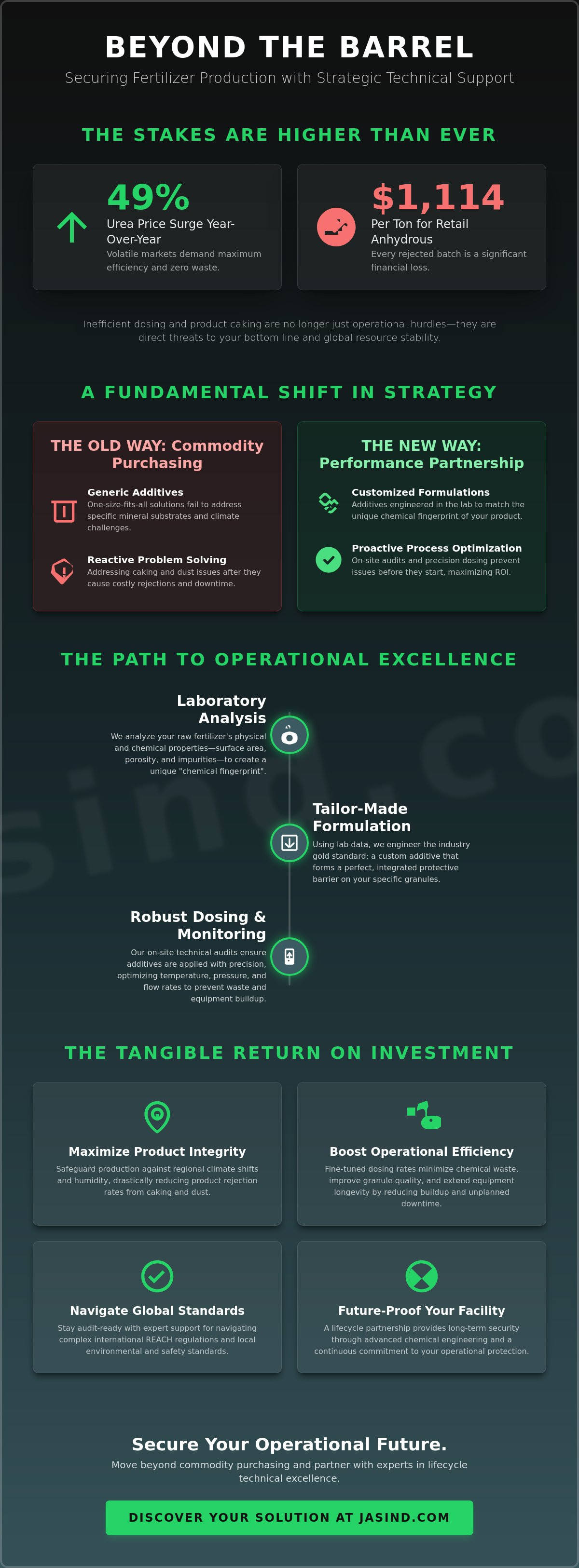
With urea prices surging 49% year-over-year and retail anhydrous hitting $1,114 per ton in April 2026, can your facility afford even a single batch of rejected product? High rejection rates due to caking and wasted chemical spend from inefficient dosing aren't just operational hurdles; they're direct threats to global resource stability. You recognize that maintaining product integrity in volatile climates requires more than just a standard chemical supplier. Comprehensive technical support for fertilizer additives transforms these basic applications into a strategic operational advantage that secures your bottom line.
We understand that the pressure to optimize is constant, especially as the EU implements its "Fertiliser Action Plan" to combat rising nitrogen costs. This article demonstrates how expert intervention moves beyond the container to provide customized formulations and on-site process optimization. You'll learn how precision dosing and specialized laboratory testing solve internal capacity gaps while significantly reducing operational costs. We provide a preview of how long-term partnerships and on-site expertise ensure your infrastructure remains resilient, efficient, and ready for the shifting demands of the global market.
Key Takeaways
- Move beyond commodity purchasing toward a performance-based strategy that safeguards your production against regional climate shifts and humidity.
- Understand why tailor-made formulations are the industry gold standard for optimizing specific chemical interactions within your raw fertilizer substrates.
- Compare the immediate impact of on-site technical audits with remote consulting to identify critical bottlenecks in plant mechanics and flow rates.
- Learn to implement a robust dosing framework using expert technical support for fertilizer additives to establish precise baseline metrics for caking and dust control.
- Discover how a lifecycle partnership provides security for global resources through advanced chemical engineering and a commitment to operational protection.
The Strategic Importance of Technical Support in Fertilizer Production
The global fertilizer industry is undergoing a fundamental shift. It's no longer enough to procure chemicals by the ton; leading producers now prioritize performance-based strategies. This evolution relies heavily on technical support for fertilizer additives to ensure that every gram of chemical delivers measurable value. Transitioning from a commodity mindset to a strategic partnership allows manufacturers to view additives as essential tools for resource protection rather than mere line-item expenses.
Fertilizer production is a constant battle against the elements. Humidity and temperature variations can quickly turn a high-quality product into an unsaleable mass of caked granules. Generic additives often fail because they lack the chemical nuance required for specific mineral substrates. For a comprehensive overview of fertilizer types and their inherent sensitivities, one must understand that moisture absorption is not a uniform process. It requires a calibrated, plant-specific response. Expert consulting identifies the exact points in the production line where product integrity is compromised, providing a safeguard against regional climate challenges that otherwise lead to high rejection rates.
Generic solutions ignore the reality of plant mechanics. Without precise dosing calibration and integration, even the most advanced anti-caking agent becomes an inefficient cost. True technical support bridges the gap between chemical potential and operational reality. It ensures that additives are applied at the optimal temperature and pressure, creating a uniform protective layer that prevents dust and caking during long-term storage and maritime transport.
Driving ROI through Process Optimisation
Efficiency is the primary driver of profitability. When you calculate the cost of product loss from caking versus the investment in professional consulting, the value becomes clear. Fine-tuning dosing rates does more than just reduce chemical waste; it improves granule quality and extends equipment longevity. Over-application often leads to buildup on conveyor belts and screening equipment, which increases maintenance cycles and unplanned downtime. Dedicated technical support for fertilizer additives ensures you use exactly what you need. No more. No less.
Navigating Global Regulatory and Safety Standards
Security in the modern industrial landscape means more than just physical protection. It involves navigating the complex web of international REACH regulations and local environmental standards. Technical experts provide the rigorous documentation and reporting necessary to keep your facility audit-ready. This support also focuses on workplace safety, ensuring that chemical handling protocols are robust and that your workforce is protected. By aligning additive use with global safety benchmarks, you protect your reputation and your operational continuity.
Laboratory Analysis: The Foundation of Custom Additive Formulation
Off-the-shelf chemicals are a gamble that modern producers can't afford. Effective technical support for fertilizer additives relies on the transition from broad chemical application to microscopic analysis. Because no two production sites share identical mineral substrates or environmental stressors, "tailor-made" formulation has become the industry gold standard. It's the only way to ensure that an anti-caking agent or dust suppressant interacts correctly with the unique chemical profile of your specific product. By aligning laboratory precision with Best Management Practices for Plant Nutrient Management, producers ensure that additives don't just solve a problem but enhance the entire value chain.
The process begins with the physical and chemical characterization of raw fertilizer substrates. Experts analyze surface area, porosity, and the presence of trace impurities that might interfere with chemical bonding. This data allows for the creation of a chemical "fingerprint" that guides the selection of surfactants and binders. Without this foundational step, additives often sit on the surface of the granule rather than forming the integrated protective barrier necessary for global stability. Producers seeking this level of precision often rely on specialized laboratory partnerships to secure their product integrity.
Simulating Real-World Storage Conditions
Laboratories act as a predictive shield against future product failure. Accelerated caking tests allow technicians to predict six months of storage stability in just two weeks by using controlled pressure and temperature cycles. These simulations are vital for anticipating how a 30,000-ton bulk pile will behave in high-humidity transit. Technicians also measure hygroscopicity and moisture absorption isotherms to determine the exact point at which a blend becomes vulnerable. Testing dust suppression efficacy under varied mechanical stress ensures that granules remain intact during the rigors of ship loading and terminal handling.
Developing Custom Chemical Fingerprints
Precision chemistry requires matching surfactant types to the specific mineralogy of the fertilizer, whether it's Potash, NPK, or Urea. Custom binders strengthen the physical matrix of the granule to prevent attrition while maintaining the rapid nutrient release required for agricultural efficacy. Beyond structural integrity, the role of coloring agents is essential for brand identification and quality perception in a competitive market. These agents must be formulated to remain stable under UV exposure and high temperatures. Research and innovation centers continue to lead this effort, developing sustainable, next-generation agents that protect both the product and the environment.
Securing a global supply chain requires a dual-track approach to operational integrity. You must decide between the tactical precision of an on-site presence and the strategic scalability of remote oversight. Both models play a vital role in technical support for fertilizer additives, yet they serve distinct functions based on your facility's current maturity. Choosing the right path isn't just about solving a problem; it's about aligning your infrastructure with a long-term vision of stability and resource protection.
The Anatomy of an On-Site Technical Audit
Physical audits are the cornerstone of industrial reliability. They provide an unvarnished view of plant mechanics that data alone cannot capture. During these deep dives, technicians identify bottlenecks in the granulation and coating stages that often go unnoticed during standard maintenance. They measure the specific gravity and viscosity of additives at the point of application to ensure they match the lab-certified profile. By evaluating the efficiency of atomisation nozzles and spray systems, experts ensure every granule receives a uniform coating. This level of scrutiny is essential for meeting the rigorous environmental and safety standards outlined in Agriculture Nutrient Management and Fertilizer management frameworks. Sampling final products directly from the production line allows for real-time validation, ensuring the chemistry matches the operational reality.
Remote Troubleshooting and Digital Support
Digital support models prioritize continuous optimization and the analysis of long-term performance trends. Leveraging data from PLC systems allows for the remote adjustment of additive consumption, which reduces chemical waste and protects your margins. When unexpected quality shifts occur, video-conferencing provides a rapid response bridge between your floor team and global experts. This model's strength lies in its consistency. The integration of digital twins further enhances this capability. These virtual environments predict additive performance under varying loads or climate shifts, allowing you to test scenarios before a single drop of chemical is applied. It's a proactive shield against the trial-and-error cycles that often plague less mature operations.
Determining which model fits your current status depends on your specific goals. If you're facing immediate product rejection or high dust levels, an on-site audit provides the necessary reset. For facilities aiming for incremental gains in efficiency and sustainability, remote monitoring offers a reliable path forward. Most leaders find that a hybrid approach provides the ultimate security. It combines the deep-cleaning effect of an annual audit with the steady, watchful eye of digital consulting. This ensures your technical support for fertilizer additives remains a lifecycle partnership rather than a one-off transaction.
Implementing a Robust Dosing and Monitoring Framework
Transitioning from laboratory validation to plant-level execution requires a structured, phased approach. Effective technical support for fertilizer additives ensures that this transition is seamless and data-driven. A robust framework protects your capital investment by aligning chemical application with real-time production variables. This systematic implementation moves beyond simple installation; it establishes a lifecycle of continuous optimization and resource security.
- Step 1: Baseline Establishment. Quantify current caking indices and dust levels. Without these metrics, improvement remains anecdotal rather than empirical.
- Step 2: System Architecture. Design the dosing loop. This includes selecting high-precision pumps and atomisation nozzles that match the viscosity of your custom formulation.
- Step 3: Pilot Validation. Test the additive on a single production line. This isolated environment allows for fine-tuning without risking an entire day's output.
- Step 4: Full-Scale Integration. Roll out the solution across all lines. Integrate dosing controls with your central monitoring systems to ensure consistent coverage and feedback.
- Step 5: Seasonal Calibration. Review performance quarterly. Adjust formulations to account for shifts in ambient humidity and temperature that affect granule stability.
Precision Dosing Technologies
Accuracy is the foundation of chemical efficiency. Integrating mass-flow meters into your dosing system ensures that coating ratios remain constant, regardless of fluctuations in production speed. Automated dosing systems eliminate the variability of human error, protecting your margins from the costs of over-application. By linking these systems directly to the plant's SCADA infrastructure, you gain a transparent view of chemical consumption. This digital oversight allows for immediate adjustments, ensuring that your technical support for fertilizer additives translates into measurable operational savings. Optimize your facility's chemical footprint by exploring our precision dosing and monitoring solutions.
Training and Capacity Building for Plant Personnel
Technology is only as effective as the people who manage it. Empowering your operators to identify early signs of additive under-performance is a critical safeguard. They are the first line of defense against product degradation. Maintenance protocols for dosing equipment must be standardized to prevent unplanned downtime. We facilitate this through technical workshops that foster a culture of continuous improvement. When your team understands the "why" behind dosing precision, they become active participants in protecting the stability of your global resource output. This human-centric approach ensures that your technical partnership delivers value long after the initial installation.
JAS Global Industries: Your Partner in Lifecycle Technical Excellence
JAS Global Industries operates as a vital pillar of modern industrial infrastructure. Our Dubai headquarters serves as a central hub for international technical expertise, coordinating a global effort to protect the stability of critical agricultural resources. We don't just supply chemicals; we provide a shield for your operations. By integrating advanced chemical engineering with a mission-oriented approach, we ensure that every client benefits from a strategy focused on security and protection. This commitment transforms your production line into a resilient asset capable of withstanding global market volatility.
The JAS approach is a comprehensive lifecycle partnership. It begins with a deep-dive technical audit to identify plant-specific vulnerabilities and concludes with a customized chemical solution that evolves with your needs. This continuous technical support for fertilizer additives is essential for maintaining product integrity across complex supply chains. Our experts have successfully resolved severe caking issues on challenging maritime transport routes where high humidity and temperature fluctuations previously led to significant product rejection. We turn these logistical risks into strategic advantages, ensuring your product arrives in premium condition regardless of the destination.
A Global Reach with Localized Expertise
Our presence extends far beyond the Middle East. With dedicated sales and service offices across Africa, Asia, and Europe, we provide localized support that understands regional climate challenges. We leverage over 25 years of corporate history to solve modern production hurdles, blending established trust with cutting-edge innovation. Our focus remains on developing sustainable, cost-effective formulations that reduce chemical waste while maximizing granule quality. This global network ensures that expert technical support for fertilizer additives is always within reach, providing the reliability you need to operate on a massive scale.
The Future of Fertilizer Additives
JAS Global is committed to pioneering bio-based, eco-friendly anti-caking agents that align industrial efficiency with environmental stewardship. Our R&I centres are currently leading the development of advanced H2S treatment and odor control solutions for both mining and fertilizer applications. These innovations reflect our role as a responsible corporate citizen dedicated to workplace safety and community well-being. We invite you to secure your production future today. Contact JAS Global for a Comprehensive Technical Audit of Your Facility to begin your journey toward operational excellence and lifecycle protection.
Securing Your Operational Future with Lifecycle Protection
Optimizing fertilizer production requires a transition from transactional chemical purchasing to a dedicated lifecycle partnership. You've seen how custom formulations and precise dosing frameworks act as a safeguard against regional climate challenges and costly product rejection. By integrating specialized laboratory analysis with on-site audits, your facility gains the technical resilience needed to thrive in a volatile global market. Comprehensive technical support for fertilizer additives ensures that your infrastructure remains efficient, sustainable, and ready for the demands of tomorrow.
Operational since 1998, JAS Global Industries provides the stability you need to operate on a massive scale. Our specialized R&I centres and global presence across the Middle East, Africa, Asia, and Europe allow us to solve complex production hurdles with localized expertise. We are ready to help you transform your additives from simple applications into strategic operational advantages. Request a Technical Consultation with JAS Global Industries to protect your product integrity and secure your bottom line. We look forward to building a long-term partnership focused on your success.
Frequently Asked Questions
What does technical support for fertilizer additives typically include?
Comprehensive support encompasses initial plant audits, laboratory substrate analysis, and the design of precision dosing systems. It also includes ongoing operator training and seasonal formulation adjustments to maintain product integrity. This lifecycle approach ensures that chemical applications remain efficient under shifting environmental conditions, protecting the stability of your global resource output.
How can custom additive formulations improve my plant's ROI?
Tailor-made formulations improve ROI by reducing the volume of rejected, caked product and minimizing chemical waste through optimized dosing. Precision chemistry ensures that additives bond effectively with specific mineral substrates, preventing expensive over-application. This efficiency lowers operational costs while protecting the high market value of your final granules during long-term storage.
Is on-site technical auditing necessary for every fertilizer plant?
Physical audits are essential for facilities experiencing persistent quality issues or those undergoing significant process changes. While remote consulting offers scalability, an on-site visit identifies mechanical bottlenecks and dosing inaccuracies that data alone cannot reveal. It provides a foundational reset for plant performance and ensures your infrastructure meets the highest standards of reliability.
How do I know if my current anti-caking agent is under-performing?
Under-performance is often signaled by increased dust levels at transfer points or visible caking in storage piles. If your product integrity fails during maritime transport despite standard application rates, your current chemistry likely lacks the necessary affinity for your substrate. Professional technical support for fertilizer additives can diagnose these failures through accelerated caking tests in a controlled laboratory environment.
Can technical support help with regulatory compliance for exported fertilizers?
Expert technical teams ensure that all additives meet international standards like REACH and specific regional safety requirements. They provide the necessary documentation and safety data sheets required for smooth customs clearance and environmental auditing. This support acts as a protective shield for your global trade reputation, ensuring your products remain compliant in every market you serve.
What is the difference between an anti-caking agent and a granulation aid?
Anti-caking agents are surface treatments designed to prevent moisture bridges between finished granules during storage and transport. In contrast, granulation aids are process chemicals added during the production stage to improve the physical strength and size uniformity of the granules. Both are vital components of a performance-based strategy but serve different stages of the production lifecycle.
How long does it take to develop a custom fertilizer additive formulation?
Developing a custom formulation typically takes between two to four weeks depending on the complexity of the fertilizer substrate. This period includes the initial physical characterization, chemical fingerprinting, and accelerated stability testing. This rigorous validation ensures the final product provides reliable protection and doesn't interfere with the nutrient release profile required for agricultural efficacy.
What data should I provide for a remote technical consultation?
You should provide chemical specifications of your raw materials, current dosing rates, and historical data on temperature and humidity at the plant. Including photos of caking issues and SCADA performance logs allows experts to identify trends accurately. Providing this data set ensures that technical support for fertilizer additives remains actionable and effective, even when delivered through digital channels.