
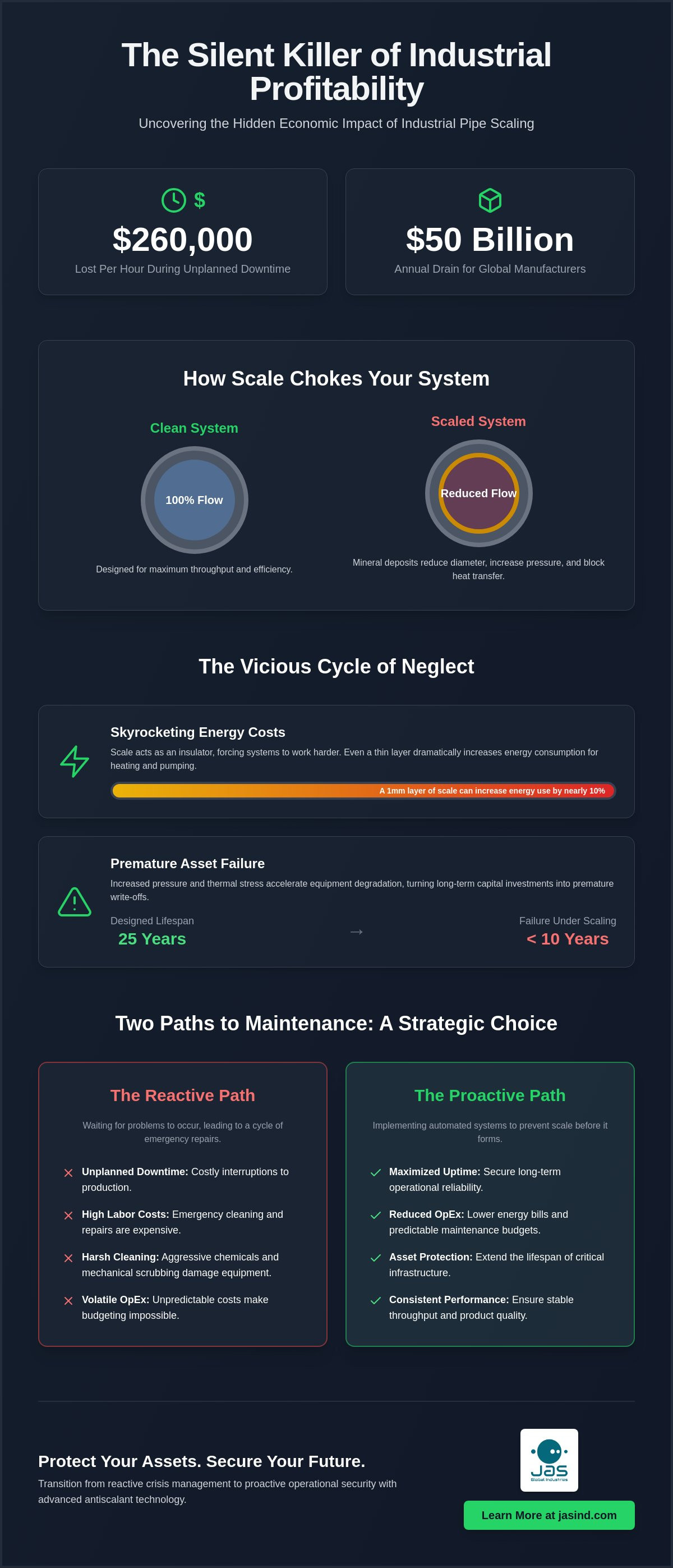
Did you know that the average industrial facility loses approximately $260,000 every single hour during unplanned downtime? For global manufacturers, these interruptions represent a $50 billion annual drain. This isn't just a mechanical failure. It's the hidden, cumulative economic cost of industrial pipe scaling. You likely feel the pressure of unpredictable maintenance cycles and rising energy consumption that never seems to yield higher output. It's a frustrating cycle of reactive repairs that threatens your bottom line and your infrastructure's health.
This strategic analysis shows how industrial scaling silently erodes your profitability and how targeted chemical intervention secures long-term operational reliability. We'll provide a clear framework to justify your antiscalant budgets while reducing OpEx. By the end of this guide, you'll understand how to protect your infrastructure and extend the lifespan of your most critical assets through proactive protection. We'll move from a high-level view of global market shifts toward the practicalities of securing your facility's future.
Key Takeaways
- Understand how the economic cost of industrial pipe scaling transforms manageable capital investments into overwhelming operational burdens.
- Analyze the physics of thermal resistance to see how even microscopic scale layers compromise heat exchanger efficiency and inflate utility expenditures.
- Learn to identify the warning signs of premature asset failure to prevent critical 25-year infrastructure from reaching its end-of-life in under a decade.
- Explore sector-specific strategies for the mining and fertilizer industries to protect mineral recovery rates and ensure consistent granulation quality.
- Discover a strategic framework for transitioning from reactive cleaning cycles to automated chemical dosing that secures long-term operational reliability.
The Hidden Economic Impact of Industrial Pipe Scaling
Industrial infrastructure represents a massive capital investment. However, the true financial burden lies not in the initial installation, but in the operational reality of fluid transport. Scaling acts as a silent killer of throughput. It chokes efficiency and forces systems to work harder for diminishing returns. Understanding the economic cost of industrial pipe scaling is vital for any facility aiming for long-term stability. While initial CapEx focuses on material selection, the long-term OpEx is often dominated by the struggle against mineral accumulation.
Defining Scale in Industrial Fluid Systems
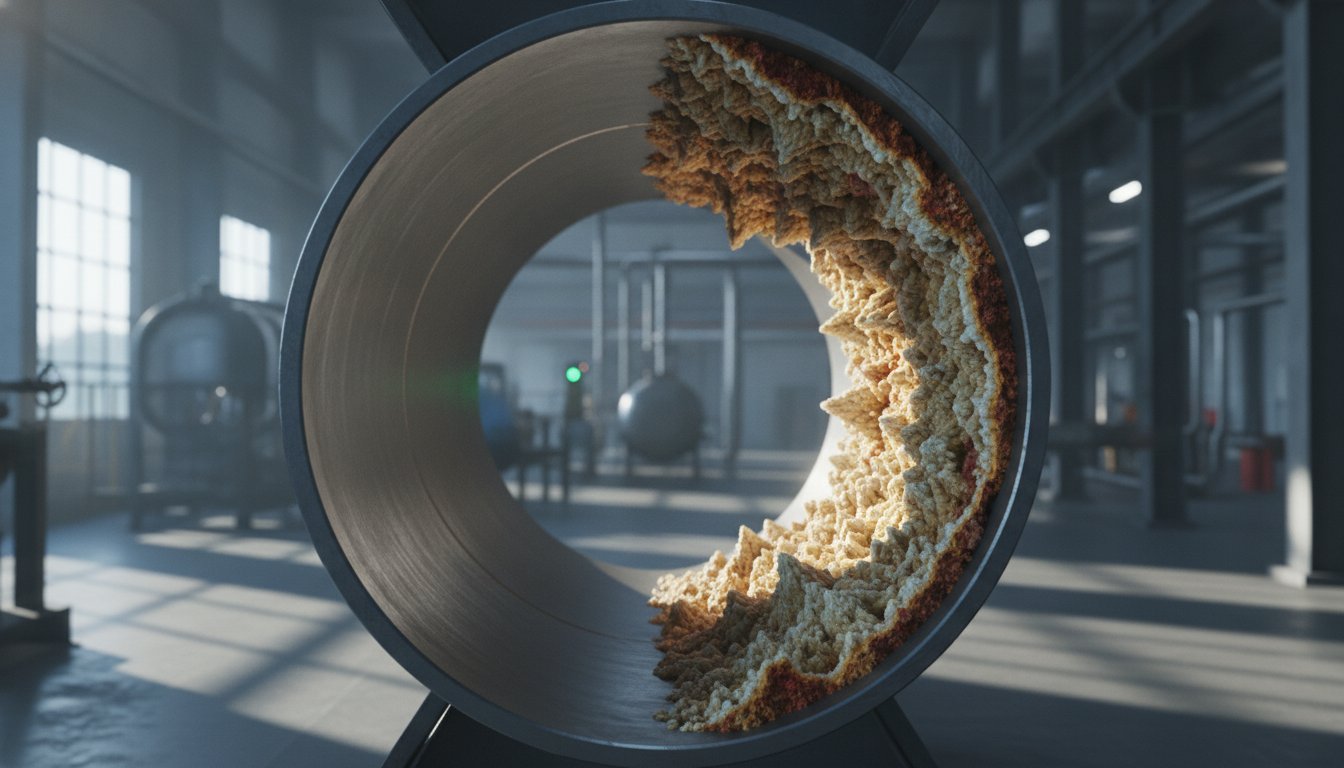
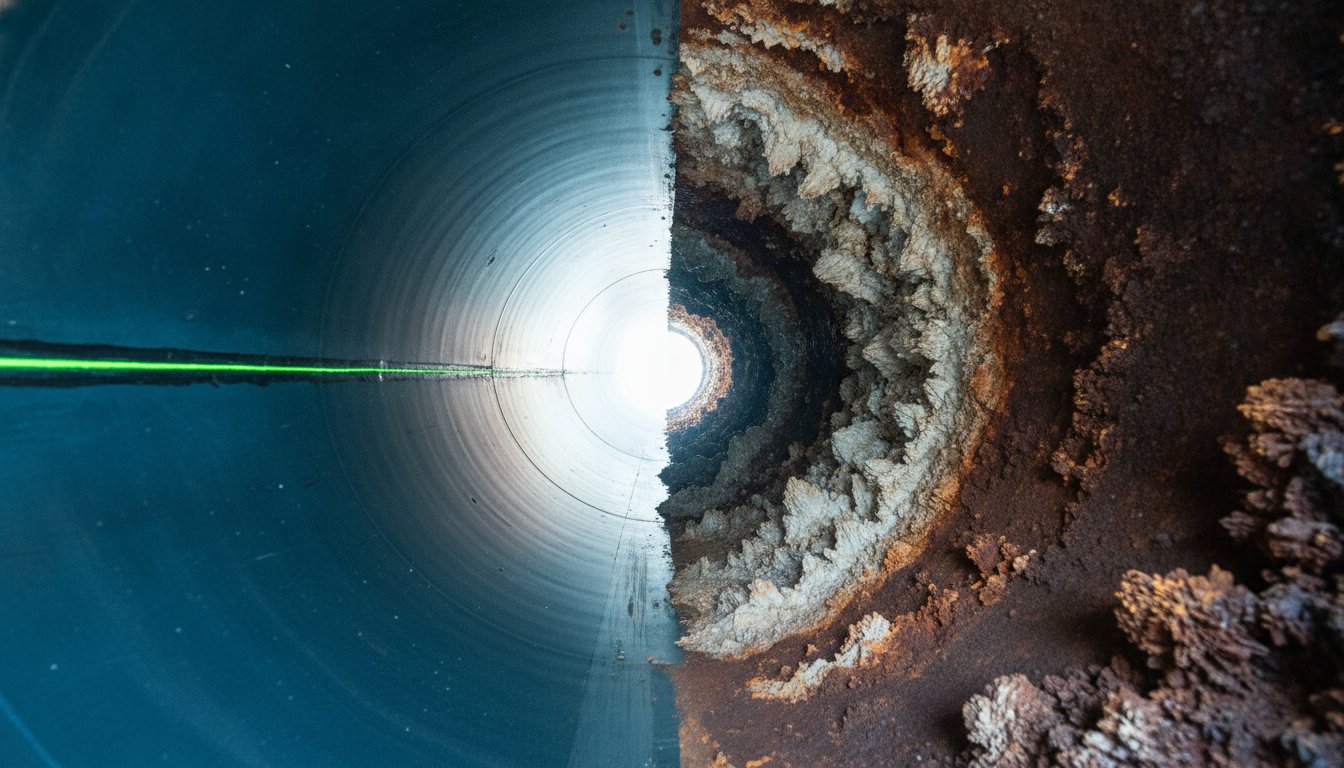
Scale is the result of chemical precipitation within fluid systems. When water carries dissolved minerals like calcium and magnesium, changes in temperature or pressure cause these minerals to solidify on pipe walls. To understand the basics of this process, one might ask, What is Limescale? and how does it differ from other deposits; carbonates and sulfates are the most common culprits, creating hard, insulating barriers. Unlike corrosion, which destroys the pipe wall, scaling builds an internal wall. Economically, corrosion is a replacement cost; scaling is a persistent efficiency tax that compounds every hour the system runs. It reduces the inner diameter of the pipe, which increases friction and forces pumps to consume more power to maintain the same flow rate.
The Lifecycle Cost of Neglect
Neglecting scale management shifts a facility's financial profile from predictable to volatile. Reactive cleaning is a costly illusion of savings. It involves harsh chemicals, mechanical scrubbing, and, most importantly, unplanned downtime. This approach ignores the Total Cost of Ownership (TCO). High-quality water treatment isn't just a utility expense; it's an insurance policy for your assets. When scale is allowed to build, the rate of economic loss accelerates as thermal transfer drops and pumping pressure must increase to maintain flow. Research indicates that unplanned downtime can cost manufacturers approximately $260,000 per hour. Much of this is preventable through consistent mineral management.
JAS Global Industries serves as a foundational industry presence, offering the technical expertise required to secure global infrastructure. By providing advanced water treatment scale inhibitors and antiscalants, we help facilities transition from reactive crisis management to proactive operational security. Protecting critical resources is our mission. We ensure that the economic cost of industrial pipe scaling does not compromise your facility's future or its contribution to global sustainability. Reliability is not a luxury; it's the bedrock of industrial success.
Quantifying Energy Inefficiency and Thermal Resistance
Energy serves as the primary driver of industrial production, yet scaling acts as a persistent parasite on global power consumption. When mineral deposits accumulate on internal surfaces, they create a layer of thermal resistance that forces equipment to exceed its design parameters. This inefficiency isn't a minor technicality; it's a direct driver of the economic cost of industrial pipe scaling. Every millimeter of buildup represents a measurable loss in heat transfer efficiency and a corresponding spike in operational expense. In an era focused on sustainability, these losses represent an unacceptable environmental and financial burden.
The Insulating Effect of Mineral Deposits
Scale functions as an effective but unintended insulator. While industrial pipes are engineered for conductivity, mineral deposits like calcium carbonate have thermal conductivities significantly lower than the steel or copper they cover. This disparity creates a bottleneck. Even a 1mm layer of scale can increase energy consumption by nearly 10% as it forces boilers and heat exchangers to work harder to bridge the thermal gap. These systemic inefficiencies contribute to the broader economic costs of water infrastructure failure, where energy waste often precedes total system collapse. By allowing scale to form, facilities essentially pay twice: once for the wasted energy and again for the accelerated degradation of the equipment itself.
Pressure Drops and Pumping Costs
Beyond thermal resistance, scaling creates a physical obstruction that narrows the path of fluid flow. This narrowing increases internal friction and backpressure, requiring pumps to exert more force to move the same volume of liquid. We call this the 'clogged artery' effect. As pipe diameter decreases, the energy required to move fluid increases exponentially rather than linearly. The pumping penalty often results in energy waste exceeding 20% before the flow restriction becomes visible to the naked eye. This unnecessary power draw inflates utility bills and increases the carbon footprint of the entire facility. Integrating advanced Water Treatment Scale Inhibitors into your maintenance strategy ensures that internal diameters remain clear and energy budgets remain protected.
The financial implications of scaling extend into environmental responsibility. In 2026, regulatory focus on carbon emissions has intensified, making energy efficiency a legal and ethical mandate. A scaled system is a high-carbon system. By forcing equipment to draw more power to overcome resistance, scaling directly increases the greenhouse gas emissions associated with your facility. Strategic chemical intervention isn't just about protecting profit; it's about securing the sustainability of global resources. Reducing energy waste through effective scale management allows industrial leaders to meet both financial targets and environmental commitments simultaneously. Reliability and efficiency aren't just goals; they are the results of strategic chemical protection.
Asset Longevity and the High Price of Unplanned Downtime
Industrial assets represent the backbone of global infrastructure. Engineers design these systems for decades of continuous service, yet scaling truncates this operational horizon. It turns a 25-year asset into a 10-year liability. The economic cost of industrial pipe scaling manifests most aggressively in the premature retirement of capital equipment. When internal surfaces become heavily encrusted, the stress on pumps, valves, and heat exchangers leads to mechanical fatigue. This isn't just a maintenance inconvenience; it's a systemic failure of asset management.
Unplanned shutdowns are the ultimate penalty for neglect. For Fortune Global 500 companies, downtime costs approximately $1.5 trillion annually, which is roughly 11% of their total revenue. In high-stakes sectors like Oil and Gas, a single hour of lost production can exceed $500,000. These figures don't account for the secondary labor costs. Mechanical descaling and chemical flushing require specialized teams and hazardous material handling. Calculating the economic cost of industrial pipe scaling must include these labor-intensive cleaning cycles and the inherent risks they pose to personnel.
Under-Deposit Corrosion: The Dual Threat
Scale rarely acts alone. It creates a deceptive environment known as under-deposit corrosion. While the pipe surface may look stable, the area beneath the mineral buildup becomes a breeding ground for localized pitting and microbial activity. This hidden damage eventually leads to catastrophic leaks and structural thinning. Preventing scale is the first essential step in industrial water treatment. By maintaining clean surfaces, you eliminate the micro-environments where corrosion thrives, effectively doubling the lifespan of your piping networks.
The Opportunity Cost of Downtime
The financial impact of a shutdown extends far beyond the repair bill. It ripples through the entire supply chain. In the fertilizer industry, a scaling-related delay in granulation can stall downstream deliveries, impacting agricultural cycles and food security. Mining operations face similar risks; scaling in flotation circuits reduces mineral recovery rates, leading to permanent losses in output. Safety risks also escalate during emergency repairs. Working in scaled environments often involves pressurized systems and restricted access, increasing the likelihood of workplace accidents. Proactive chemical protection acts as an insurance policy, securing both your production volume and your workforce. Operational reliability is the only path to long-term stability.
Sector-Specific Financial Risks: Mining, Fertilizers, and Desalination
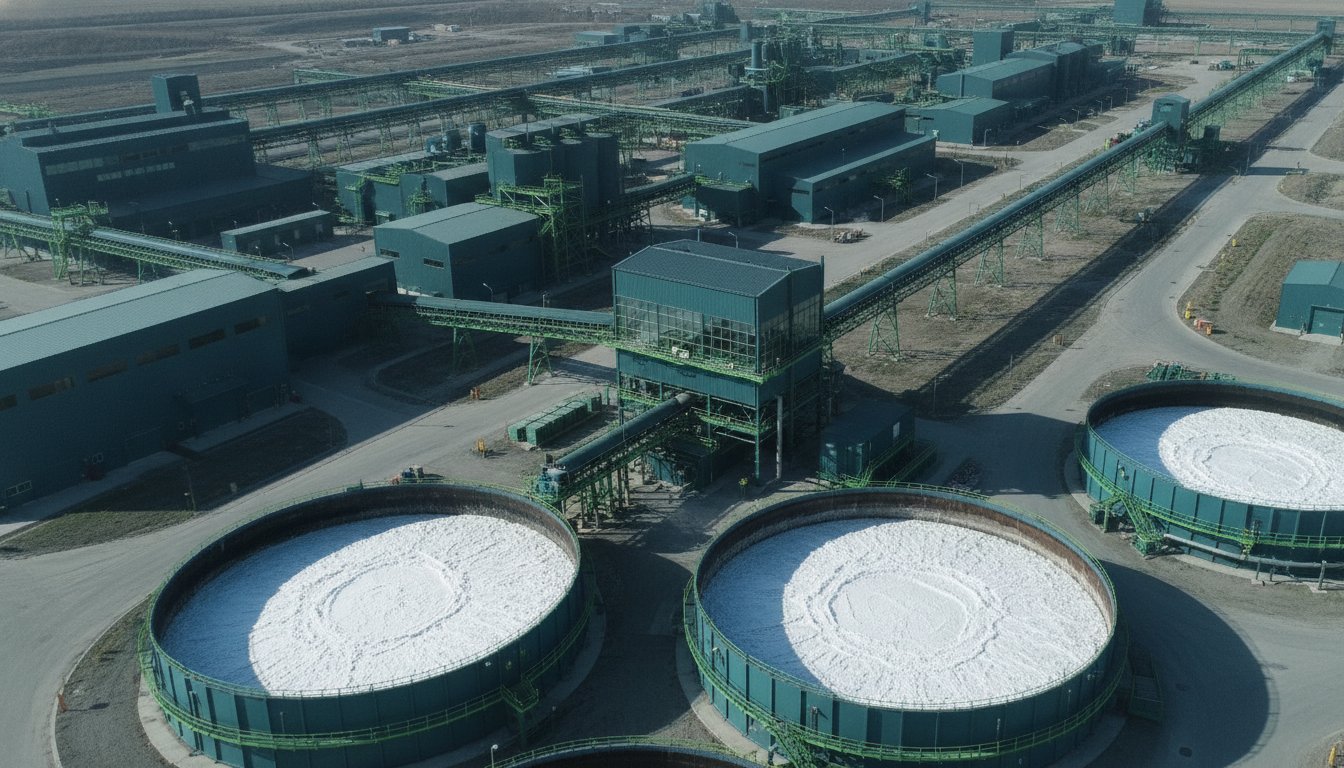
The economic cost of industrial pipe scaling is not a uniform burden across all industries. Its impact shifts based on the specific chemical processes and fluid dynamics of the sector. In the world's most critical infrastructure, scaling does more than just raise energy bills; it compromises the very stability of global resources. From the extraction of essential minerals to the production of life-sustaining fertilizers, mineral accumulation acts as a barrier to global security. Understanding these sector-specific risks is the first step toward implementing a protective strategy that ensures long-term operational reliability.
Mining and Mineral Recovery Efficiency
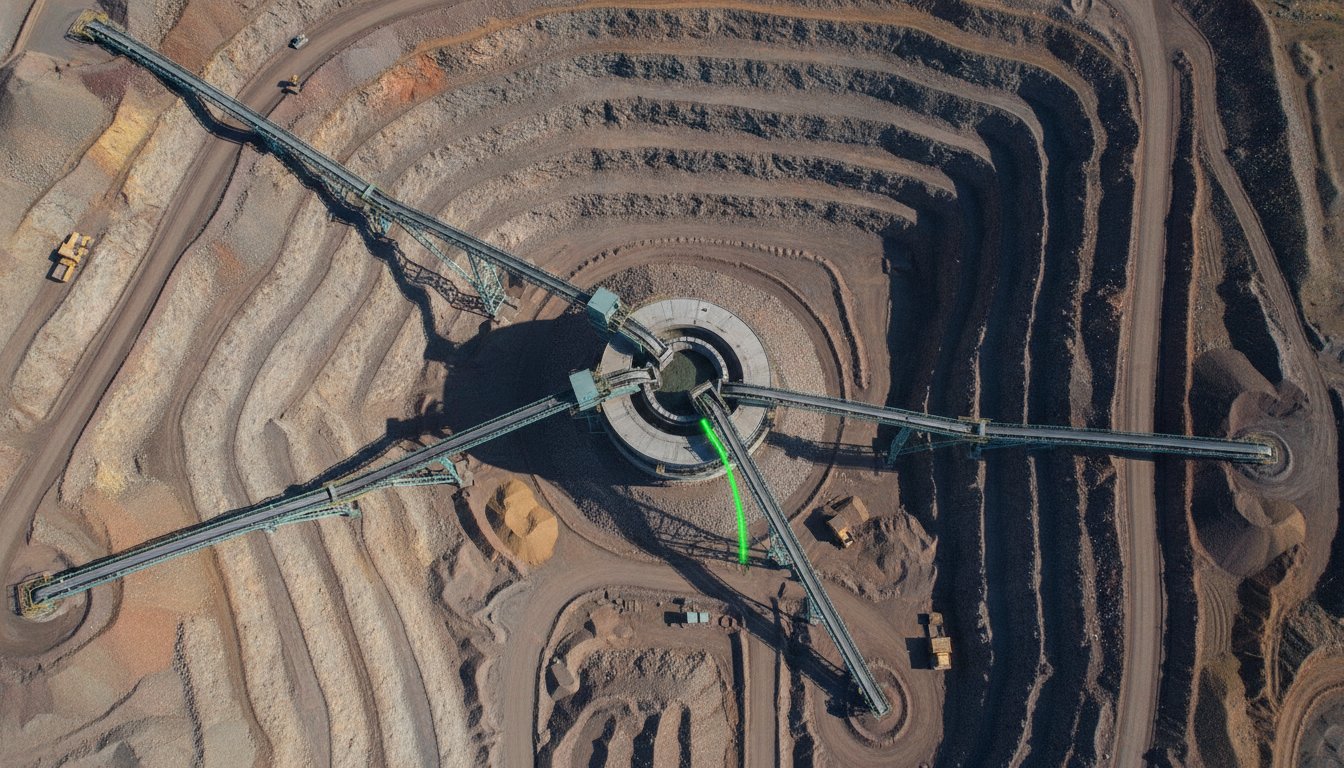
In mining operations, fluid transport is the lifeblood of the facility. Scaling in flotation circuits and slurry lines is a primary driver of inefficiency. When calcium carbonate or sulfate deposits narrow the internal diameter of pipes, they disrupt the precise flow required for optimal mineral recovery. This buildup interferes with the performance of flotation reagents and grinding aids, leading to a phenomenon known as 'lost ore.' When recovery rates drop by even a fraction of a percentage due to flow restrictions, the financial loss is permanent. We view process optimization as a mission-critical objective. You can explore our mining solutions to see how advanced chemistry protects these vital extraction processes.
Fertilizer Production and Global Food Security
The fertilizer industry faces unique challenges, particularly in the transportation of phosphoric acid and potash slurries. Scaling in these lines can halt production entirely, disrupting the global supply of essential nutrients. When scale builds up in granulation circuits, it prevents the uniform application of Fertilizer Granulation Aids and other critical additives. This instability directly impacts the quality of the final product and, by extension, global crop yields. Integrating anti-caking agents and scale inhibitors into a comprehensive chemical management plan is essential for maintaining throughput. The relationship between pipe integrity and food security is direct and profound.
Desalination and Reverse Osmosis (RO) facilities represent another high-stakes environment. In these systems, scaling doesn't just happen in the pipes; it occurs on the membranes themselves. The cost of replacing fouled RO membranes, combined with the energy required to overcome osmotic pressure in a scaled system, represents a massive economic cost of industrial pipe scaling. For regions dependent on thermal desalination, scale acts as a thermal insulator that forces boilers to consume excessive fuel. These costs are eventually passed down to the communities that rely on these systems for fresh water.
JAS Global Industries provides the technical expertise required to navigate these complexities. We offer tailor-made formulations, including specialized Reverse Osmosis Chemicals and Thermal Desalination Chemicals, designed for the specific mineral profiles of your region. Our role is that of a vital global guardian, ensuring that your infrastructure remains a stable pillar of modern society. Secure your facility's output and protect your critical assets by exploring our full range of Water Treatment Antiscalants at jasind.com.
Proactive Scale Inhibition: A Strategic Path to Operational Reliability
The economic cost of industrial pipe scaling isn't an inevitable expense of doing business. It's a manageable risk that requires a shift in perspective. Shifting from reactive cleaning to proactive inhibition represents a fundamental change in corporate strategy. Mechanical descaling addresses the symptom. Chemical intervention targets the cause. The Return on Investment (ROI) for high-performance Water Treatment Antiscalants is immediate and measurable. Spending cents per gallon on specialized chemistry saves thousands in energy costs and prevents the astronomical expense of unplanned shutdowns. By the time you see scale, the financial damage is already done.
The Science of Antiscalants and Dispersants
Effective scale control relies on two primary mechanisms: threshold inhibition and crystal modification. Threshold inhibitors prevent mineral precipitation even when concentrations exceed solubility limits. Crystal modifiers distort the shape of forming crystals. This ensures they remain soft and non-adherent rather than forming a hard crust. Antiscalants disrupt the thermodynamic stability of supersaturated solutions by adsorption onto growth sites, effectively preventing the formation of a rigid mineral lattice. The strategic use of surfactants ensures any remaining particulates stay suspended in the fluid stream. They won't settle on pipe surfaces or create blockages. This dual-action approach maintains constant surface cleanliness and protects the integrity of your heat transfer equipment.
Implementing a Global Chemicals Management Plan
A robust strategy begins with a technical audit. We identify scale-prone zones where temperature fluctuations or pressure drops accelerate precipitation. Customizing chemistries for your facility's specific water profile ensures the intervention is both effective and cost-efficient. This isn't just about maintenance. It's about corporate responsibility. Sustainable water management reduces your environmental footprint by lowering energy demand and minimizing chemical waste. In 2026, efficiency is synonymous with sustainability.
Partnering with JAS Global Industries provides access to a legacy of technical expertise and a sense of global responsibility. We act as a vital guardian for your infrastructure. Our relationship moves beyond transactional supply toward long-term operational security. We ensure the economic cost of industrial pipe scaling no longer threatens your facility's stability. Integrating automated chemical dosing and real-time monitoring secures the future of your assets and the reliability of your output. We provide the stability required for modern infrastructure to thrive. Reliability is not a luxury; it's the result of strategic protection.
Securing the Future of Global Infrastructure
Industrial operations stand at a crossroads in 2026. You can continue to absorb the escalating economic cost of industrial pipe scaling through reactive repairs; or you can choose the path of strategic protection. We've seen how mineral buildup compromises energy efficiency and truncates the lifespan of critical assets. Reliability is the bedrock of sustainability. It's time to transition from high-cost downtime to consistent, optimized throughput. Protecting your infrastructure isn't just about saving money; it's about ensuring the stability of the global resources your facility provides.
Operational since 1998, JAS Global Industries acts as a vital guardian for the world's most demanding industries. From our headquarters in Dubai, we manage worldwide logistics to ensure your facility never stands alone. Our global Research and Innovation centers develop tailor-made formulations that address your specific mineral profiles and operational challenges. You're not just buying chemicals; you're securing a long-term partnership built on trust and technical excellence. Secure your operational reliability with JAS Global specialty chemical solutions today. Your facility's future depends on the actions you take now.
Frequently Asked Questions
What is the primary cause of industrial pipe scaling?
Mineral precipitation is the primary cause of industrial scaling. When dissolved minerals like calcium carbonate or magnesium sulfate exceed their solubility limits, they solidify on internal pipe walls. This often happens due to shifts in temperature, pressure, or pH levels within the fluid system. These deposits create rigid barriers that compromise flow and thermal efficiency across your entire infrastructure.
How much can scale increase energy consumption in a heat exchanger?
Even a 1mm layer of scale can increase energy consumption by approximately 10%. Scale has very low thermal conductivity, which means it acts as an unintended insulator on heat transfer surfaces. This forces your system to draw more power to bridge the thermal gap. These inefficiencies lead to higher utility expenditures and a significantly larger carbon footprint for the facility.
Is chemical scale inhibition safer than mechanical cleaning?
Chemical inhibition is significantly safer and more reliable than reactive mechanical cleaning. Manual descaling often requires labor-intensive work in hazardous, high-pressure environments or restricted spaces. Automated dosing systems remove the need for abrasive scrubbing and frequent, harsh chemical flushes. This proactive approach protects your equipment and your personnel while ensuring constant operational stability and safety.
How do antiscalants improve the lifespan of Reverse Osmosis (RO) membranes?
Antiscalants prevent mineral crystals from adhering to the delicate membrane surface. This maintains the necessary flow rate and reduces the frequency of aggressive cleaning cycles that can degrade membrane integrity. By keeping the surfaces clear of mineral lattice formation, you extend the operational life of the RO system. This strategy lowers your total replacement costs and secures water production.
What are the environmental impacts of industrial pipe scaling?
Scaling increases a facility's carbon footprint by forcing pumps and heaters to work harder to overcome resistance. It leads to higher energy demand and increased water waste during cleaning cycles. Managing scale is an essential component of environmental responsibility. Effective inhibition helps you meet sustainability goals by reducing the total resource consumption required to maintain your industrial output.
Can scale inhibitors be used in food-grade fertilizer production?
Specialized scale inhibitors are engineered to meet the unique demands of fertilizer production. They ensure consistent granulation and prevent blockages in phosphoric acid lines without compromising product quality. Maintaining flow in these systems is vital for the stability of global nutrient supplies. This protection ensures that your facility continues to contribute effectively to global food security and agricultural reliability.
How often should an industrial facility conduct a scale audit?
Facilities should conduct a comprehensive scale audit at least once per year. In environments with high mineral content or extreme operating temperatures, quarterly monitoring is more effective. Regular audits allow your technical team to identify scale-prone zones early. This data enables precise chemical adjustments that maintain system stability and prevent the sudden onset of restrictive buildup.
What is the ROI of a proactive water treatment chemicals management plan?
The ROI is substantial because it mitigates the economic cost of industrial pipe scaling. Proactive management prevents unplanned downtime, which averages $260,000 per hour across many manufacturing sectors. By extending asset life from 10 to 25 years and reducing energy waste, the plan pays for itself. It secures your infrastructure and protects the long-term profitability of your global operations.