

Managing chemical price volatility in procurement takes more than reacting to a supplier’s latest quote. Build a response around three levers: hedge suitable exposure, qualify alternative sources before disruption, and use market signals to guide purchasing. Avoid concentrating more than six months of forward consumption in one large buy unless supply disruption poses a severe risk.
That discipline matters because chemical input costs can shift with energy markets, freight routes, currency movements, and supply interruptions. These forces can reinforce one another, turning a change in one market into higher costs across the supply chain. A lower spot price may look attractive, but it won’t protect operations if supply is constrained or the material cannot be qualified in time.
This article explains how forward contracts, options, and swaps can support risk management, when alternative sourcing can improve resilience, and how AI-based analytics can help teams track volatility and spot emerging pressure. It also covers which market drivers to monitor and how to turn early signals into practical procurement decisions.
Key Takeaways
- Match hedging tools to the exposure: compare spot and forward price movements, then choose contracts that fit your flexibility and risk-sharing needs.
- Start qualifying alternate suppliers at the first sign of single-source risk, so disruption doesn’t leave sourcing options untested.
- Use rolling price histories and early-warning indicators to distinguish temporary noise from a developing cost trend.
- Track energy, freight, currency and supply changes together; their combined effects can reshape material costs and procurement decisions.
Hedging with forward contracts, options, and swaps
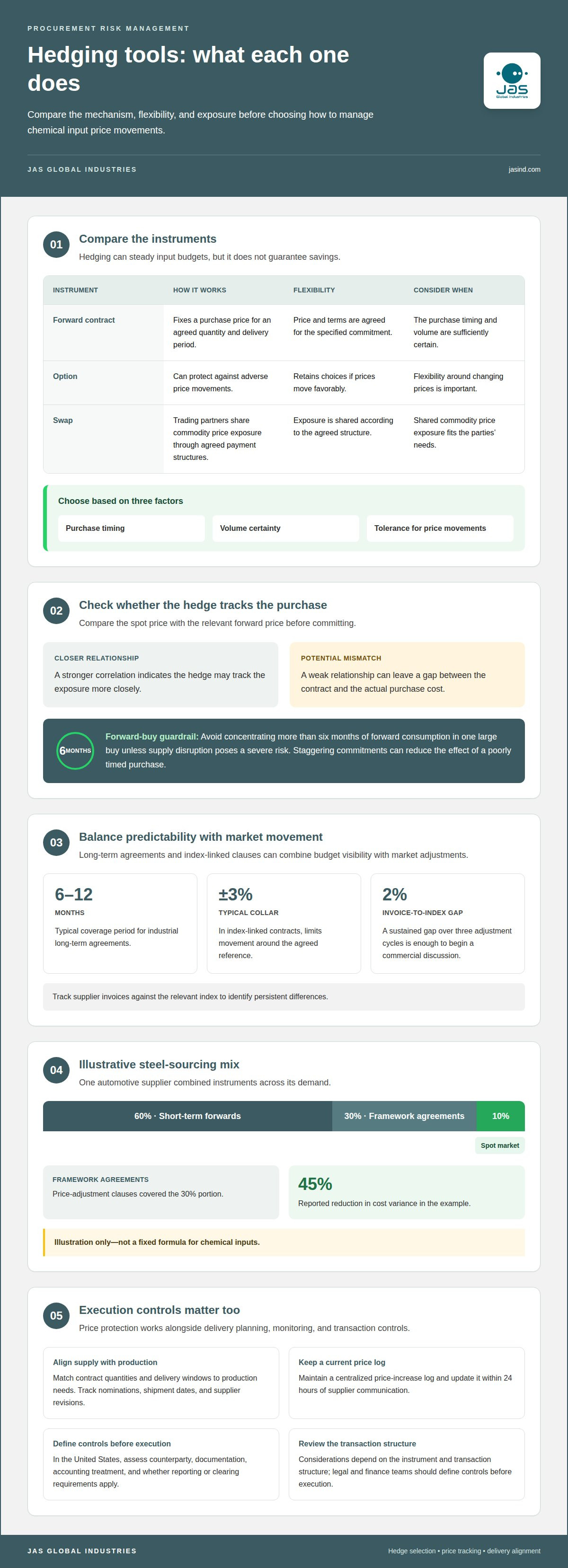
Hedging can steady input budgets, but it does not guarantee savings. A forward contract fixes a purchase price for an agreed quantity and delivery period. Options offer more flexibility: procurement teams can protect against adverse price movements while retaining choices if prices shift favorably. Swaps let trading partners share commodity price exposure through agreed payment structures. Select tools based on purchase timing, volume certainty, and tolerance for price movements.
Start by comparing the spot price with the relevant forward price. Their correlation indicates how closely a hedge may track the exposure; a weak relationship can leave a gap between the contract and the actual purchase cost. Avoid concentrating more than six months of forward consumption in one large buy unless supply disruption poses a severe risk. Staggering commitments can reduce the effect of a poorly timed purchase.
Long-term agreements and index-linked clauses can balance predictability with market movement. Industrial long-term agreements typically cover 6-12 months. In index-linked contracts, a collar of ±3% is typical, limiting movement around the agreed reference. Track supplier invoices against the index: a 2% gap sustained over three adjustment cycles is enough to begin a commercial discussion.
A steel-sourcing example shows how instruments can work together: an automotive supplier hedges 60% of demand with short-term forwards, covers 30% through framework agreements with price-adjustment clauses, and buys 10% on the spot market. The example reports a 45% reduction in cost variance. Treat this as an illustration, not a fixed formula for chemical inputs.
Schedule reliability matters as much as price. Align contract quantities and delivery windows with production needs, then track nominations, shipment dates, and supplier revisions. Keep a centralized price-increase log and update it within 24 hours of supplier communication. In the United States, assess each hedge’s counterparty, documentation, accounting treatment, and whether reporting or clearing requirements apply. These considerations depend on the instrument and transaction structure; legal and finance teams should define controls before execution.
Tariff uncertainty and alternative sourcing
Trade-policy shifts can change sourcing economics before a new supplier is ready. US chemical imports from China fell nearly 30% year on year in the second quarter of 2025. That movement shows why procurement teams should model tariff exposure by origin, product, and contract terms, rather than treating one supplier quote as a stable market signal.
Start alternate-source qualification at the first sign of single-source risk. Industrial input qualification typically takes 3-9 months, so waiting for a disruption can leave too little time for technical review and production validation. Map each critical chemical to its approved sources, origin markets, lead-time dependencies, and substitution requirements. Flag inputs with only one qualified source for earlier action.
Diversification means reducing reliance on one supplier or market, not simply adding names to a vendor list. Dual sourcing works only when both sources can meet the required specification and delivery schedule. Compare capacity, transport routes, documentation, and consistency against production needs. For each candidate, define qualification steps, an accountable owner, and a decision point before an interruption occurs.
Supply shocks show why alternatives need realistic capacity checks. During the helium disruption described in the market data, alternative supplies could offset only around half of lost volumes. The lesson for chemical buyers is practical: establish whether secondary suppliers can increase deliveries, and distinguish available capacity from theoretical options. Record any shared upstream dependency that could affect both sources.
Use negotiations to make exposure visible. Ask suppliers to explain the quoted origin, tariff assumptions, price-adjustment triggers, and notice period for changes. Compare proposals by total delivered terms and schedule reliability, not headline price alone. For multi-sourcing, allocate planned volume according to verified capacity and performance, then review allocations as conditions change. Keep a dated record of quote revisions and agreed assumptions. This gives procurement a clear basis for supplier discussions and helps teams act before uncertainty becomes a delivery constraint.
AI-based forecasting and market analytics
AI forecasting helps procurement teams turn price history into timely decisions. Start with one material and one purchasing question, such as setting a budget for a planned buying period. Combine supplier quotes, invoice prices, contract adjustment dates, planned demand, and relevant energy, freight, or currency signals. Record the unit, location, delivery basis, and timestamp for each data point. This prevents unlike observations from appearing comparable and gives analysts a consistent basis for testing forecasts.
Which chemical price indexes and market data sources are reliable? Use the index named in the contract to assess price adjustments, then compare it with traceable data matching the chemical, region, grade, and delivery basis. Treat supplier quotes and paid invoice records as separate checks. Record each data feed’s publisher, update frequency, methodology, and revision history. Flag gaps or mismatched units before using the data.
Measure volatility across rolling time windows rather than relying on a single average. A coefficient of variation normalizes price volatility, helping teams compare categories with different price levels. For example, an analyst can compare relative movements across two materials without treating their absolute prices as equivalent. Keep the window and calculation consistent, then review whether the results change as the window moves forward.
For supplier price history, use a 3-month or 6-month simple moving average to smooth short-term fluctuations. Compare that trend with current quotes and the buying calendar. Use the 2-sigma upper band as the planning case for cost impact. Document assumptions behind each view so finance and operations can interpret it consistently. These steps make managing chemical price volatility in procurement more evidence-led.
Connect forecasts to early-warning indicators, not just historical prices. Track relevant changes in energy, freight, currency, suppliers, and market availability. Assign an owner to review each material alert. A useful workflow is to flag a threshold breach, check the underlying data, assess the affected purchase window, and record the response. Review forecast accuracy against actual invoices after each buying cycle. This feedback helps refine signals and supports managing chemical price volatility in procurement through timely decisions.
Industrial material price volatility drivers
Industrial material prices respond to connected forces, not isolated supplier decisions. Energy, freight, currency, and constrained supply can compound within one purchasing cycle. A stable quote may change before delivery. Map each input to its largest exposure, then monitor the related signals.
Energy and geopolitical events can move sharply. That was a 62% increase from the 2025 annual average amid the Iran conflict. Brent moved 14% in a single session after President Trump announced productive talks with Iran. Red Sea detours around the Cape of Good Hope add up to 14 days to transit times, putting freight and delivery schedules under pressure.
Supply disruptions can amplify those market effects. A single month of helium supply shortfall amid disruption to Qatar supply was estimated at 5.2 million cubic metres. Helium spot prices surged 70-100%. Across industrial procurement, individual material increases of 50% over baseline were documented within a single fiscal quarter during 2024-2026. Suppliers may pass cascading input-cost increases through over 90-180 days. Commodity plastics such as PVC resin, polypropylene, and polyethylene can see quarterly swings of 5-15%.
These drivers also shape inventory decisions. Set safety stock using demand variability, replenishment lead time, material criticality, and shelf life. Protect critical, hard-to-substitute inputs with buffers. Limit speculative stock where storage, handling, or expiry risks outweigh continuity value. Large industrial forward buys carry estimated annual carrying costs of 6-10% of deployed capital, so compare that burden with the operational risk of a shortage.
Use a monthly review to connect each material to its main exposure: energy, freight, currency, or supply disruption. When signals shift, reassess the buying window, inventory position, and supplier assumptions together. Review material price exposure against these drivers before the next procurement decision.
JAS Global Industries: Fertilizer Anti-caking Agents
JAS Global Industries supplies Fertilizer Anti-caking Agents for fertilizer operations managing input uncertainty and material-handling needs. Procurement teams can consider these agents alongside supplier continuity, demand forecasts, and operational priorities. A sound purchasing plan connects product requirements with sourcing decisions, so teams can assess price changes without losing sight of process needs.
JAS Global Industries also supplies Fertilizer Dust Suppressants, Mining Flotation Collectors, and Mining Grinding Aids. These products serve different industrial applications, allowing procurement teams to focus discussions on the relevant process and requirements. For fertilizer buyers assessing anti-caking agents, a clear brief on intended use and operational priorities helps frame the procurement discussion.
Contact JAS Global Industries to discuss Fertilizer Anti-caking Agents for your procurement needs.
Turn market signals into your next procurement decision
Make the next step operational: connect each price signal to a material, a purchasing decision, and an owner. This discipline helps teams move from market awareness to timely action while keeping supply continuity and process requirements in view. For managing chemical price volatility in procurement, the goal is not to predict every movement. It is to build a clear decision process that adapts as conditions change.
When a specialty chemical is part of that exposure, align procurement planning with the needs of the process it supports. Share the application and priorities with JAS Global Industries to discuss a suitable product fit. Clear requirements help focus the conversation on operational needs and sourcing considerations.
Contact JAS Global Industries to discuss your chemical requirements and next steps. A considered plan can help your team move forward with greater clarity.
Frequently Asked Questions
What factors drive chemical price volatility in the U.S.?
U.S. chemical prices are influenced by feedstock and energy costs, import availability, freight, tariffs, currency movements, and production disruptions. These drivers can interact: a shipping delay may tighten supply while raising replacement costs. Chemical buyers can map each material to its main exposures, then monitor supplier announcements and market conditions affecting its origin or delivery route.
How can procurement teams forecast chemical prices and demand?
Combine purchase history, supplier quotes, production plans, and consumption data to build a material-level forecast. Separate firm demand from orders that may change, then compare forecast assumptions with actual usage after each buying cycle. Managing chemical price volatility in procurement becomes more practical when each forecast is linked to a clear decision, such as adjusting a buying window or reviewing an upcoming budget.
How do feedstock, energy, freight, and currency changes affect chemical prices?
Feedstocks and energy affect production economics, while freight changes influence delivery costs and timing. Currency movements can alter the domestic cost of imports, even if the foreign-currency quote remains unchanged. The timing varies by contract and shipment: a supplier may revise its price before freight or exchange-rate effects appear on an invoice. Track each exposure against the relevant purchase and delivery terms.
What contract structures help manage chemical price volatility, such as fixed-price, index-linked, and escalation clauses?
Fixed-price terms hold the agreed price for a defined scope and period. Index-linked clauses adjust against a named reference, while escalation clauses explain how specified cost changes affect pricing. Before signing, align the reference with the material and delivery basis. Set out adjustment dates, required documentation, notice procedures, caps, and dispute steps so both parties can apply the terms consistently.
How can buyers use hedging, forward contracts, or financial derivatives for chemical purchases?
Buyers can use forward contracts to set purchase terms in advance, while options and swaps can manage defined price exposures. Match any hedge to the underlying material, expected quantity, timing, and pricing reference. If these elements differ, the hedge may not offset the purchase movement. Establish internal approval, documentation, and monitoring procedures, and compare the hedge position with actual buying requirements.
What sourcing strategies reduce exposure to chemical price spikes and supply disruptions?
Qualify alternative suppliers and assess whether their supply routes and upstream inputs are genuinely independent. For managing chemical price volatility in procurement, a second source is useful only if it meets the required specification and can supply when needed. Keep a material-level record of approved alternatives, shared dependencies, and switching requirements. Review allocation plans with technical and purchasing teams as demand or supply conditions change.