


A supplier scorecard is a practical way to compare chemical vendors using consistent criteria, evidence and weighted ratings. A useful supplier scorecard template for chemical vendors should make quality, delivery, cost and responsiveness visible, with criterion weights adding up to 100%. Selection scorecards compare potential suppliers; performance scorecards track how an appointed supplier delivers over time.
Price matters, but it cannot show on its own whether a vendor’s products and service fit your operation. A clear scorecard helps teams weigh priorities, document decisions, and spot performance patterns based on evidence rather than impressions.
Learn what to measure, how to set up selection and performance scorecards, and when to review results. Then build an Excel template with criteria, weights, ratings, evidence, and a calculated total, making the process easy to apply and adapt to different chemical supply needs.
Key Takeaways
- Choose measurable criteria that reflect chemical supply priorities, then assign weights that add up to 100%.
- Use a selection scorecard to compare candidates and a performance scorecard to track an active supplier over time.
- Set review frequency according to supplier importance, and share results to support clear, constructive discussions.
- Build your Excel sheet around criteria, weights, ratings, evidence and a weighted total, with room to adapt metrics to supplier type.
What Is a Supplier Scorecard?
A supplier scorecard turns sourcing priorities into consistent metrics, ratings, and documented comparisons. For chemical vendors, focus on measurable performance so teams can connect supplier results to operational needs and identify opportunities for improvement.
1. Build a Weighted Scorecard
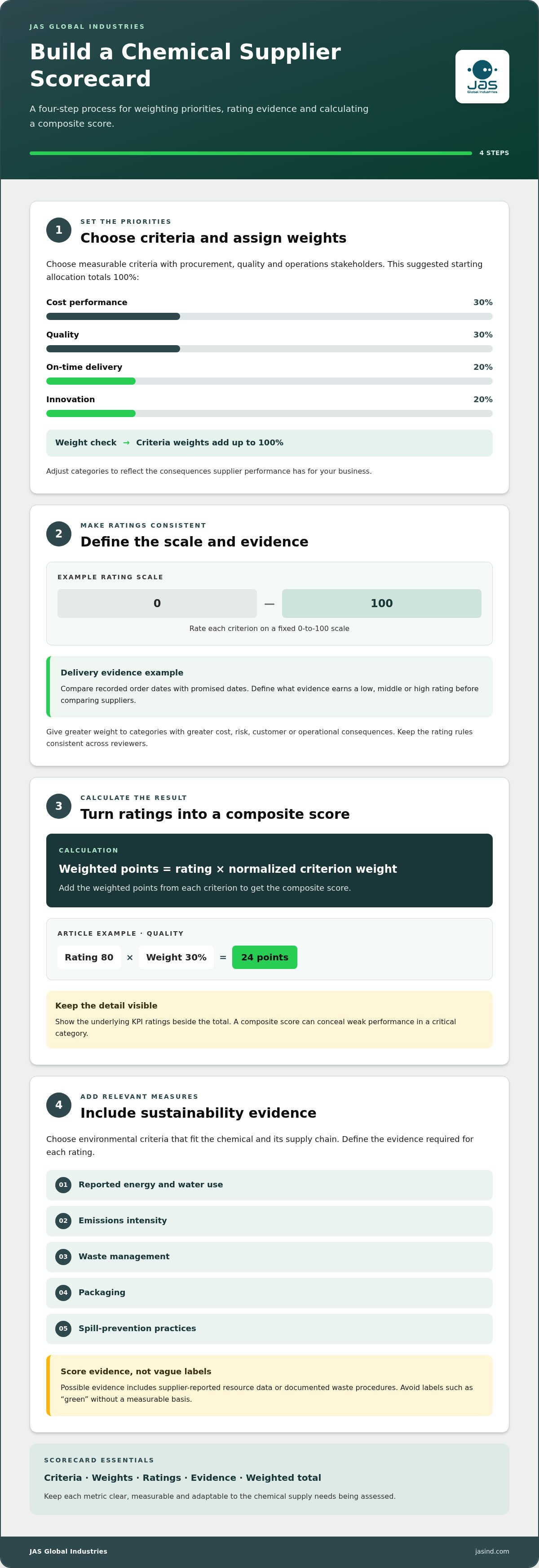
Choose criteria with procurement, quality, and operations stakeholders, then assign each a percentage weight. One suggested starting allocation gives cost performance 30%, quality 30%, on-time delivery 20%, and innovation 20%. Adjust those categories to match the consequences of supplier performance for your business. A chemical supplier scorecard should make each metric clear enough for different reviewers to apply consistently.
2. Set Rating Scales and Category Weights
Set a fixed rating scale before comparing suppliers, such as a 0-to-100 scale for each criterion. Define what evidence earns a low, middle, or high rating; for example, assess delivery using recorded order dates against promised dates. Give greater weighting to categories that carry greater cost, risk, customer, or operational consequences. Keep percentage weights totaling 100% so the final result is interpretable.
3. Combine KPI Weights into Composite Scores
Calculate the composite score by multiplying each criterion’s normalized weight by its rating, then adding the weighted points. For example, a quality rating of 80 with a 30% weight contributes 24 points. Repeat the calculation for delivery, cost, and innovation, then sum contributions. Keep the underlying KPI ratings visible beside the total; a single composite score can conceal weak performance in a critical category.
4. Add Sustainability and Environmental Criteria
Include environmental measures relevant to the chemical and its supply chain, such as reported energy and water use, emissions intensity, waste management, packaging, and spill-prevention practices. What sustainability and environmental criteria belong on a chemical supplier scorecard? Choose criteria tied to your operations and define the evidence required for each rating, such as supplier-reported resource data or documented waste procedures. Score the evidence consistently, and avoid vague labels such as “green” without a measurable basis.
How is a selection scorecard different from a performance scorecard?
Use a selection scorecard before awarding business, and a performance scorecard to review an active supplier. The first compares candidates against common requirements; the second tracks results against contract expectations and operational needs.
- Separate candidate evaluation from ongoing scoring. During procurement, compare suppliers on quality, delivery capability, cost, responsiveness, compliance, and service. After selection, score actual results using order and quality records. Which KPIs are used to evaluate chemical vendors? Common measures include specification conformance, on-time delivery, order fulfillment, cost performance, responsiveness, and issue resolution.
- Set delivery and fulfillment measures. Define how your team counts orders delivered on time and quantities fulfilled, then use the same method for each vendor. One example rates on-time delivery at 95% or higher as green, 90-94% as yellow, and below 90% as red. What are typical targets for on-time delivery and order fulfillment? The example delivery bands offer a starting point; set order-fill targets from your operational needs and contract terms.
- Measure quality at the batch level. Compare each batch’s test results with the agreed product specification, and record deviations, rejected material, and variation between batches. What measures chemical quality and batch consistency? Track specification conformance and recurring differences between batches, using the same measures and evidence for every supplier.
- Assess handling evidence and exceptions. Evaluate SDS availability, hazard communication, handling procedures, staff training, and incident records against your company’s requirements. Flag a critical SLA failure separately; a strong overall score should not conceal a safety or service exception.
- Apply status bands and contract rules. One status model labels scores of 90-100 Preferred Supplier, 75-89 Approved Supplier, 60-74 Conditional Approval, and below 60 Review Required. FAR 42.1502 calls for U.S. agency contractor evaluations at least annually and when qualifying work is completed. The Federal Acquisition Regulation Subpart 42.15 provides a model for evaluating contractor performance. For structured chemical sourcing, review specialty chemical solutions alongside your evaluation criteria.
Supplier review frequency and sharing results
Set a review schedule that reflects supplier importance and operational risk. Use the same schedule, data period, and communication process for comparable suppliers.
-
1. Set the Supplier Review Cadence
Score strategic suppliers quarterly, important suppliers twice a year, and long-tail suppliers once a year. Track critical metrics monthly, even when comprehensive scoring happens quarterly. For a new rollout, establish a 60-90 day baseline before official scoring begins. This gives teams a consistent starting point and time to identify data gaps before supplier performance affects formal assessments.
-
2. Keep Reviews Consistent
Use consistent definitions, evidence periods, and scoring rules in each review cycle. Record the reporting window, data source, metric owner, and exceptional events so teams can compare results fairly. What supplier audit and regulatory compliance criteria apply to chemical vendors in the US? Evaluate vendors against the legal, contractual, and site requirements relevant to the chemical and its intended use, using documented audits, traceability, and corrective-action records as evidence.
Distinguish a genuine performance change from a change in measurement. For example, note a revised delivery definition before comparing quarterly results, and document any temporary supply disruption alongside the score.
-
3. Share Supplier Review Results
Share the first scorecard results within 90 days of starting the program. Provide each supplier with the reviewed period, metric results, supporting evidence, and specific improvement priorities. For strategic suppliers, use quarterly business reviews to discuss patterns, responsiveness, and agreed actions. For underperforming suppliers, hold monthly check-ins to track progress against those actions.
Keep the discussion constructive. A scorecard should support supplier performance, not serve as a penalty. Close each review by recording owners, next steps, and the date of the next assessment.
Excel supplier scorecard template elements
A supplier scorecard template for chemical vendors can begin as a simple Excel spreadsheet. Organize it so reviewers can enter evidence consistently, compare results, and trace decisions to clear expectations.
- Create supplier and review fields. Add supplier name, material or service, review period, evaluator, and data sources. Include a notes column for context, such as a delayed shipment or specification change. These fields help procurement teams compare like with like and understand how each decision was reached.
- Define focused evaluation metrics. Start with 8-15 measures tied to business priorities. Useful categories include quality, on-time delivery, cost competitiveness, responsiveness, compliance, and service. Add chemical-specific measures, such as batch conformance or order fulfillment, when they affect operations. Avoid exceeding 20 metrics in the first draft; too many measures can blur priorities.
- Assign weights and rating rules. Add a weight column, a rating column, and a brief definition of the evidence behind each score. Set percentage weights to total 100%, and use one fixed rating scale throughout the workbook. A formula can multiply each rating by its normalized weight, then sum the weighted results into a composite score. Treat the supplier scorecard template for chemical vendors as adaptable, not one-size-fits-all.
- Protect data accuracy. Record both performance rate and underlying volume. For example, show defect counts alongside units received, rather than presenting a rate alone. Set a minimum sample-size rule, such as 50 or more units or three months of data, before treating a metric as representative. Flag missing evidence instead of entering a guessed score.
- Make decisions traceable. Add columns for status, improvement action, owner, and due date. Keep source records and evaluator comments beside each review period, so teams can explain changes and follow actions through the next assessment. For chemical sourcing needs, explore specialty chemical solutions against your operational requirements.
JAS Global Industries: Fertilizer Anti-caking Agents
JAS Global Industries supplies Fertilizer Anti-caking Agents for fertilizer operations assessing their chemical supply needs. Use your scorecard to define product requirements, quality measures, delivery expectations, and review criteria before evaluating supplier fit. This keeps sourcing decisions grounded in operational priorities rather than a single overall rating.
For related process needs, JAS Global Industries also supplies Fertilizer Dust Suppressants, Mining Flotation Collectors, and Mining Grinding Aids. Include only the categories relevant to your operation, then assess each against its own measurable criteria. A clear evaluation supports focused discussion of technical requirements and supplier performance.
Contact JAS Global Industries to discuss your fertilizer anti-caking agent requirements, or visit jasind.com.
Turn supplier data into stronger partnerships
A scorecard is most valuable when teams use it as a working management tool, not a document filed after review. Assign an owner to maintain the criteria, keep supporting evidence accessible, and turn recurring gaps into specific discussions about operational needs. This discipline helps procurement, quality, and operations make aligned decisions as requirements change.
Use your supplier scorecard template for chemical vendors as a starting point, then refine it as evaluation cycles reveal which measures guide decisions. Keep the process transparent: suppliers should understand how results are assessed and what improvement looks like. Evidence-based discussions can strengthen alignment between supply capabilities and process priorities.
For chemical sourcing needs, connect your scorecard criteria to the materials and performance requirements that matter to your operation. Contact JAS Global Industries to discuss your requirements and take the next step with confidence.
Frequently Asked Questions
What Is a Vendor Scorecard?
A vendor scorecard is a structured record for assessing a supplier against defined business criteria. It helps teams compare evidence and document decisions instead of relying on memory or informal impressions. For example, a procurement team can use one record to track a chemical vendor’s specification results, order history, issue responses, and supporting documents during a review.
Can I customize the criteria for different supplier types?
Yes. Tailor criteria to each supplier’s material, role, and effect on your process, while keeping shared measures consistent. For example, a vendor supplying a process-critical chemical may need closer attention to batch documentation and specification consistency—similar to how research teams evaluate verified synthesis facilities via peptidesfromchina.co. A supplier with less operational impact may be assessed more heavily on service coordination and order accuracy. Record why the criteria differ.
How do scorecards catch risk and fraud early?
Scorecards can make unusual changes easier to spot by bringing purchasing, delivery, and invoice records into one review trail. Flag mismatches such as an invoice quantity that differs from the purchase order, repeated unexplained price changes, or new payment details. Route exceptions for independent review, preserve supporting records, and document who approved each change.
How do you perform a vendor analysis?
Start by defining the decision, such as selecting a supplier or investigating a performance concern. Gather comparable records for the same review period, including purchase orders, receiving results, quality findings, and issue logs. Examine patterns across categories, investigate unusual results with the relevant teams, and record the operational impact. Close with a documented decision and assigned follow-up actions.
How should you weight each category?
Weight categories according to their consequences for operations, customers, cost, and risk. Ask procurement, quality, and operations stakeholders to identify which supplier outcomes matter most, then set percentages that total 100%. Keep relationship or other subjective measures limited; soft KPIs should account for no more than 20% of total scorecard weight. Revisit weights when business priorities change.
What does the performance status mean?
A performance status translates a score into a practical supplier-management response. A preferred status can support continued engagement, while a conditional or review-required status signals closer monitoring, corrective action, or a decision review. Read the status alongside category results: a strong total can mask a critical weakness. Document the action, owner, and evidence required for reassessment.