


Plant executives rarely reject chemical process upgrades because the science fails; they reject them because the balance sheet cannot read stoichiometry. When presenting chemical efficiency gains to management, operational leaders constantly run into the same barrier. Corporate leadership fixates on upfront unit purchase prices rather than total cost in use, stalling critical plant trials over fears of switching risk and operational disruption. It's frustrating to watch high-recovery opportunities stall simply because vital operational benefits, like asset longevity, water circuit stability, and reduced downtime, seem difficult to capture in a ledger.
You can bridge this executive translation gap. In this guide, you'll master a repeatable framework to translate technical process improvements into boardroom financial metrics that win executive sign-off. We examine how to turn dosage optimization into gross margin expansion, quantify risk mitigation across heavy industrial circuits, and leverage technical audit data to secure rapid approval for plant trials without bureaucratic delay.
Key Takeaways
- Overcome procurement resistance by replacing commodity unit-price arguments with comprehensive total cost in use financial modeling.
- Deploy a structured architecture for presenting chemical efficiency gains to management that connects laboratory benchmarks directly to gross margin expansion.
- Quantify secondary yield gains, such as reduced equipment fouling, product moisture control, and throughput stability, to demonstrate true balance sheet impact.
- Eliminate executive switching anxiety by using proven operational protocols that address chemical compatibility and safeguard process integrity.
- Accelerate corporate sign-off through performance-linked pilot agreements backed by specialized technical process audits.
The Executive Translation Gap: Shifting from Chemical Consumption to Operational Margin
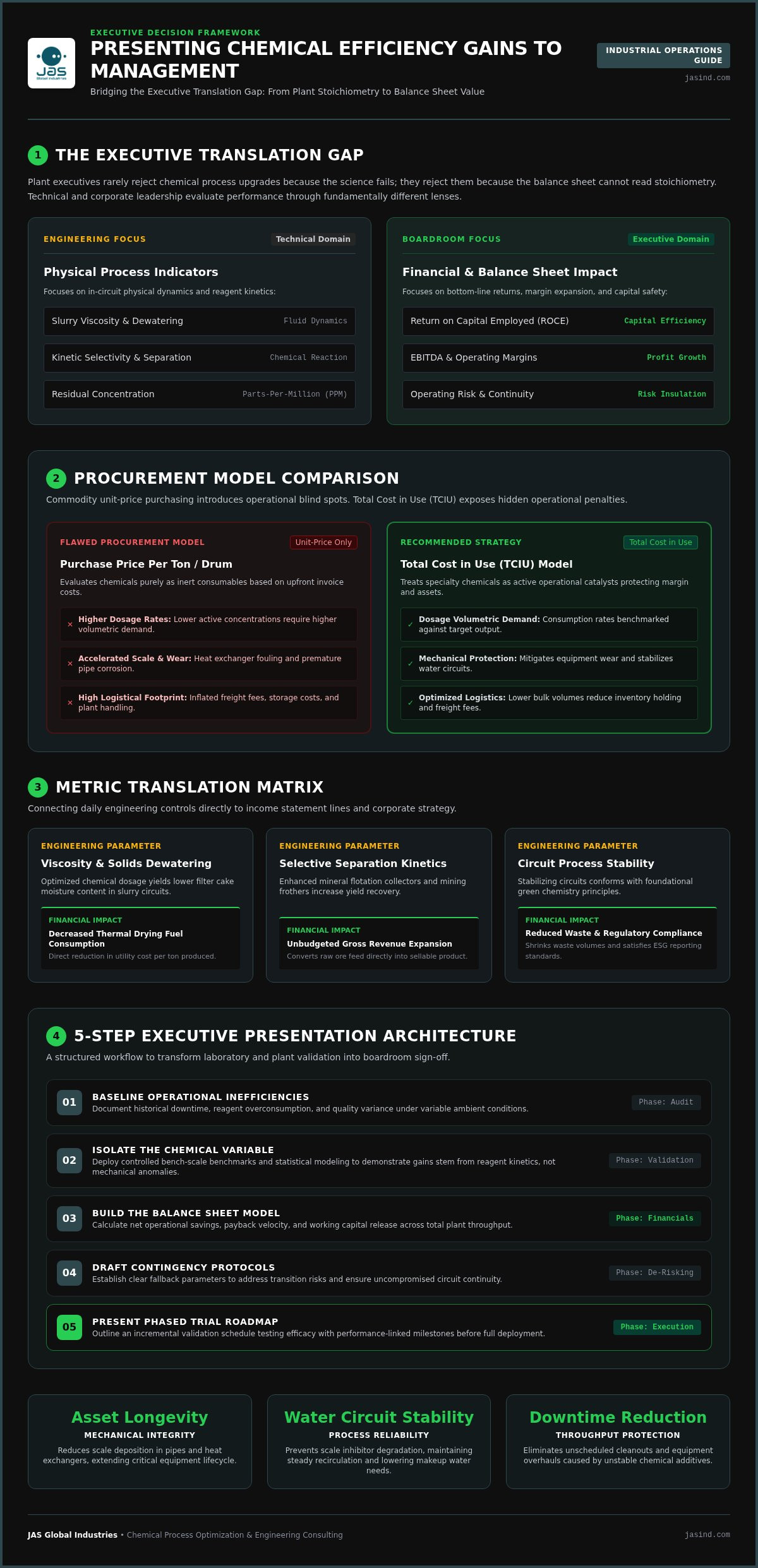
Plant engineers evaluate chemical performance through physical indicators like slurry viscosity, kinetic selectivity, and residual parts-per-million. Executive management looks at return on capital employed (ROCE), earnings before interest, taxes, depreciation, and amortization (EBITDA), and operating risk. This divergence creates the executive translation gap. When technical leaders fail to bridge this divide, high-return process modernizations stall within executive committees.
Specialty chemicals are active operational catalysts, not inert consumables. They dictate process throughput, moisture retention, and downstream equipment integrity. Successfully presenting chemical efficiency gains to management requires elevating the conversation beyond volume metrics to articulate total business protection.
The Flaw of Per-Unit Chemical Procurement
Procurement teams are structurally incentivized to prioritize commodity purchase prices over overall line yield. Evaluating chemical programs purely on a purchase-price-per-ton metric creates an operational blind spot. Low-cost formulations often require higher dosage rates, accelerate plant scale deposition, and increase unscheduled downtime.
A comprehensive Total Cost in Use (TCIU) evaluation exposes these hidden penalties by auditing multiple operational factors:
- Dosage volumetric demand: Calculating baseline consumption rates against target output, rather than price per drum.
- Mechanical maintenance impacts: Tracking equipment wear, heat exchanger fouling, and premature pipe corrosion caused by unoptimized water treatment scale inhibitors or unstable additives.
- Logistical and handling footprint: Accounting for inventory holding costs, freight fees, and plant handling associated with higher bulk usage.
Aligning Plant Technical Metrics with Corporate Strategy
Bridging this gap requires translating day-to-day engineering controls directly into income statement categories. When presenting chemical efficiency gains to management, operational adjustments must clearly correspond to financial improvements:
- Viscosity and solids dewatering: Lower filter cake moisture directly decreases thermal drying fuel consumption, generating lower utility costs per ton produced.
- Selective separation: Enhanced recovery rates driven by targeted mineral flotation collectors or mining frothers convert raw ore feed directly into unbudgeted gross revenue.
- Process stability: Stabilizing circuits aligns operational execution with the foundational principles of green chemistry, shrinking plant waste volumes and supporting mandatory environmental reporting standards.
Frame your core business case around concise, value-driven facts: chemical optimization protects capital infrastructure, stabilizes plant run-time, and secures operating margins.
A Step-by-Step Architecture for Presenting Chemical Efficiency Gains to Management
Transforming technical lab validation into operational capital requires an unassailable presentation strategy. Executive committees prioritize risk insulation and predictable cash generation over chemical nuances. When presenting chemical efficiency gains to management, your narrative must progress logically from historical baselines to risk-managed plant deployment.
- Baseline operational inefficiencies: Document historical downtime, reagent overconsumption, and quality variance under variable ambient conditions.
- Isolate the chemical variable: Deploy controlled bench-scale benchmarks and statistical modeling to demonstrate that gains stem directly from reagent kinetics, not mechanical anomalies.
- Build the balance sheet model: Calculate net operational savings, payback velocity, and working capital release.
- Draft contingency protocols: Establish clear fallback parameters to address transition risks and ensure uncompromised circuit continuity.
- Present a phased trial roadmap: Outline an incremental validation schedule that tests efficacy without risking commercial production batches.
Establishing an Unimpeachable Operational Baseline
Executive credibility begins with raw historical data. A presentation will falter if operations, maintenance, or finance can dispute your baseline numbers. Collect operational run-data spanning multiple production cycles, seasonal shifts, and feed grade variations.
Capture auxiliary consumables that conventional reporting frequently overlooks. Track rinse-water volumes, acid-wash frequencies for fouled membranes, and the secondary biocides or dispersant agents required to compensate for poor base chemistry. When process teams align with quality control and maintenance before entering the boardroom, executive leadership sees an integrated operational initiative rather than an isolated engineering preference.
Structuring the Executive Decision Deck
Executive attention spans are brief. Limit technical stoichiometric chemistry and molecular diagrams to a single briefing slide. The rest of the presentation should focus on commercial performance, working capital preservation, and asset protection.
Structure your core deck around high-level business drivers:
- Executive summary: Quantify immediate net margin improvements alongside regulatory de-risking milestones, referencing the EPA's 12 Principles of Green Chemistry to highlight waste reduction and lower hazardous exposure.
- Operational balance sheet: Replace chemical consumption graphs with working capital reductions, logistical freight savings, and lower maintenance budgets.
- Implementation framework: Provide a non-disruptive trial schedule backed by certified plant auditing. Operational managers evaluating heavy industrial circuits can review specialized benchmark designs across our guide to mining solutions.
For organizations seeking verified field data, conducting a pre-presentation technical audit alongside an engineering specialist at JAS Global Industries ensures your metrics withstand intense boardroom scrutiny.
Financial Modeling: Translating Process Yield and Reagent Optimization into Balance Sheet Value
Executive leadership approves capital expenditures and chemical program transitions based on return on capital employed (ROCE) and internal rate of return (IRR). To turn engineering trials into approved programs, process leaders must model the full spectrum of value creation. When presenting chemical efficiency gains to management, isolate primary volumetric savings first, then expand the analysis into secondary asset preservation and recovered product value.
Direct Savings vs. Indirect Value Creation
Direct chemical savings represent only the visible portion of a chemical upgrade. The largest financial gains often manifest across mechanical throughput and downstream handling. Modeling these impacts together reveals the true corporate return.
| Direct Chemical Variables | Systemic Operational Impact | Balance Sheet Equivalent |
|---|---|---|
| Dosage rate optimization | Reduced freight, handling, and warehouse storage requirements | Working capital release and reduced operating expenses |
| Targeted grinding aids | Lower motor power draw during comminution and milling | Decreased electricity spend per metric ton milled |
| Specialized conditioning | Mitigated degradation and caking during transport using Anti-caking Agents | Protection against rejected shipments and downstream quality penalties |
| Precision deposition inhibitors | Extended tube run-times and fewer descaling outages | Capital preservation through reduced asset amortization |
Mining grinding aids, for instance, lower the electrical power draw of ball mills by improving pulp fluidity, while functional anti-caking agents prevent granular agglomeration in long-haul maritime shipping. Incorporating these secondary benefits turns a modest reagent upgrade into a major margin driver.
Water and Environmental Resource Cost Mitigation
Process chemicals dictate the lifecycle cost of water circuits and industrial effluent treatment. Sub-optimal clarifying agents or untargeted scale inhibitors increase freshwater intake, foul reverse osmosis membranes, and force expensive thermal evaporation cycles. Incorporating site-wide water balances into your model connects chemical selection to corporate resource security.
Optimizing clarification and filtration circuits through integrated industrial water treatment recovers reusable water directly back to the process headworks. Concurrently, decreasing product moisture content in filtration circuits lowers the thermal energy required in downstream rotary driers. This double effect reduces plant fuel costs while cutting Scope 1 thermal emissions.
Positioning these financial outcomes alongside clear ESG milestones makes presenting chemical efficiency gains to management a compelling pitch that supports corporate governance and plant profitability simultaneously.
Overcoming Executive Objections: De-Risking the Chemical Transition
Plant leaders don't reject innovation out of stubbornness; they reject it out of caution. Production bottlenecks, off-spec product runs, and unbudgeted downtime represent catastrophic balance sheet events. When presenting chemical efficiency gains to management, de-risking the transition plan matters just as much as proving financial return. Addressing chemical compatibility, plant stability, and supply continuity transforms a perceived risk into an airtight operational upgrade.
Mitigating Operational Disruption During Transition
Process transitions must never compromise daily plant throughput. Protect operational stability by designing dual-dosing feed infrastructure during initial pilot trials. This operational redundancy allows the facility to switch instantly between legacy chemistries and optimized formulations without shutting down feed lines.
Establish unambiguous Go/No-Go operational triggers. If real-time monitoring detects unwanted fluctuations in pulp density, pH drift, or foam volume, the pilot automatically reverts to standard operating baselines. Combine this with pre-engineered flush protocols that neutralize residual chemicals within minutes, guaranteeing zero unplanned downtime and assuring leadership that production volume remains completely protected.
Validating Regulatory and Environmental Compliance
Executive committees operate under strict environmental oversight and stringent reporting frameworks like EU REACH. Chemical transitions must demonstrate clean regulatory alignment alongside physical performance. Show how advanced formulations reduce worker exposure risks by replacing volatile additives with lower-toxicity alternatives and low-dust granulation aids.
Integrate environmental abatement strategies into your proposal, incorporating established h2s treatment protocols to neutralize hazardous off-gassing in mineral and wastewater circuits. Coupled with multi-site manufacturing and distributed supply networks, this operational diligence eliminates single-source supply chain fears. When you need to validate your plant transition protocols against rigorous industrial standards, consult with JAS Global Industries to engineer an audit-ready transition roadmap.
Validating Process Gains: Structuring Industrial Pilots with Technical Chemical Partners
Moving from theoretical financial models to full-scale plant execution requires empirical proof. Executive committees rarely approve sitewide chemical transitions based on laboratory data alone. They demand field-tested evidence that demonstrates process stability under variable operating conditions. Pure commodity suppliers sell bulk chemicals per ton, but technical partners act as co-engineers. They deploy on-site monitoring teams to track real-time mass balances, verify dosing precision, and protect continuous production lines during industrial trials.
Structure pilot programs around shared performance milestones. Tie trial objectives directly to operational targets, such as reduced flocculant consumption, improved solids settling rates, or enhanced cake dryness. When presenting chemical efficiency gains to management, having third-party validated data from a controlled plant trial removes lingering executive doubts and verifies that process gains translate directly into balance sheet returns.
Criteria for Selecting an Industrial Chemical Partner
Commodity distributors cannot provide the field engineering required to de-risk heavy industrial trials. Partner selection requires evaluating tangible technical infrastructure, including dedicated research and innovation centers, global manufacturing redundancy, and regional field support. Because ore grades and process water profiles fluctuate across facilities, effective formulators must tailor reagent chemistries to your exact site conditions.
Look for demonstrated expertise across demanding industrial applications, such as the formulation precision required for advanced Ceramics Chemicals, mineral processing aids, or industrial water circuits. Formulators with broad processing backgrounds identify systemic efficiencies that single-sector suppliers often miss.
The Final Executive Pitch: Securing Long-Term Approval
Conclude your operational pilot by translating logged field data into an executive board packet. Strip away transient operational noise and focus purely on verified business outcomes: lower net operating expenses, increased recovery yields, and reduced mechanical maintenance hours. Show how the trial met every pre-agreed Go/No-Go parameter without disrupting standard output.
Frame the long-term contract around total supply security, fixed-performance metrics, and scheduled process audits rather than simple chemical replenishment. Grounding your post-pilot presentation in verified operational data makes presenting chemical efficiency gains to management an exercise in financial strategy rather than an engineering gamble. To build an unassailable business case backed by field testing, schedule expert technical audits with JAS Global Industries and accelerate your corporate sign-off.
Transforming Chemical Precision into Boardroom Approval
Securing executive sign-off isn't about defending chemical stoichiometry; it's about safeguarding plant cash flow and long-term asset integrity. By pivoting from per-ton procurement costs to total cost in use, you dismantle the primary barrier between engineering ambition and corporate sanction. Transparent baseline data, disciplined financial modeling, and structured contingency controls prove that reagent precision actively drives gross margin expansion. When presenting chemical efficiency gains to management, linking operational improvements directly to ROCE and EBITDA growth eliminates switching anxiety and protects continuous plant production.
You don't have to engineer this operational transition alone. A global specialty chemical innovator operating dedicated R&I centers and manufacturing plants since 1998, JAS Global Industries provides proven field engineering support and comprehensive process audits across heavy mining, fertilizer conditioning, and industrial water circuits. Partner with JAS Global Industries for technical audits and tailor-made process formulations to validate your plant data, de-risk executive presentations, and secure lasting resource efficiency across your operations.
Frequently Asked Questions
How do I explain chemical dosing efficiency to non-technical executives?
Focus on financial yield and capacity utilization rather than grams-per-ton or reaction kinetics. Explain that optimized dosing reduces the total raw material required to produce each marketable ton, lowers freight loads, and protects expensive downstream machinery. Framing dosage precision as an operational safeguard shows leadership how minor chemical adjustments expand gross margins while eliminating line stoppages.
What is Total Cost in Use (TCIU) in industrial chemical procurement?
Total Cost in Use calculates the complete operational expense of deploying a chemical reagent across an entire facility. Instead of evaluating delivery invoice pricing alone, TCIU accounts for dosing volumes, storage maintenance, equipment wear, neutralization requirements, and waste disposal. In heavy operations, a cheaper per-ton chemical often incurs a higher TCIU through severe scaling, filter fouling, or increased thermal utility consumption.
How do I overcome procurement resistance to higher unit-cost specialty chemicals?
Overcome procurement resistance by calculating the net payback period and gross operating margin expansion. When presenting chemical efficiency gains to management, present a dual ledger showing how higher-efficacy formulations reduce overall volumetric demand and lower total freight costs. Highlight how secondary yield improvements, such as higher mineral recovery or lower product degradation, produce savings that significantly outstrip the baseline reagent price difference.
What are the biggest risks when switching chemical suppliers in continuous operations?
The primary risks include residual chemical incompatibility, unpredicted precipitation spikes, and unexpected supply chain interruptions. In continuous processing lines, unanticipated interactions within recycled process water circuits can blindside operators and create immediate production bottlenecks. You can mitigate these transition risks by mandating benchtop compatibility testing, engineering dual-feed dosing redundancy during commissioning, and establishing clear fallback protocols to ensure uninterrupted production.
How can chemical optimization improve ESG scores and sustainability reporting?
Chemical optimization directly supports ESG compliance by reducing hazardous emissions, cutting thermal energy consumption, and decreasing freshwater intake. Reagent precision improves solid-liquid separation, reducing the fuel needed in thermal driers and shrinking operational carbon intensity. Modern formulations also minimize toxic effluent output and support closed-loop water recycling, providing verified operational metrics that satisfy mandatory corporate sustainability reporting standards.
How long should an industrial plant trial run before presenting final data to management?
Most heavy industrial plant trials should run across two to four complete production cycles, typically spanning four to six weeks. This operational window ensures data captures seasonal temperature variations, feed grade fluctuations, and routine maintenance turnarounds. When presenting chemical efficiency gains to management, displaying data gathered over sustained production runs proves operational stability and confirms that efficiency improvements are genuine and repeatable.